Children across the European Union could face new restrictions on social media as Brussels moves toward common age limits and stronger safeguards for young internet users.
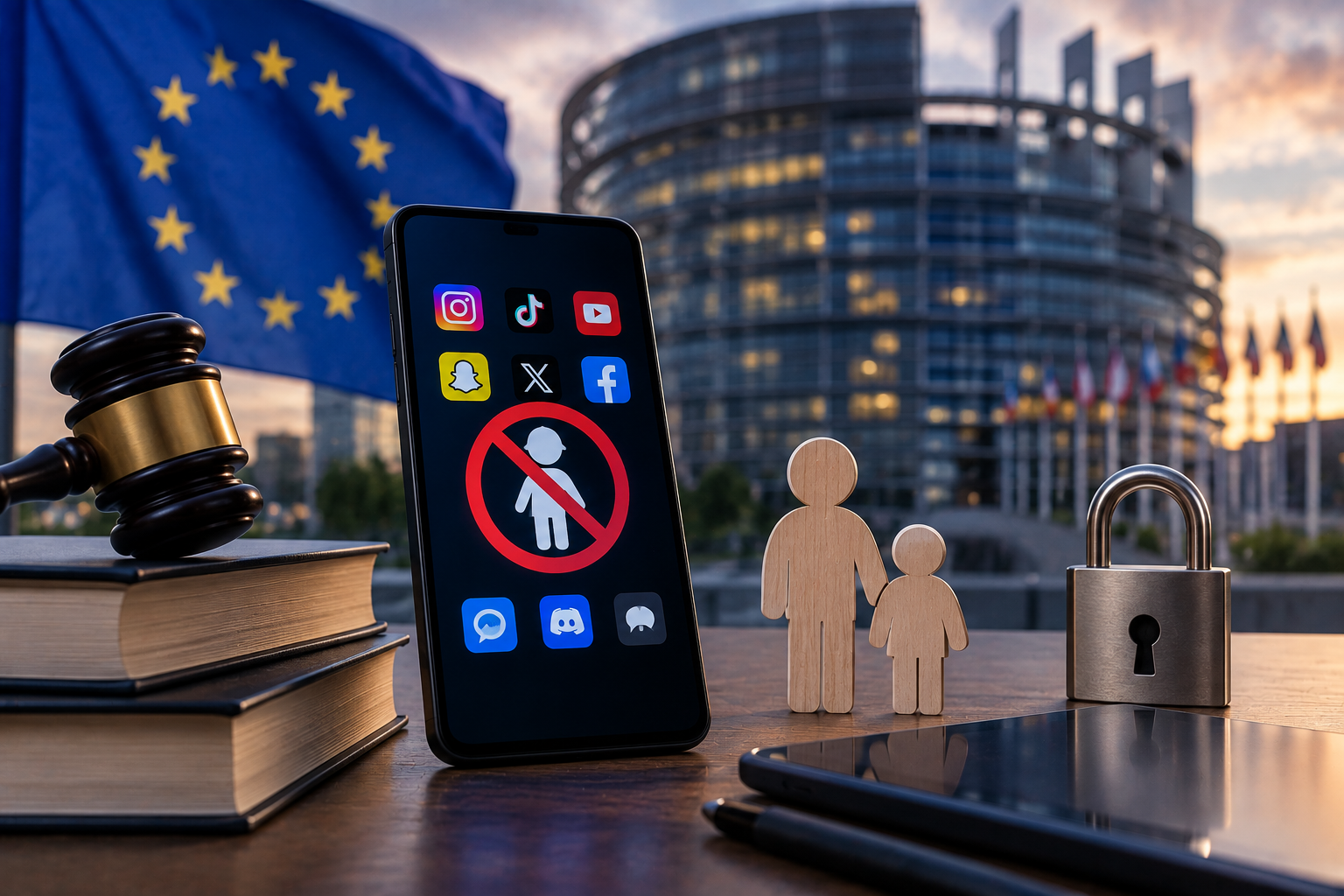
European Commission President Ursula von der Leyen has proposed preventing children under 13 from accessing social media, while teenagers aged 13 to 15 could face additional restrictions unless they have parental permission.
The plan represents a significant shift from the current system, where individual platforms generally establish their own minimum ages and enforcement varies considerably.
Many major social networks already state that users must be at least 13. In practice, however, children can often bypass these limits simply by entering a false date of birth. EU policymakers want stronger age checks to make future restrictions enforceable rather than relying on self-declared birthdays.
The European Commission has been developing a privacy-focused age verification system that would allow users to prove that they meet an age requirement without revealing their identity, exact date of birth, or other unnecessary personal information to a platform. Instead, an online service would receive confirmation that a user is above or below the required age.
Social media is only one part of the EU’s broader effort to strengthen protections for children online. Policymakers are also examining risks associated with video-sharing platforms, online games and AI chatbots.
Particular attention has been placed on features designed to keep young users engaged for long periods. These include infinite scrolling, recommendation systems and other mechanisms that policymakers argue can encourage excessive use or repeatedly expose children to inappropriate material.
The European Parliament has previously supported an even higher benchmark, calling for a harmonized digital minimum age of 16 for independent access to social media, video-sharing platforms and AI companions. Under that approach, children between 13 and 16 could gain access with parental consent.
Member states have also been developing their own rules. Denmark, France, Spain and other European countries have considered or introduced different forms of age restrictions, increasing pressure for a common EU framework that would avoid different requirements across the single market.
Any EU-wide restrictions would also have to address concerns surrounding privacy and children’s rights.
Age verification systems can themselves create risks if they require platforms to collect identity documents, biometric information or other sensitive data. The Commission says its approach is intended to avoid that problem by allowing people to prove only that they meet a particular age threshold.
The EU already regulates platforms used by minors through the Digital Services Act, which requires online services accessible to children to provide a high level of privacy, safety and security.
A uniform social media age limit would go considerably further by determining when children can access certain services in the first place.
The details are not final, and the proposal would still need to move through the EU legislative process before becoming binding across the bloc. Questions surrounding the precise age thresholds, parental consent, and which services would fall under the restrictions therefore remain open.