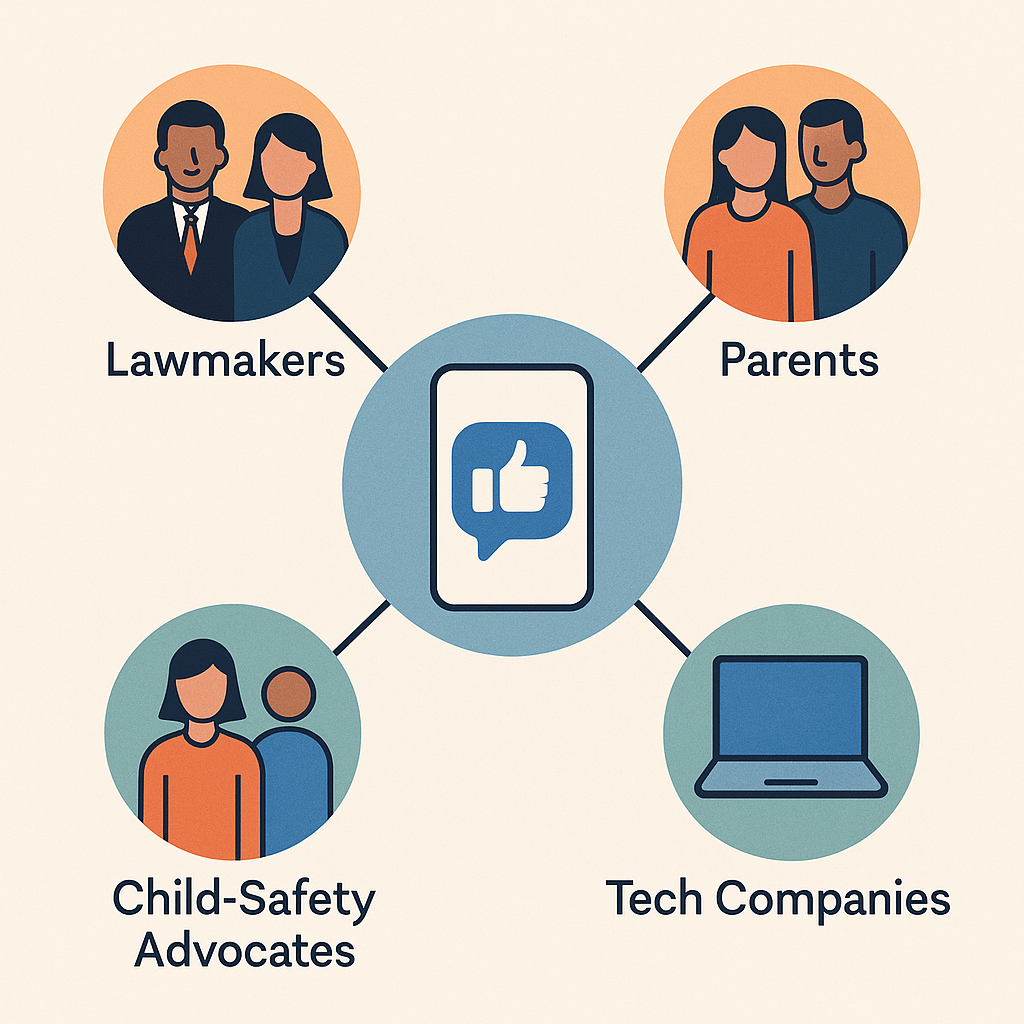
Governments across several regions are accelerating efforts to regulate how young people access social media services, with proposals ranging from mandatory age checks to outright bans for children below defined age thresholds. These measures have gained momentum as policymakers respond to concerns about the impact of social media on young users. Although some observers question whether a coordinated force is driving the legislation, the actors involved tend to be a familiar combination of elected officials, regulatory agencies, advocacy groups focused on child safety and private companies that offer age assurance tools. Together they form a loose coalition rather than an organised network, yet their combined influence has shaped the direction of new laws.
In many countries, the push for age verification rules has expanded from earlier efforts that targeted explicit content. Several governments have shifted their focus to general social media platforms, arguing that widespread access to these services exposes younger users to risks related to mental health, bullying, harassment and inappropriate content. Legislators often cite concerns about increased dependence on digital platforms, reduced sleep among young users and growing evidence that online environments influence behaviour, attention and emotional development. Although the evidence is contested, these themes have shaped public debate and provided political momentum for stronger controls.
Australia is one of the countries moving most rapidly. Beginning in December 2025, social media services will be required to block access for users under the age of sixteen. Under the legislation, platforms must take steps to verify user age and prevent minors from creating accounts or maintaining existing profiles. The requirements include the use of government documents, identity checks or selfie analysis to confirm age. The government argues that the law is necessary to protect young people, and it threatens financial penalties for companies that fail to comply. The plan is among the most sweeping global efforts to restrict access to social platforms based on age alone. Similar laws or proposals have appeared in Europe, parts of North America and several Asian countries.
Much of this activity is driven by lawmakers who frame the issue as one of youth protection. Parliamentary committees, national child safety councils and public health bodies have urged tighter standards for verifying user age online. They often cite concerns about data collection by platforms and the inability of younger users to evaluate risks such as impersonation, manipulation or exposure to harmful content. Legislators propose that age verification rules will create safer digital spaces, reduce access to harmful material and make it harder for strangers to contact minors.
Parent organisations and advocacy groups are also active participants. Groups that campaign for stricter limits on digital exposure for children argue that social media companies have not acted decisively to safeguard young audiences. They cite examples of underage users accessing platforms despite minimum age requirements and argue that platforms benefit from increased usage by younger audiences without providing adequate protection. These groups often support age verification laws and may lobby lawmakers during the drafting process. Their influence can be significant in countries where child safety has become a high-profile political issue.
At the same time, private companies that develop age assurance solutions have become increasingly prominent. These companies market software for verifying age through document analysis, facial estimation or behavioural profiling. Some have presented their technology to lawmakers as an efficient method for enforcing age limits across multiple online services. Age assurance providers promote their tools as ways to reduce the administrative burden on platforms and to create standardised processes for verifying age, potentially influencing the direction of legislation. Critics argue that the involvement of these companies complicates the landscape, as lawmakers may adopt solutions that align with the commercial interests of vendors rather than broader public needs.
The interplay between these actors has led to concerns from civil liberties groups, who warn that age verification laws may create new privacy risks. Some verification systems require users to upload identity documents, increasing the amount of sensitive information stored by private companies. Other systems rely on face analysis, which raises questions about biometric data retention, accuracy and fairness. Opponents argue that age verification could normalise the routine collection of personal data and create entry points for misuse or security breaches. They caution that a government’s intention to protect children could inadvertently increase surveillance across large portions of the population.
Another concern is that strict age limits may drive younger users toward unregulated services. If major platforms block access for underage users, those users may migrate to smaller or less secure sites that have limited content moderation and fewer safety controls. Critics note that while these laws restrict access to mainstream services, they do not eliminate the desire among younger users to participate in online communities. Without careful planning, the laws could push vulnerable users into environments that expose them to greater risks.
The trend is not confined to one region. European lawmakers have drafted proposals that tighten age-related controls under broader online safety regulations. These proposals may require platforms to implement standardised verification systems, restrict data collection for younger users and enforce strict advertising limitations. Some European countries are exploring more comprehensive frameworks, arguing that national legislation is needed to address gaps in platform self-regulation. Although the proposals vary widely, they reflect a shared belief among lawmakers that the status quo is inadequate.
In the United States, several states have introduced or debated laws requiring age verification for social media use. These proposals differ by state, but many share a common structure: platforms must verify user age, block underage accounts and provide reporting tools for parents or guardians. The proposals also include requirements for platforms to adjust algorithms or limit exposure to certain types of content for minors. Supporters of these laws argue that social media companies are not doing enough to mitigate risks associated with online engagement by young users. Opponents counter that the laws violate free speech principles, create barriers to access and impose new privacy risks.
Large technology companies have responded with mixed reactions. Some companies argue that app stores should play a central role in age verification because app stores already control access to apps and can verify user identity before installation. Others contend that third-party verification services should handle age checks, reducing their own exposure to sensitive data. This debate reflects a broader struggle over who should bear responsibility for verifying user age and managing compliance. The involvement of app stores, identity providers and verification firms adds layers of complexity that can obscure where accountability lies.
For many lawmakers, the central argument is that platforms need stronger obligations to protect young users. They contend that platforms have benefited from widespread youth engagement without investing sufficiently in safeguards. Proposals often require platforms to build internal controls that limit exposure to harmful content, reduce opportunities for unwanted contact and provide tools for monitoring user behaviour. Regulators argue that mandatory age verification will force platforms to take responsibility for ensuring that their services are safe for young users. Critics, however, argue that these laws impose burdens on users rather than companies and that safer design principles should be prioritised instead.
Amid these competing interests, one point is clear: the movement to enforce age verification and restrict underage access to social media is not being driven by a single entity. Instead, it draws support from a coalition of lawmakers who want to respond to public concern, advocacy groups that focus on protecting children, regulators who enforce safety and privacy standards, and technology companies that offer verification tools. While their goals sometimes align, their interests are not always identical. The result is a patchwork of laws and proposals that differ by region but share a common theme of increased oversight.
As these laws take shape, the debate over privacy, responsibility and digital rights continues. Civil society groups warn that age verification rules could pave the way for broader surveillance and reduce anonymity online. Privacy advocates caution that once data collection becomes a requirement for using mainstream services, the boundary between safety and monitoring may blur. Supporters of the laws argue that action is long overdue, given the growing influence of online platforms on the lives of young people. The coming years may determine whether these laws achieve their stated goal of protecting young users or create new challenges for privacy and digital governance.