Many of the most popular free Android games contain dozens of tracking technologies capable of collecting information about their users, with a new study finding widespread links to advertising companies in China, Russia, Israel, and Western countries.
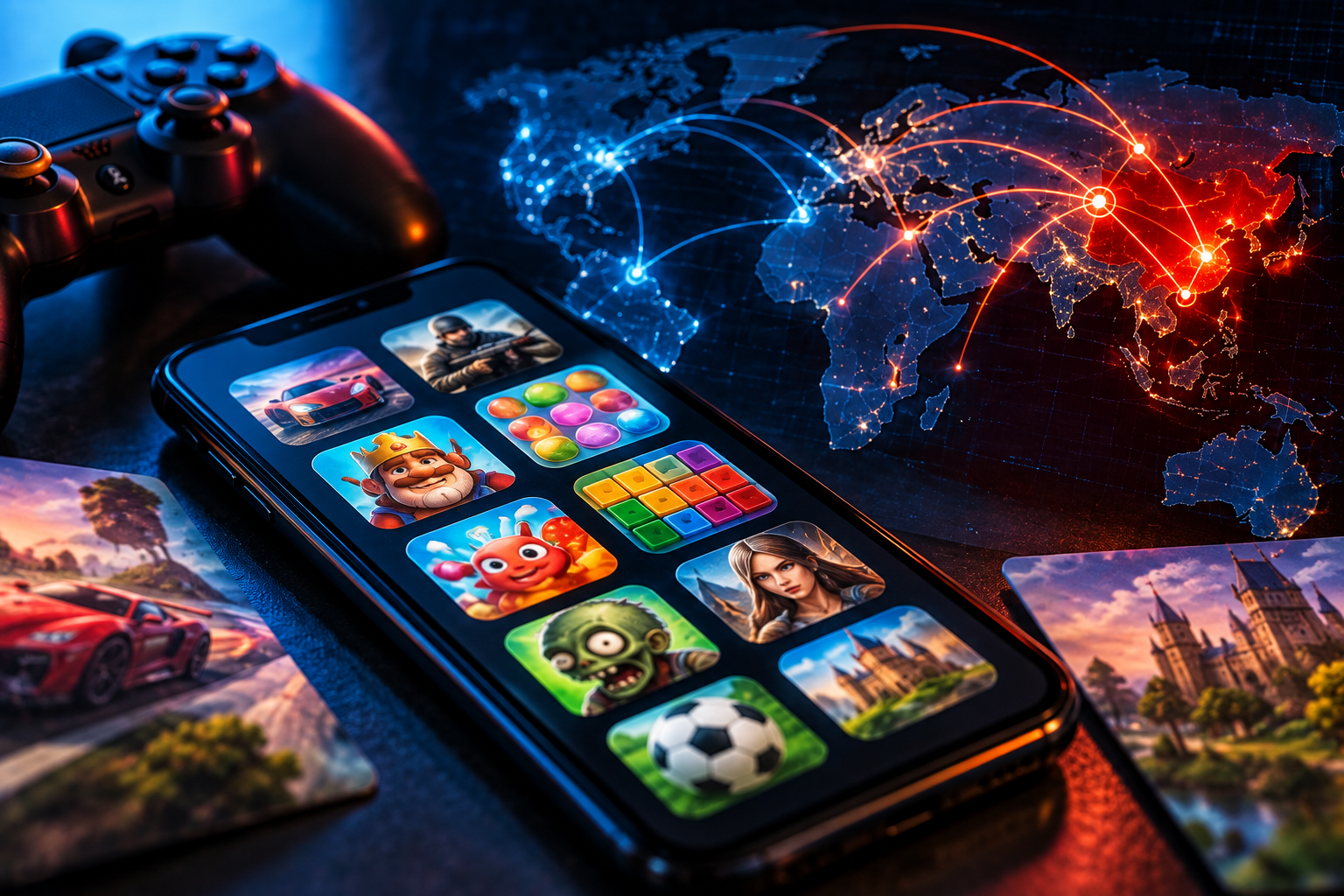
Researchers examined the 100 most-downloaded free mobile games available through Google Play in the US. Among them, 81% contained trackers linked to Chinese companies and 71% had trackers associated with Russia. Trackers connected to Israeli companies appeared in 95%, while 98% included trackers associated with companies in Five Eyes countries.
The scale becomes more significant when downloads are considered. The games analyzed have collectively accumulated almost 20 billion downloads worldwide, while the top US games were downloaded nearly 20 million times during May 2026 alone.
Of those monthly US downloads, approximately 15.8 million involved games containing Chinese trackers and 13.7 million involved games with Russian trackers. Around 70% of downloads were for games containing trackers connected to all four regions examined by the researchers.
Tracking was also extensive within individual apps. An average game contained 29 trackers, while some had more than 30. Popular titles examined included Block Blast!, Disney Solitaire, Roblox, Coin Master, and several puzzle and coloring games.
The presence of a tracker does not necessarily mean every type of information it can access is continuously collected from every player. However, such technologies can potentially gather information including device details, app usage, demographic information, payment-related data, and other behavioral information, depending on their configuration and the permissions available.
Location collection was among the more sensitive findings. Seven of the top 100 US games contained trackers actively collecting location information, and games with these capabilities accounted for around 1.7 million US downloads in May.
Location access can be necessary for some games. Pokémon Go, for example, depends on a player’s physical position as part of its gameplay. Researchers questioned why location tracking was also present in much simpler applications, including puzzle and coloring games where a user’s physical location is not an obvious requirement.
The pattern was not limited to American users. Similar analysis in the UK found Chinese trackers associated with 84% of downloads and Russian trackers with 74%. Germany recorded rates of 82% and 69%, respectively, while France reached 78% for China and 70% for Russia.
Free games frequently rely on advertising and analytics rather than an upfront purchase price, creating an incentive to collect information that can be used for advertising, profiling, and measuring user behavior. The result can involve several third-party companies receiving information generated by a single app.
The research does not show that China or Russia directly operates the affected games, nor does the presence of a tracker demonstrate that a foreign government obtained users’ information. Instead, it highlights how widely personal information can travel through the advertising and analytics infrastructure built into free mobile games.
With some individual games containing more than 30 trackers, the findings show that installing a seemingly simple free game can connect a device to a much larger data-collection network than players may realize.