The “1 Virus found in your mailbox” email scam is a phishing campaign that attempts to steal email account credentials by claiming that malicious files or viruses have been detected inside the recipient’s mailbox. The email presents itself as a security alert and warns that immediate action is required to prevent potential damage to the account and its contents. In reality, the notification is fraudulent and is designed to redirect victims to a credential-harvesting website.
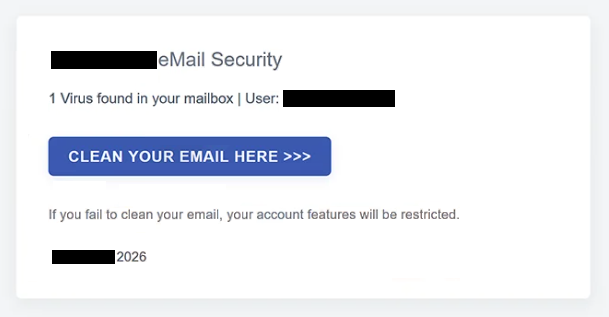
The phishing email informs recipients that a security scan has allegedly identified malicious messages, infected attachments, or suspicious content within their mailbox. According to the message, the detected threats could compromise account security, disrupt email functionality, or expose sensitive information if they are not addressed promptly.
To supposedly remove the threats, the “1 Virus found in your mailbox” email instructs recipients to click a button or link provided in the message. Rather than directing users to a legitimate security portal or email management page, the link leads to a phishing website that imitates a webmail login interface. The fraudulent page requests the user’s email address and password under the pretense of verifying ownership and performing the recommended security cleanup.
Once credentials are entered, they are transmitted directly to the attackers operating the campaign. Cybercriminals can then gain access to the compromised mailbox and potentially use it to collect sensitive information, monitor communications, distribute phishing emails, or attempt to compromise other accounts associated with the victim.
The “1 Virus found in your mailbox” scam exploits concerns about malware infections and account security. Many users are aware of the risks posed by malicious attachments and phishing emails, making warnings about infected messages appear believable. Attackers take advantage of this awareness by presenting a fake threat that encourages recipients to act quickly.
Another factor contributing to the effectiveness of the scam is its use of security-related terminology. The email may reference virus scans, malware detection systems, quarantine procedures, security monitoring, or threat analysis reports. These references are intended to make the notification appear as though it originated from a legitimate security service or email administrator.
Unlike phishing campaigns that focus on mailbox quotas or password expiration, the “1 Virus found in your mailbox” scam centers on the fear of an active security threat. Recipients may worry that their email account has already been compromised and therefore become more likely to follow the instructions provided in the message without carefully verifying its authenticity.
The email often uses professional formatting and warning-style language to reinforce credibility. Some versions may include references to detected threats, suspicious messages, or account protection measures. These elements are intended to create the impression that urgent intervention is required to protect the mailbox.
A compromised email account can expose a considerable amount of sensitive information. Attackers may search for personal data, financial records, business communications, password reset emails, or confidential documents stored within the mailbox. Because email accounts often serve as recovery mechanisms for other online services, unauthorized access can lead to additional account compromises.
Anyone who entered credentials into a website linked to the “1 Virus found in your mailbox” scam should immediately change their password and review the account for suspicious activity. If the same password was used elsewhere, those accounts should also be secured to reduce the risk of further compromise.
The full “1 Virus found in your mailbox” phishing email is below:
Subject: 1 Virus found in your mailbox | User: –
– eMail Security
1 Virus found in your mailbox | User: –
[CLEAN YOUR EMAIL HERE >>>]
If you fail to clean your email, your account features will be restricted.
– 2026
How to recognize phishing emails
Phishing campaigns like the “1 Virus found in your mailbox” scam frequently impersonate security alerts and account protection notifications in order to convince recipients to disclose sensitive information. Understanding the warning signs can help prevent credential theft.
One major indicator is an unexpected email claiming that malware, viruses, or other threats have been discovered in the mailbox. Legitimate providers may notify users about security concerns, but unsolicited messages demanding immediate verification through embedded links should always be treated with caution.
The sender’s address should be examined carefully. Fraudulent emails often impersonate security teams, technical support departments, or email administrators while using unrelated domains or suspicious email addresses. Even when the display name appears legitimate, the underlying address may reveal that the email did not originate from the claimed organization.
Links embedded within phishing emails are another important warning sign. In the “1 Virus found in your mailbox” scam, the provided link typically leads to a counterfeit login page rather than an official account management portal. Hovering over links before clicking can help reveal suspicious or misleading destinations.
Another common tactic is the use of urgency and fear. The email may warn that the mailbox contains dangerous content, account security is at risk, or immediate action is required to prevent further damage. Attackers use these warnings to pressure recipients into acting impulsively instead of verifying the authenticity of the message.
Users should also be cautious whenever an email requests credentials through an external verification page. Legitimate email providers generally allow users to manage security settings through official websites rather than through links embedded in unsolicited emails.
Generic wording can provide another clue. Many phishing campaigns are distributed to large numbers of recipients and therefore contain broad references to viruses, security threats, or account protection measures instead of highly personalized account information.
The safest response to suspicious security notifications is to avoid interacting with the email directly. Instead of clicking embedded links, users should manually access their email provider’s official website and review account notifications there. If no corresponding alert exists within the account, the email is likely fraudulent.
Site Disclaimer
2-remove-virus.com is not sponsored, owned, affiliated, or linked to malware developers or distributors that are referenced in this article. The article does not promote or endorse any type of malware. We aim at providing useful information that will help computer users to detect and eliminate the unwanted malicious programs from their computers. This can be done manually by following the instructions presented in the article or automatically by implementing the suggested anti-malware tools.
The article is only meant to be used for educational purposes. If you follow the instructions given in the article, you agree to be contracted by the disclaimer. We do not guarantee that the artcile will present you with a solution that removes the malign threats completely. Malware changes constantly, which is why, in some cases, it may be difficult to clean the computer fully by using only the manual removal instructions.