The “Account abnormal login reminder” phishing email claims that a suspicious sign-in attempt has been detected on the recipient’s account and urges them to verify their identity. It presents the situation as a security alert, suggesting that immediate action is required to prevent unauthorized access. This email is not connected to any real account activity and is used to direct recipients to a fraudulent login page.
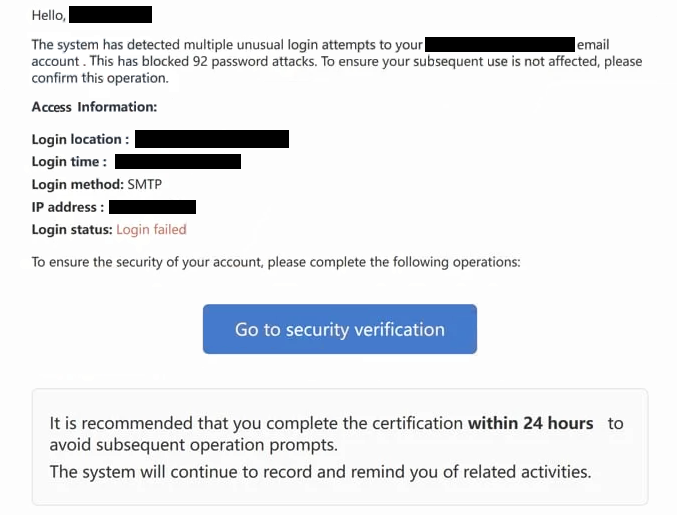
The content of the email is intentionally vague. It may mention an unfamiliar device or location, but it does not provide details that can be checked. There is no timestamp, no device name, and no record of the supposed login attempt. This lack of information is a key part of the scam, as it prevents the recipient from confirming whether the alert is legitimate.
A link is included to “review activity” or “secure the account.” Clicking it leads to a page that imitates a standard sign-in screen. The design is simple and resembles a familiar service, but it does not provide access to any account features. There is no way to view login history or confirm the alert without entering credentials.
The page is designed with a single purpose. It collects login details entered by the user. Once an email address and password are submitted, the information is sent directly to the scammers. The page may then reload, display a short confirmation message, or redirect to a legitimate website to make the process appear normal.
The alert itself is not based on any real system data. It is a generic warning that can apply to any user. These emails are sent to many recipients at once, relying on the possibility that some will respond without verifying the source.
If attackers obtain valid login credentials, they can attempt to access the real account. This can expose stored data, communication history, and account settings. In the case of email accounts, access may also allow password resets for other services connected to the same address. This can extend the impact beyond a single account.
The full “Account abnormal login reminder” phishing email is below:
Subject: Account abnormal login reminder –
Hello, –
The system has detected multiple unusual login attempts to your – email account . This has blocked 92 password attacks. To ensure your subsequent use is not affected, please confirm this operation.
Access Information:
Login location : –
Login time : –
Login method: SMTP
IP address : –
Login status: Login failedTo ensure the security of your account, please complete the following operations:
Go to security verificationIt is recommended that you complete the certification within 24 hours to avoid subsequent operation prompts.
The system will continue to record and remind you of related activities.
This email is automatically sent by the system. Please do not reply directly. If you are operating this personally, you can ignore this reminder.
Notification time: 3/7/2026 (GMT+08:00)
Ref-ID: –
How to recognize phishing emails like “Account abnormal login reminder”?
Phishing emails that use alerts like “Account abnormal login reminder” follow patterns that can be identified with careful review. One of the most noticeable signs is the lack of specific information. The email claims that a security event occurred, but does not provide enough detail for the recipient to confirm it. Legitimate alerts usually include clear data such as login time, device type, or location.
The link included in the email is another important indicator. Instead of directing users to log in through the official website, the email provides a direct link to a login page. This page is hosted on a domain that does not belong to the real service, even if it looks similar. Checking the website address before entering any information can reveal this difference.
The sender’s address should also be examined closely. While the display name may appear to represent a security or support team, the actual email address often comes from a domain unrelated to the service being referenced. This mismatch is a strong indication that the email is not genuine.
Another sign is the lack of personalization. Phishing emails are usually written in a general way so they can be sent to many recipients. They do not include the recipient’s name, account details, or other identifying information that would confirm the email is legitimate.
The wording of the email is designed to prompt quick action. Even without strong or dramatic language, the mention of a suspicious login attempt creates concern. This encourages recipients to follow the link without taking time to verify the message.
Legitimate services do not require users to confirm account activity through external links in unsolicited emails. Accessing accounts through official websites rather than links provided in emails is a reliable way to avoid these threats.
Recognizing these patterns makes it easier to identify phishing emails before interacting with them. Emails that combine vague alerts, unfamiliar links, and inconsistent sender details should be treated with caution.
Site Disclaimer
2-remove-virus.com is not sponsored, owned, affiliated, or linked to malware developers or distributors that are referenced in this article. The article does not promote or endorse any type of malware. We aim at providing useful information that will help computer users to detect and eliminate the unwanted malicious programs from their computers. This can be done manually by following the instructions presented in the article or automatically by implementing the suggested anti-malware tools.
The article is only meant to be used for educational purposes. If you follow the instructions given in the article, you agree to be contracted by the disclaimer. We do not guarantee that the artcile will present you with a solution that removes the malign threats completely. Malware changes constantly, which is why, in some cases, it may be difficult to clean the computer fully by using only the manual removal instructions.