The “Account Details Issue — Cloud Storage” email scam is a phishing email that claims there is a problem with the recipient’s cloud storage account details. The message states that a recent change to account settings could not be verified and that the user must review or update their information to restore full access. These claims are false and are not connected to any legitimate cloud storage provider.
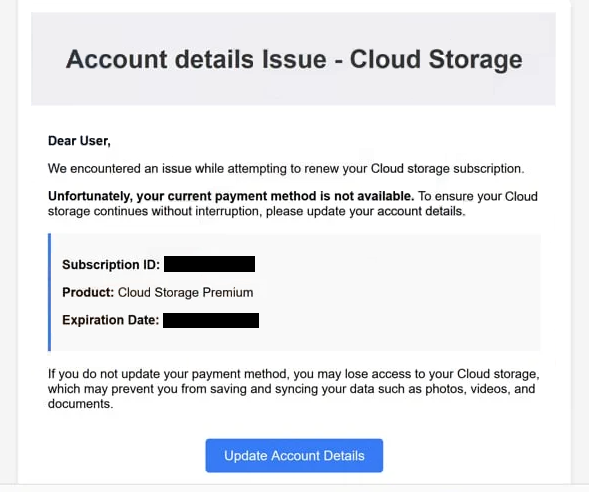
The email text asserts that the recipient’s cloud storage account has inconsistencies in stored account information. It warns that failure to verify or update account details will result in restricted access to stored files and related services. The wording includes references to “account details,” “security checks,” or “verification required” to create urgency. These alerts are fabricated and designed to prompt the recipient into interacting with a link in the email.
A prominent link or button in the email is labeled with terms such as “Verify Account,” “Update Details,” or “Restore Access.” Clicking this link does not open a real cloud storage provider’s site. Instead, it opens a fraudulent web page crafted to look like an official login or verification portal. The fake page displays fields for an email address and password, and may also request additional verification information. It may include simple branding elements or a generic web interface to appear credible. However, the domain shown in the browser address bar does not belong to any legitimate cloud storage service.
When the recipient enters login credentials on that fake page, the information is sent directly to the scammers. The data is not used to verify anything with a real service provider. The fraudulent page does not communicate with actual account systems and does not perform any legitimate verification. Its sole purpose is to collect sensitive credentials. After submission, the page may show a generic error message or redirect to a legitimate login page to make the interaction appear normal. By then, the credentials have already been captured.
The main information targeted by the “Account Details Issue — Cloud Storage” scam is the user’s login credentials. A cloud storage account often contains personal files, documents, and backups. It can also serve as a hub for password reset emails and recovery communications for other accounts. With access to the compromised email account or cloud storage login, attackers can view private data, extract stored documents, and use the account for further identity misuse.
Once attackers capture valid credentials through the fraudulent page, they can sign into the real account as if they were the legitimate user. From there, attackers can change the account password and recovery settings, locking out the actual account owner. They can download or delete files stored in the cloud, view personal information, and potentially upload malicious or unwanted content. The consequences extend beyond loss of access and can include privacy breaches or data loss.
A compromised cloud storage account can also be used to distribute phishing emails or malicious links to contacts stored within the account. These malicious emails can replicate the same verification theme or present entirely new false notifications. Since the emails originate from a legitimate address, recipients are more likely to trust them and follow the embedded links. This expands the impact of the original scam by exposing more individuals to potential credential theft.
The claim about an account details issue is purely a tactic to prompt credential submission. The scammers have no connection to the recipient’s real cloud storage service and cannot enforce verifications or updates. Legitimate providers do not demand verification of account details through links in unsolicited emails.
Subject: -, Your_Cloud_Account has been locked on 02-06-2026. Your_photos and videos will be_removed!
Account details Issue – Cloud Storage
Dear User,
We encountered an issue while attempting to renew your Cloud storage subscription.
Unfortunately, your current payment method is not available. To ensure your Cloud storage continues without interruption, please update your account details.
Subscription ID: –
Product: Cloud Storage Premium
Expiration Date: –
If you do not update your payment method, you may lose access to your Cloud storage, which may prevent you from saving and syncing your data such as photos, videos, and documents.
Update Account DetailsFor your security, we recommend:
Always accessing your account through our official website
Never sharing your password with anyone
Ensuring your contact information is up to dateThank you for trusting us with your data.
Best regards,
Cloud Storage Customer Service TeamContact Support | Account Settings
© 2023 Cloud Storage. All rights reserved.
123 Cloud Drive, Data Center, CA 94107
Signs of a phishing email
The “Account Details Issue — Cloud Storage” scam is delivered as an email with a subject line that references an account details problem, security verification, or required action. The sender name is crafted to resemble cloud storage support or security services. When the full sender address is inspected, the domain does not match the legitimate service provider’s domain. This mismatch between the displayed sender name and the actual sender domain is a clear indicator that the email is fraudulent.
The email body focuses solely on the claim about account details. It states that a verification or update is needed and warns that access may be restricted if no action is taken. The message often includes a short timeframe for response to create urgency. It does not include real account identifiers, recent access details, or references that tie the notice to actual service history, which legitimate providers normally include in verified alerts.
The email includes one or more links labeled with terms related to updating details or verifying the account. These links do not connect to the official domain of the cloud storage provider. Instead, they open a counterfeit web page hosted on a domain unrelated to the legitimate service. The fraudulent page displays fields for entering email and password credentials and may request additional verification information. It lacks the security indicators, detailed navigation menus, and verified branding found on legitimate cloud storage service pages.
Another identifying trait of the “Account Details Issue — Cloud Storage” scam is the narrow focus on the account details claim. The same claim appears in the subject line, body text, and link labels. The email does not discuss billing, storage limits, or subscription updates. It remains centered on the alleged account information problem.
Legitimate providers send notifications through authenticated channels and direct users to sign in through their official account pages. They do not request users to enter credentials on external links embedded in unsolicited emails. Recognizing the combination of an account details issue claim, a mismatched sender domain, and a login page hosted on an unrelated site helps distinguish the “Account Details Issue — Cloud Storage” scam from genuine service communications.
Site Disclaimer
2-remove-virus.com is not sponsored, owned, affiliated, or linked to malware developers or distributors that are referenced in this article. The article does not promote or endorse any type of malware. We aim at providing useful information that will help computer users to detect and eliminate the unwanted malicious programs from their computers. This can be done manually by following the instructions presented in the article or automatically by implementing the suggested anti-malware tools.
The article is only meant to be used for educational purposes. If you follow the instructions given in the article, you agree to be contracted by the disclaimer. We do not guarantee that the artcile will present you with a solution that removes the malign threats completely. Malware changes constantly, which is why, in some cases, it may be difficult to clean the computer fully by using only the manual removal instructions.