The “Account Has Breached Our Terms Of Service” scam is a phishing email that accuses the recipient of violating a platform’s usage rules. The message claims that the account has been flagged for breaching the terms of service and warns that restrictions or suspension will follow unless corrective action is taken. The accusation is fabricated. The email is not connected to any legitimate service provider.
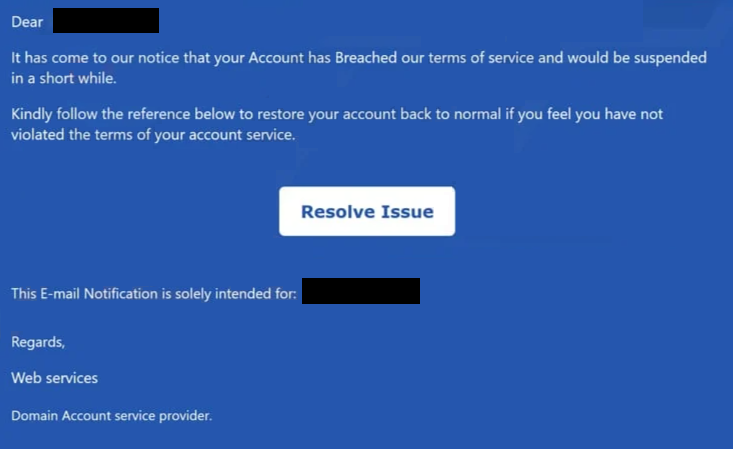
Unlike alerts that focus on suspicious logins or security updates, this scam relies on policy enforcement language to deceive users. The message often refers to prohibited content, unusual behavior, or failure to comply with platform guidelines. It does not clearly explain what rule was broken. Instead, it presents a general violation notice and directs the recipient to resolve the issue through a provided link.
The link leads to a fraudulent web page that imitates a login or appeal form. The page may indicate that the account needs to be reviewed or reactivated. It asks for login credentials to continue the process. The layout can resemble the impersonated service, but the web address shown in the browser does not match the legitimate domain.
The purpose of this page is not to process an appeal or verify compliance. It is designed to capture usernames, passwords, and sometimes additional information such as phone numbers or recovery email addresses. Once entered, these details are sent to the scammers. The page may then display a generic message indicating that the review is complete or redirect to the official website to reduce suspicion.
If attackers obtain valid credentials, they can access the real account associated with the service being impersonated. Depending on the platform, this could include email services, social media accounts, business tools, or cloud storage. Access to these accounts allows attackers to read private data, change settings, and lock the legitimate user out.
The accusation of violating terms of service is used as psychological pressure. It creates concern about account loss and reputation damage. Many users react quickly when faced with the possibility of suspension. The scammers rely on that reaction to prompt credential submission before the recipient verifies the message.
The service provider mentioned in the email has not actually flagged the account. Real platforms do not require users to submit login credentials through links in unsolicited emails to resolve policy issues. Official enforcement actions are handled within authenticated account dashboards.
The full “Account Has Breached Our Terms Of Service” phishing email is below:
Subject: [-]: Please confirm to continue.
Dear -,
It has come to our notice that your Account has Breached our terms of service and would be suspended in a short while.
Kindly follow the reference below to restore your account back to normal if you feel you have not violated the terms of your account service.
Resolve Issue
This E-mail Notification is solely intended for: –
Regards,
Web services
Domain Account service provider.
© Webmail account service provider – 2026 All rights reserved.
How to identify phishing emails
This scam can be recognized by examining how the message presents the alleged violation. The email typically uses broad language and does not specify the exact policy that was breached. It avoids detailed explanations and instead focuses on urgency. Legitimate policy notices usually include specific references, timestamps, or links to official documentation within the account.
The sender address is another indicator. Although the display name may resemble a known platform, the actual domain in the sender’s email address does not match the official service domain. This mismatch is a common trait of phishing emails.
The link included in the message also reveals the deception. When inspected, the destination does not correspond to the legitimate website. The domain may contain unrelated words or subtle alterations of the real brand name. Authentic service providers direct users to manage account issues through their established websites or apps, not through unfamiliar external links.
The structure of the linked page further exposes the scam. It focuses immediately on credential entry and offers no access to account history, support articles, or platform features. Legitimate services provide complete account access after authentication, not a single static form tied to a violation claim.
The tone of the email centers on potential suspension or permanent loss of access. This pressure is meant to limit careful review. Real enforcement notices provide structured steps for review inside the official platform rather than demanding credential submission on external pages.
Site Disclaimer
2-remove-virus.com is not sponsored, owned, affiliated, or linked to malware developers or distributors that are referenced in this article. The article does not promote or endorse any type of malware. We aim at providing useful information that will help computer users to detect and eliminate the unwanted malicious programs from their computers. This can be done manually by following the instructions presented in the article or automatically by implementing the suggested anti-malware tools.
The article is only meant to be used for educational purposes. If you follow the instructions given in the article, you agree to be contracted by the disclaimer. We do not guarantee that the artcile will present you with a solution that removes the malign threats completely. Malware changes constantly, which is why, in some cases, it may be difficult to clean the computer fully by using only the manual removal instructions.