The “cPanel System Maintenance” scam is a phishing email that claims scheduled maintenance requires the recipient to confirm or update their hosting account details. The message presents the action as part of routine server maintenance. It suggests that failure to complete the verification process could result in the temporary suspension of email services or hosting features. This notification is fraudulent and is not sent by cPanel or a legitimate hosting provider.
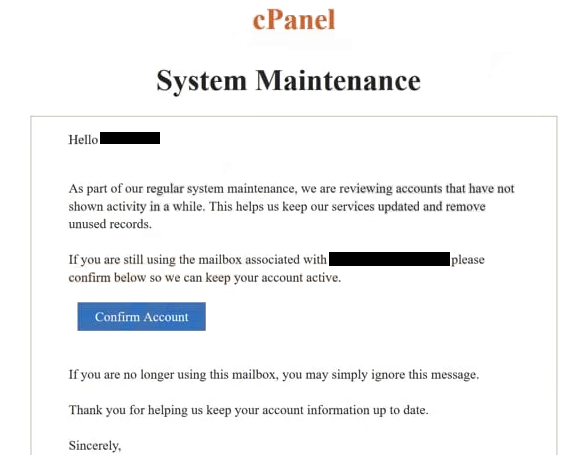
The email is written in an administrative tone. It may reference system upgrades, server validation, or infrastructure checks. Instead of focusing on suspicious activity, it frames the request as a standard maintenance procedure. A link or button is included, often labeled with phrases such as “Confirm Account,” “Validate Hosting,” or “Update cPanel.” The wording implies that user confirmation is required to finalize maintenance.
Clicking the link does not open the official cPanel interface. It directs the recipient to a counterfeit web page that imitates a cPanel login screen. The page may display a familiar layout with fields for a username and password. In some cases, it may also request the associated email address or additional login details. The domain shown in the browser does not match the legitimate hosting provider’s website.
The purpose of this page is to capture account credentials. It does not provide access to real hosting controls or maintenance information. Once the login details are entered, they are transmitted to the scammers. The page may then display a generic confirmation message or redirect to the actual cPanel login page to reduce suspicion.
If attackers obtain valid cPanel credentials, they can access the hosting account. A compromised cPanel account can expose website files, databases, email accounts, and configuration settings. Attackers may modify website content, create new administrator accounts, or access stored data. In some cases, they may upload malicious files or change email routing settings.
The maintenance claim in the “cPanel System Maintenance” email is fabricated. Hosting providers do not require customers to submit login credentials through unsolicited email links to complete routine maintenance. Official maintenance notices are communicated through authenticated dashboards or established support channels.
The full “cPanel System Maintenance” phishing email is below:
Subject: ACCOUNT SYSTEM MAINTENANCE
cPanel
System Maintenance
Hello -,
As part of our regular system maintenance, we are reviewing accounts that have not shown activity in a while. This helps us keep our services updated and remove unused records.
If you are still using the mailbox associated with -, please confirm below so we can keep your account active.
Confirm AccountIf you are no longer using this mailbox, you may simply ignore this message.
Thank you for helping us keep your account information up to date.
Sincerely,
ROUNDCUBE Mail Team
Privacy Policy – –
How to identify the “cPanel System Maintenance” phishing email
The “cPanel System Maintenance” scam can be identified by reviewing both the sender information and the content of the message. The sender address is often inconsistent with the legitimate hosting provider. While the display name may suggest technical support or system administration, the underlying domain typically does not match the official domain used by the provider.
The email usually lacks specific account references. It may not include the hosting account name, server details, or ticket numbers. Genuine maintenance notifications typically provide identifiable information and direct users to access their account through the official website rather than through embedded links.
The link in the email is another indicator. When examined, the destination does not correspond to the official domain of the hosting provider. The domain may include unrelated words or slight variations of the brand name. Legitimate cPanel access is performed through the hosting provider’s secure login page, not through unfamiliar external sites.
The design of the linked page also reveals its intent. It focuses on collecting login credentials and does not provide access to system status pages or maintenance documentation. Real maintenance updates are handled within authenticated account dashboards.
The tone of the email emphasizes that action must be taken promptly to avoid disruption. This pressure is intended to encourage immediate interaction. Authentic providers schedule maintenance internally and do not require credential submission via email links.
By examining the sender domain, reviewing the link destination, and recognizing that maintenance procedures are not completed through external login forms, recipients can identify the “cPanel System Maintenance” scam and protect their hosting credentials.
Site Disclaimer
2-remove-virus.com is not sponsored, owned, affiliated, or linked to malware developers or distributors that are referenced in this article. The article does not promote or endorse any type of malware. We aim at providing useful information that will help computer users to detect and eliminate the unwanted malicious programs from their computers. This can be done manually by following the instructions presented in the article or automatically by implementing the suggested anti-malware tools.
The article is only meant to be used for educational purposes. If you follow the instructions given in the article, you agree to be contracted by the disclaimer. We do not guarantee that the artcile will present you with a solution that removes the malign threats completely. Malware changes constantly, which is why, in some cases, it may be difficult to clean the computer fully by using only the manual removal instructions.