The “Due to server congestion, we are deleteing all e-mails” email is a phishing scam created to steal email account login credentials. The message is presented as an administrative notification concerning the recipient’s mailbox and falsely claims that email accounts considered inactive are being removed because of server congestion.
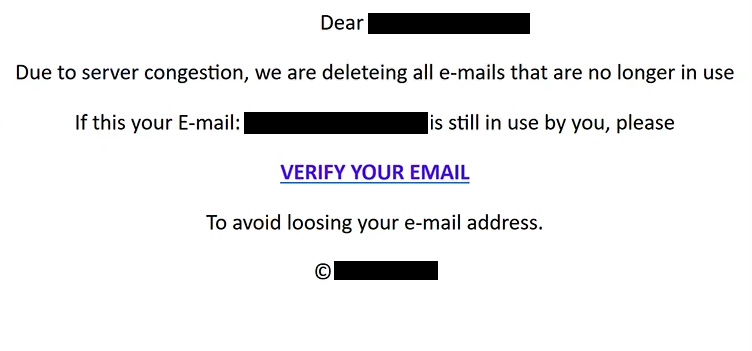
The scam uses the exact phrase “Due to server congestion, we are deleteing all e-mails” as part of its warning. The spelling error in “deleteing” appears in the phishing email itself. Recipients are led to believe that their email address could be included in this supposed account-removal process unless they confirm that the mailbox is still being used.
The email has been observed with the subject line “Server Congestion for [recipient’s address].” By including the recipient’s email address in the subject, the message attempts to make the warning appear specifically related to their account rather than being a mass-distributed notification.
According to the email, accounts that are no longer in use are being deleted to address congestion on the server. Recipients who still use their email address are instructed to verify it so that it will not be removed. The message therefore creates a simple choice: complete the requested verification or supposedly risk losing access to the email address.
To perform the alleged verification, recipients are provided with a button labeled “VERIFY YOUR EMAIL.” This button is not part of a legitimate mailbox maintenance procedure. The message is a phishing attempt, and the requested verification is intended to direct users toward a fraudulent website designed to obtain email account credentials.
When this phishing campaign was examined, the website associated with it was no longer accessible. As a result, the exact appearance and functionality of the destination could not be examined at that time. It would therefore be inaccurate to describe specific fields, branding, or other characteristics of the inactive page without additional evidence.
The purpose of the campaign is nevertheless credential theft. Phishing websites associated with such messages are designed to collect information submitted by victims rather than perform the account operation described in the email. If valid email credentials are obtained, scammers may be able to access the corresponding mailbox without authorization.
Unauthorized mailbox access can expose messages and information contained in the account. Email accounts can also be connected to other online services through password recovery and account verification processes. Consequently, control over an email account may provide criminals with opportunities to target additional accounts associated with the same address.
The full “Due to server congestion, we are deleteing all e-mails” phishing email is below:
Subject: Server Congestion for –
Dear –
Due to server congestion, we are deleteing all e-mails that are no longer in use
If this your E-mail: – is still in use by you, please
[VERIFY YOUR EMAIL]
To avoid loosing your e-mail address.
© –
How to recognize phishing emails
The unusual explanation for the supposed account deletion is one of the main reasons to question this message. It claims that unused email accounts need to be deleted because of server congestion and asks recipients to confirm that their address remains active. Instead of accepting this explanation, users should verify their account status directly through their email provider.
The wording also contains noticeable spelling and grammatical mistakes. In addition to “we are deleteing all e-mails,” the examined message uses “loosing” when referring to the possibility of losing an email address. Errors alone do not establish that every email is fraudulent, but they are relevant warning signs in this specific message.
Recipients should not click the “VERIFY YOUR EMAIL” button to determine whether their account is affected. The safer approach is to open the email provider’s official website or application independently and check the account there. This prevents an unsolicited email from controlling which website receives the user’s credentials.
The complete sender address should also be inspected. Display names and formatting can make an email appear administrative or official without proving its origin. If the sending domain does not correspond with the organization supposedly responsible for the mailbox, the message should not be trusted.
Users can also inspect the destination attached to an email button where their browser or email client provides this functionality. An unexpected destination, particularly one unrelated to the claimed email provider, is a strong indication that the verification request should not be followed.
Receiving or opening the “Due to server congestion, we are deleteing all e-mails” email does not by itself provide scammers with the recipient’s password. Users who have not submitted any information through the associated website can simply avoid the button and delete the email.
Site Disclaimer
2-remove-virus.com is not sponsored, owned, affiliated, or linked to malware developers or distributors that are referenced in this article. The article does not promote or endorse any type of malware. We aim at providing useful information that will help computer users to detect and eliminate the unwanted malicious programs from their computers. This can be done manually by following the instructions presented in the article or automatically by implementing the suggested anti-malware tools.
The article is only meant to be used for educational purposes. If you follow the instructions given in the article, you agree to be contracted by the disclaimer. We do not guarantee that the artcile will present you with a solution that removes the malign threats completely. Malware changes constantly, which is why, in some cases, it may be difficult to clean the computer fully by using only the manual removal instructions.