The “Email Verification Campaign” email is part of a phishing campaign targeting users’ email login credentials. The email claims that users’ email accounts require verification to remain active. The message is presented as a routine administrative request and appears to come from the email service provider. The goal is to direct recipients to a phishing website where attackers harvest login credentials. The email structure is simple, which increases its ability to blend into regular inbox traffic and avoid suspicion from less cautious users. These qualities make the campaign effective and adaptable across different regions and user groups.
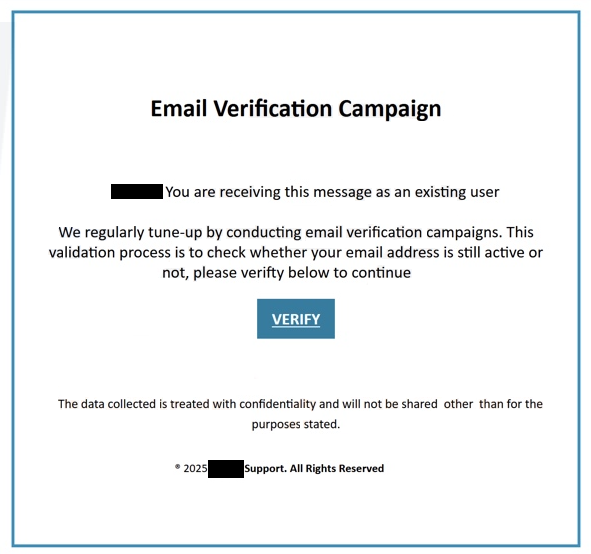
The email contains a short introduction, a brief explanation that verification is required and a single action button. The design uses a simple layout that resembles standard service notifications. There are no references to specific account details, and the content relies on generic language that could apply to any user. The lack of personalised identifiers is one of the strongest indications that the email does not originate from the email service provider. The email does not contain any legitimate contact information or links to official support pages.
The verification button leads to a website that copies the appearance of a genuine login page for an email account. The page contains a login box, a basic logo and minimal supporting text. These elements are arranged in a manner that matches what many users expect from a routine login screen. Once the recipient enters their email address and password, the information is recorded directly by the operators of the phishing campaign. There is no authentication process beyond the fake input fields. Submitting credentials on the page grants the operators full access to the victim’s inbox.
When attackers gain access to an email account, they can review emails, examine personal information contained in past communications and access connected services that rely on the same login credentials. Email accounts serve as central hubs for password resets, account recovery prompts and authentication links. A single compromise can allow attackers to control multiple unrelated services. If the victim reuses passwords across accounts, the exposure expands further. Emails containing invoices, receipts, personal correspondence or account confirmations can provide additional information that can be exploited after the initial compromise.
The full “Email Verification Campaign” email
Subject: Important Update – -: Email Verification Campaign
Email Verification Campaign
-You are receiving this message as an existing user
We regularly tune-up by conducting email verification campaigns. This validation process is to check whether your email address is still active or not, please verifty below to continue
VERIFY
The data collected is treated with confidentiality and will not be shared other than for the purposes stated.
® 2025 – Support. All Rights Reserved
How to identify phishing emails designed to steal credentials
The “Email Verification Campaign” email displays several identifiable characteristics that indicate it is fraudulent. The email uses a generic greeting or no greeting at all. It does not address the recipient by name and does not reference any specific account information. Legitimate service providers include personalised elements when initiating account-related contact. The absence of such information is one of the clearest signs that the email is not authentic.
The sender address does not match the domain of the service the email claims to represent. The visible display name may resemble a support department, but the underlying email address reveals a domain that is unrelated to the platform. The address may contain irregular formatting or an unfamiliar domain structure. Inspecting the sender field closely exposes these inconsistencies.
The link in the email can also be examined without clicking it. Hovering a cursor over the verification button shows the destination address. The domain that appears does not match the official website of any recognised service provider. The address may include random characters or an unrelated domain extension. This confirms that the verification request is not legitimate.
The email intends to create a sense of urgency by stating that verification is required to keep the account active. This tactic is common across credential theft operations because users may respond quickly when they believe account access is at risk. A legitimate provider does not require immediate verification without additional context or prior notice. Any email that demands instant action should be reviewed carefully before a response is given.
The layout of the email includes minor irregularities that appear when compared with authentic service notifications. The spacing, formatting and structure differ from official templates. The email lacks standard footer information such as customer support contacts, legal notices or account details. These omissions further confirm the fraudulent nature of the communication.
Users who interacted with the email should change their password immediately and review their inbox for unfamiliar forwarding rules. Enabling multi-factor authentication can prevent attackers from accessing the account even if credentials were exposed. Users should also review activity on other services linked to the same email address. Early action reduces the risk of unauthorised access after credential exposure.
Incoming search terms:
Site Disclaimer
2-remove-virus.com is not sponsored, owned, affiliated, or linked to malware developers or distributors that are referenced in this article. The article does not promote or endorse any type of malware. We aim at providing useful information that will help computer users to detect and eliminate the unwanted malicious programs from their computers. This can be done manually by following the instructions presented in the article or automatically by implementing the suggested anti-malware tools.
The article is only meant to be used for educational purposes. If you follow the instructions given in the article, you agree to be contracted by the disclaimer. We do not guarantee that the artcile will present you with a solution that removes the malign threats completely. Malware changes constantly, which is why, in some cases, it may be difficult to clean the computer fully by using only the manual removal instructions.