The “Instagram Account Hack” scam refers to websites or tools that claim they can break into someone else’s Instagram account. These pages often advertise themselves as hacking services, promising access to private profiles, messages, or login credentials. In reality, no such functionality is provided. The entire setup is designed to mislead users and generate profit through deceptive methods.
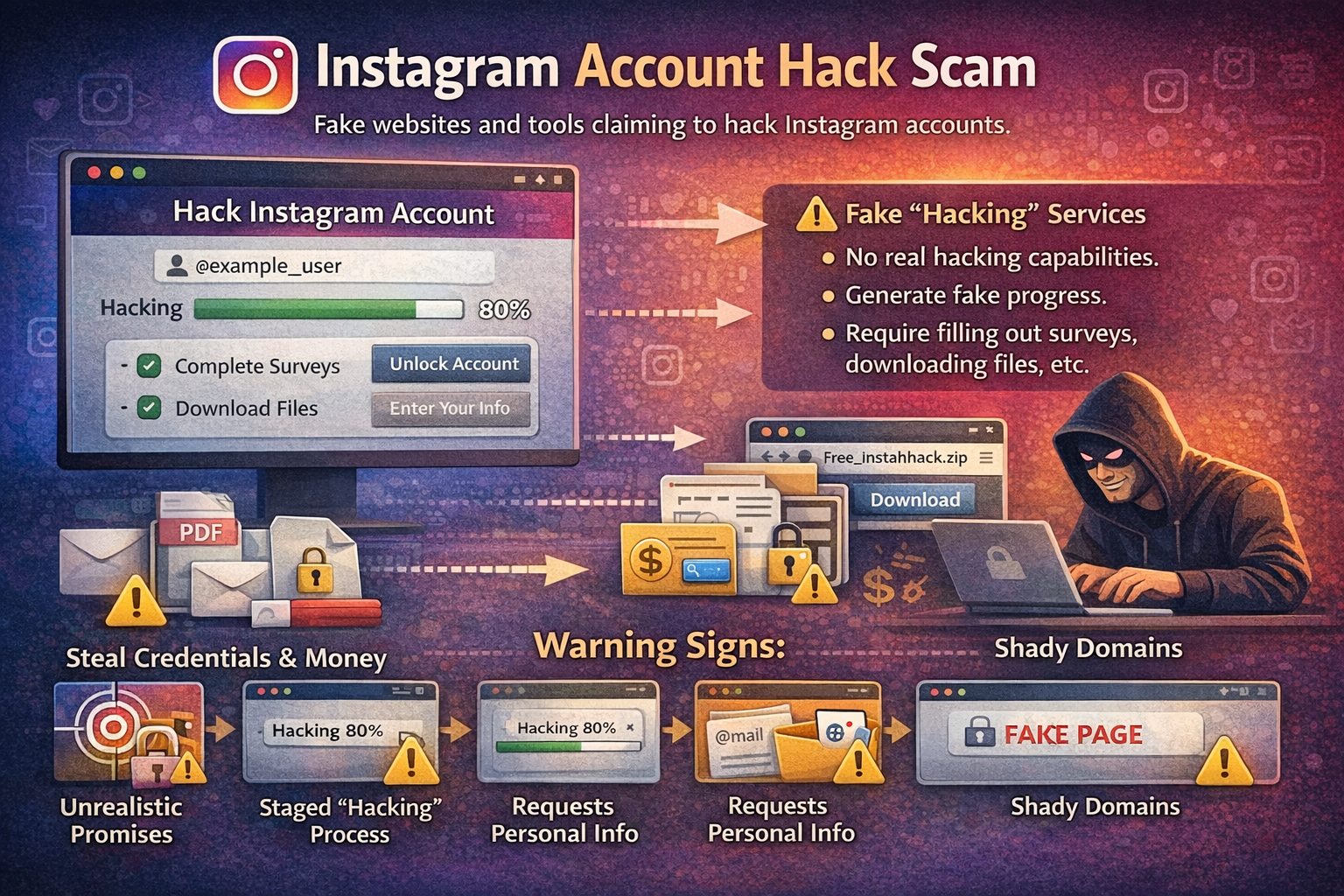
Instead of delivering what is promised, these scam pages typically guide users through a series of steps that appear legitimate. They may ask for a target username, simulate a “hacking process,” and display fake progress messages to create the illusion that something is happening. This staged process is meant to build trust and keep the user engaged.
At the end of this process, users are usually asked to complete an additional step. This can include filling out forms, downloading files, or completing surveys. These actions do not unlock any account. Instead, they are used to generate revenue for the scammers through affiliate schemes or to collect personal information.
In some cases, users may be redirected to pages that request sensitive data such as email addresses, passwords, or payment details. Providing this information can lead to account compromise, financial loss, or identity misuse. The scam may also expose users to further threats, including phishing pages or malicious downloads.
Another variation involves distributing files that claim to be hacking tools. These files are often delivered through links embedded in PDFs or other documents. When opened, they may install harmful software instead of a legitimate tool. This can result in malware infections that steal data, monitor activity, or damage the system.
The central claim of being able to hack Instagram accounts is false. These scams rely on curiosity or intent to gain unauthorized access, using that interest to lure users into unsafe actions. There is no legitimate service that allows access to someone else’s account in this way.
How to recognize scams like “Instagram Account Hack”
Scams that promise account hacking services share several recognizable traits. One of the most obvious is the offer itself. Claims about hacking social media accounts are unrealistic and not supported by legitimate services. Any page or tool making such promises should be treated as suspicious.
Another common sign is the use of staged processes. These pages often display progress bars, loading screens, or verification steps that appear technical but do not perform any real function. These elements are designed only to create a sense of legitimacy.
Requests for additional actions are also a key indicator. Users may be asked to complete surveys, download files, or provide personal information to finish the process. These steps are unrelated to the claimed service and are used to generate profit or collect data.
The source of the page is another important factor. These scams are often promoted through unreliable websites, pop-ups, or links in emails and messages. They may also be distributed through downloads that appear unrelated at first, such as PDF files containing embedded links.
A lack of transparency is also common. Legitimate services provide clear explanations of their function and do not require unusual steps to operate. Scam pages, on the other hand, avoid providing verifiable information and rely on generic descriptions.
Understanding these patterns makes it easier to identify scams that promise unauthorized account access. Any service that claims it can hack social media accounts should be avoided, as it is intended to mislead and exploit users rather than provide real functionality.
Site Disclaimer
2-remove-virus.com is not sponsored, owned, affiliated, or linked to malware developers or distributors that are referenced in this article. The article does not promote or endorse any type of malware. We aim at providing useful information that will help computer users to detect and eliminate the unwanted malicious programs from their computers. This can be done manually by following the instructions presented in the article or automatically by implementing the suggested anti-malware tools.
The article is only meant to be used for educational purposes. If you follow the instructions given in the article, you agree to be contracted by the disclaimer. We do not guarantee that the artcile will present you with a solution that removes the malign threats completely. Malware changes constantly, which is why, in some cases, it may be difficult to clean the computer fully by using only the manual removal instructions.