The “Mail Services Notification – Delivery Delay Notice” email scam is a phishing email that claims incoming emails are being delayed or held back from the recipient’s mailbox. The message states that several messages could not be delivered in real time and are waiting for release. It instructs the recipient to review or confirm their account to receive those emails. This email is not sent by a legitimate mail provider, and no messages are being held. The purpose of this scam is to steal email login credentials.
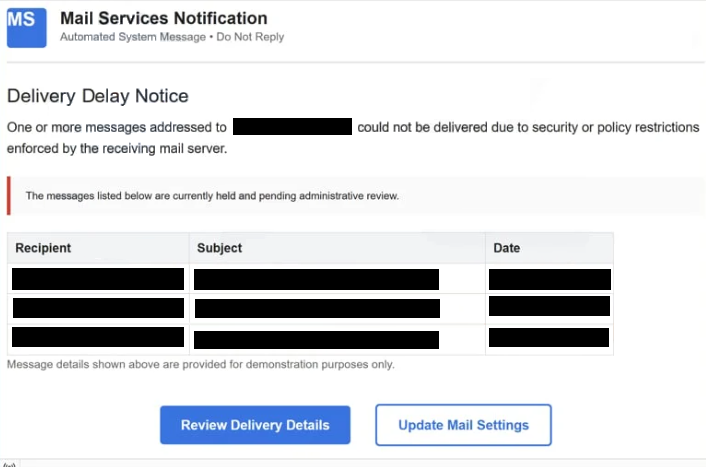
The email tells the recipient that the mail system detected a delivery delay affecting their account. It claims that messages are queued on the server and cannot reach the inbox until the account is verified. The email frames this as a technical issue that requires immediate action. This scenario is fabricated. The sender has no access to the recipient’s real mailbox or server status.
No real delivery data is included. The email does not list sender addresses, subject lines, timestamps, or queue IDs for the supposed delayed emails. It does not show server logs or provider-specific diagnostics. These details are absent because the scammer does not know the recipient’s email activity.
The email contains a link labeled as a way to review or release pending messages. The text suggests that clicking the link will restore normal delivery. This link does not open the official website of any email provider. It leads to a phishing page.
The phishing page is designed to look like a webmail sign-in screen. It asks the recipient to enter their email address and password to access delayed messages. Entering this information does not release any emails. The credentials are sent directly to scammers.
After credentials are submitted, the page can display a message claiming that delivery has resumed or that verification is complete. This response is only visual and not connected to a real mail system. No delayed emails exist, and no changes have been made to the account.
If scammers gain access to a mailbox, they can read stored emails, collect personal information, and search for financial or account-related data. They can also send emails from the compromised account. Messages sent from a real account are more likely to be trusted by recipients.
Mailbox access also allows password resets for other services. Many online accounts rely on email for recovery. Control of the inbox can therefore lead to additional account takeovers involving shopping accounts, social platforms, or financial services tied to that email address.
The delivery delay described in the “Mail Services Notification – Delivery Delay Notice” email is entirely false. Legitimate providers do not hold messages and then ask for passwords through external links to release them. Real mail flow issues are visible inside the mailbox after signing in through the official website or app.
The full “Mail Services Notification – Delivery Delay Notice” phishing email is below:
Subject: Delivery Delay Notice
Mail Services Notification
Automated System Message • Do Not Reply
Delivery Delay NoticeOne or more messages addressed to – could not be delivered due to security or policy restrictions enforced by the receiving mail server.
The messages listed below are currently held and pending administrative review.
Recipient Subject Date
–
–
–Message details shown above are provided for demonstration purposes only.
Review Delivery Details Update Mail Settings
This automated notification was generated by a mail delivery system.
© 2026 Mail Services · Training & Demonstration Use
How the “Mail Services Notification – Delivery Delay Notice” email is sent, and how to recognize it
The “Mail Services Notification – Delivery Delay Notice” email scam is distributed through large phishing campaigns. The same message is sent to many addresses without checking whether recipients are experiencing mail delays. The wording is broad, so it can apply to any email user.
The sender name may include terms like mail services or admin team, but the sending address does not match a real provider’s domain. It often comes from unrelated or random domains. Viewing the full sender address reveals this mismatch.
The content does not include verifiable delivery information. It does not identify who sent the supposed delayed emails or when they were received by the server. Legitimate providers show actual message details inside the account. This scam cannot provide them.
The link in the email leads to a domain that a mail provider does not own. Even if the page looks like a real login screen, the web address is different. Any login page reached from a delivery delay claim should be treated as fraudulent.
Another warning sign is the push for quick action. The email states that messages will remain unavailable until verification is completed. Real providers do not block incoming mail while waiting for password confirmation on external pages.
The email also does not guide users to check their inboxes directly through the provider’s official website. It only promotes the embedded link. Legitimate providers allow users to review account status from within their authenticated mailbox.
The “Mail Services Notification – Delivery Delay Notice” email scam relies on concern about missing important emails. Checking sender domains, avoiding login through email links, and signing in only through the official provider website are reliable ways to avoid this phishing attempt.
Site Disclaimer
2-remove-virus.com is not sponsored, owned, affiliated, or linked to malware developers or distributors that are referenced in this article. The article does not promote or endorse any type of malware. We aim at providing useful information that will help computer users to detect and eliminate the unwanted malicious programs from their computers. This can be done manually by following the instructions presented in the article or automatically by implementing the suggested anti-malware tools.
The article is only meant to be used for educational purposes. If you follow the instructions given in the article, you agree to be contracted by the disclaimer. We do not guarantee that the artcile will present you with a solution that removes the malign threats completely. Malware changes constantly, which is why, in some cases, it may be difficult to clean the computer fully by using only the manual removal instructions.