The “Official account restriction notification” email scam is a phishing email built around a simple threat: access to an account will be limited unless the recipient acts immediately. The email presents itself as a formal warning from an account provider, using strict language that suggests enforcement, compliance, or a pending restriction. The message is not a real service notice. It is written and sent by scammers attempting to capture login details.
The email usually frames the situation as urgent and unavoidable. It may claim the account has been flagged, placed under review, or marked for restriction due to unusual activity. Some versions claim there has been a policy issue or that the account needs “verification” before it can continue to function normally. The wording is chosen to create anxiety, especially for recipients who rely on the account for work, billing, or personal communication.
A key part of the scam is the action prompt. The email includes a link or button that claims it will prevent the restriction or restore full access. The destination is not a real account page. It is a fake sign-in screen designed to look like a legitimate login page. Once the recipient enters their email address and password, the information is sent directly to the scammers.
The scam does not stop at basic credentials in every case. Some fake pages request additional details such as phone numbers, recovery email addresses, or other account information. This data can be used to strengthen an account takeover attempt, especially if the scammers plan to reset passwords or bypass recovery steps later.
If the scammers gain access to an email account, the impact can spread beyond that inbox. Email accounts are often tied to password resets for other services. With control of the mailbox, scammers can request password reset links, intercept verification codes, and take over connected accounts. They may also send more phishing emails from the compromised address, making the next wave of scams more believable because it comes from a real contact.
The “Official account restriction notification” email scam relies on panic and speed. It tries to keep the recipient focused on avoiding restriction rather than checking whether the message makes sense. The threat is the hook, and the fake login page is the trap.
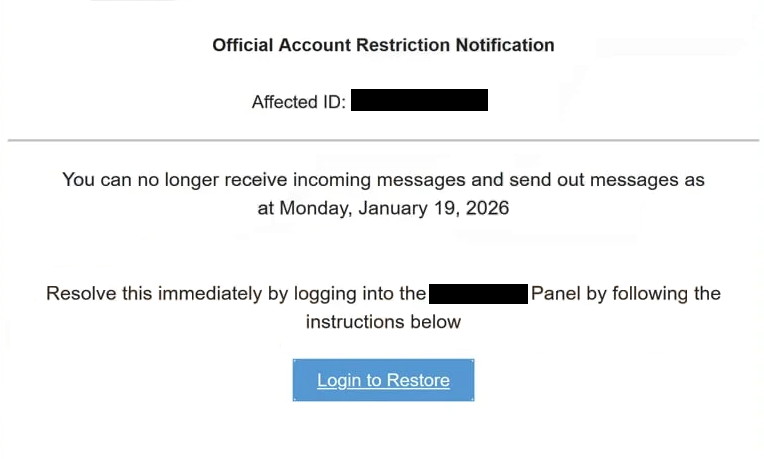
The full “Official Account Restriction Notification” email is below:
Subject: Resolve – Account Restriction to Restore Full Access
Official Account Restriction Notification
Affected ID: –
You can no longer receive incoming messages and send out messages as at Monday, January 19, 2026
Resolve this immediately by logging into the – Panel by following the instructions below
Login to Restore
How this phishing email is delivered and what makes it easier to spot
The “Official account restriction notification” email scam is sent through spam campaigns that reach large numbers of recipients. These emails are not delivered because the sender has a real relationship with the recipient. They are distributed widely, hoping that some recipients will be concerned enough to follow the link.
One of the clearest warning signs is the sender’s identity. The display name may look official, but the actual email address often does not match the service being imitated. Many phishing emails use unrelated domains, random strings, or addresses that have no connection to the company they claim to represent. This mismatch is often visible even before opening the email fully.
The writing style can also reveal the scam. These emails frequently use stiff, formal wording that sounds official but stays vague. Instead of giving specific information about the account, they rely on broad statements like “your account will be restricted” or “verification is required.” Legitimate providers usually include clear context, such as where the alert came from, what part of the account is affected, and how to review the issue safely.
Links are another major clue. Phishing emails commonly hide the real destination behind buttons such as “Verify now” or “Restore access.” The linked address often does not match the real domain of the provider. Even when the page looks convincing, the domain name can show that it is not part of the actual service.
The fake login pages used in this scam often focus on speed rather than accuracy. Some have small mistakes in layout, wording, or branding. Others look polished but still behave differently from real login pages, such as asking for extra details immediately or pushing repeated prompts after credentials are entered.
Another red flag is the pressure to act without verification. The email may claim the restriction will happen within hours or that the account will be permanently affected. This is meant to stop the recipient from checking the account through normal methods. A legitimate restriction notice does not depend on a single link in an unsolicited email. Account status can be reviewed by signing in through the official website or app, not through a third-party page reached from a warning email.
The “Official account restriction notification” email scam works because it imitates common account security language and adds a threat that feels personal. Careful review of the sender address, the link destination, and the lack of specific account information can help separate this phishing email from a real service notice.
Site Disclaimer
2-remove-virus.com is not sponsored, owned, affiliated, or linked to malware developers or distributors that are referenced in this article. The article does not promote or endorse any type of malware. We aim at providing useful information that will help computer users to detect and eliminate the unwanted malicious programs from their computers. This can be done manually by following the instructions presented in the article or automatically by implementing the suggested anti-malware tools.
The article is only meant to be used for educational purposes. If you follow the instructions given in the article, you agree to be contracted by the disclaimer. We do not guarantee that the artcile will present you with a solution that removes the malign threats completely. Malware changes constantly, which is why, in some cases, it may be difficult to clean the computer fully by using only the manual removal instructions.