The “Posteitaliane” email scam is a phishing message that pretends to be a delivery notification from the Italian postal service. The email informs recipients that a package is waiting for delivery and claims that a small shipping or handling fee must be paid before the parcel can be released. This message is fraudulent and is not connected to the legitimate postal service.
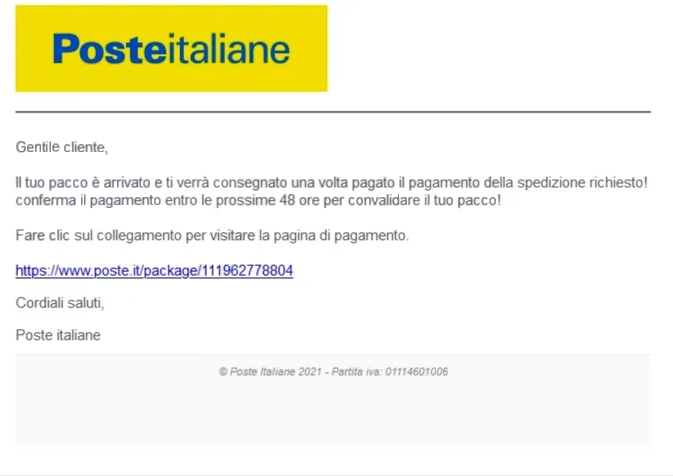
The email usually states that the shipment has arrived at a local distribution center and is ready to be delivered. However, the recipient must complete a payment to finalize the delivery process. The message often includes a deadline, suggesting that the payment must be completed within a short period of time. This time pressure is used to push recipients into acting quickly without verifying whether the email is authentic.
A link included in the email directs the recipient to a website that appears to be related to “Posteitaliane”. The page may display the postal service’s logo and design elements that resemble an official tracking or payment portal. Despite its appearance, the page is not operated by the real postal service. It is a phishing site created to collect financial information from visitors.
The page typically asks users to enter credit card details in order to pay the supposed delivery fee. The amount requested is usually small, which helps the request appear believable. However, the payment form is designed to capture the information entered by the victim. Credit card numbers, expiration dates, and security codes provided on the page can then be used by scammers for unauthorized transactions.
Once the scammers obtain payment information, they may attempt online purchases or other financial activities using the stolen card details. Victims can experience unexpected charges and financial loss. The information collected through the phishing page may also be used for additional fraud.
The delivery notification described in the email is fabricated. These messages are typically distributed as part of large spam campaigns sent to thousands of recipients. The scammers do not know whether the recipients are actually expecting a package. They rely on the fact that many people receive deliveries and may assume the message is legitimate.
Legitimate postal services do not request payment through unsolicited email links in order to deliver packages. Any request to provide payment information through an unfamiliar website should be treated with suspicion.
How the “Posteitaliane” phishing email is delivered
The “Posteitaliane” scam spreads through mass email campaigns targeting many recipients at once. The emails often use subject lines that mention parcel delivery, shipment arrival, or package tracking. The sender name may appear similar to the official postal service, but the actual sender address usually belongs to an unrelated domain.
The message itself tends to be short and direct. It informs the recipient that a shipment cannot be delivered until the payment is completed. The email may include a reference number or tracking identifier to make the message appear more credible. However, the message usually does not include real shipment details such as the sender of the package or the delivery address.
The link provided in the email leads to the phishing page where the payment is requested. The domain name used for this page may resemble the official “Posteitaliane” website, but often contains additional words or unusual domain endings. These domains are not controlled by the legitimate postal service.
The phishing page encourages the visitor to complete the payment immediately in order to release the parcel. The small fee displayed on the page is intended to make the request seem harmless. In reality, entering payment details exposes financial information to scammers.
Recognizing the signs of the “Posteitaliane” email scam can help prevent financial loss. Emails that request payment for package delivery through unfamiliar links should be approached with caution, especially when they arrive unexpectedly and do not contain verifiable shipping information.
Site Disclaimer
2-remove-virus.com is not sponsored, owned, affiliated, or linked to malware developers or distributors that are referenced in this article. The article does not promote or endorse any type of malware. We aim at providing useful information that will help computer users to detect and eliminate the unwanted malicious programs from their computers. This can be done manually by following the instructions presented in the article or automatically by implementing the suggested anti-malware tools.
The article is only meant to be used for educational purposes. If you follow the instructions given in the article, you agree to be contracted by the disclaimer. We do not guarantee that the artcile will present you with a solution that removes the malign threats completely. Malware changes constantly, which is why, in some cases, it may be difficult to clean the computer fully by using only the manual removal instructions.