The “Security Update To Recognize Trusted Devices And Locations” email is a phishing scam that attempts to trick recipients into surrendering their email account credentials. The message is presented as a security-related notification claiming that the email provider has introduced new protections designed to identify trusted devices and approved login locations. While the alert may appear legitimate at first glance, it is fraudulent and created to steal sensitive information from users who interact with it.
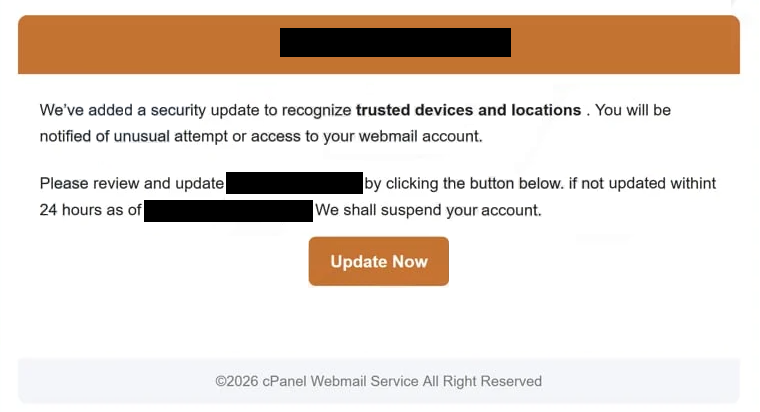
The scam typically claims that users must complete a verification process to continue accessing their mailbox without interruptions. The “Security Update To Recognize Trusted Devices And Locations” email often warns that accounts not updated in time could face login restrictions, failed authentication attempts, or limited access from unfamiliar locations. By framing the request as a security improvement rather than an obvious threat, the phishing email appears more believable and less aggressive than many traditional scams.
To complete the supposed update, recipients are instructed to click a link or button included in the email. However, instead of leading to a legitimate provider’s security page, the link redirects users to a counterfeit login portal designed to imitate a real webmail interface. These phishing pages are often intentionally generic so they can target users of different email providers using the same template. Once login credentials are entered, the information is immediately captured by the attackers.
The “Security Update To Recognize Trusted Devices And Locations” scam relies heavily on trust in familiar security terminology. Notifications about account protection, device recognition, and suspicious login prevention are common features offered by legitimate providers, which makes the phishing email seem plausible. Attackers exploit this familiarity to reduce suspicion and encourage users to comply without carefully inspecting the message.
A compromised email account can create serious security risks. Attackers who gain access may review stored correspondence, search for sensitive information, or use the account to distribute additional phishing emails. Since email accounts are frequently connected to password recovery systems for other services, access to one mailbox can potentially expose multiple online accounts. This can lead to identity theft, financial fraud, or unauthorized access to additional platforms.
Another factor that makes the “Security Update To Recognize Trusted Devices And Locations” scam effective is its broad targeting approach. The email usually avoids mentioning a specific provider directly, allowing the same phishing template to be sent to users of many different services. Even recipients who have not experienced any security issues may still react because the email appears to involve routine account protection measures.
How to recognize phishing emails
Recognizing phishing emails like the “Security Update To Recognize Trusted Devices And Locations” scam requires paying attention to common warning signs often found in fraudulent account notifications. Although these emails are designed to imitate legitimate security alerts, they usually contain inconsistencies that reveal their true purpose.
One major warning sign is urgency. Phishing emails frequently suggest that immediate action is required to maintain account access or prevent security problems. In this case, the message may warn that login issues or restrictions could occur if the update is not completed quickly. This pressure is intentional and is meant to encourage fast reactions rather than careful verification.
The sender’s email address should also be examined carefully. Fraudulent emails often imitate official support or security addresses but include subtle differences such as unusual domains, extra characters, or misspellings. Even if the display name appears legitimate, the actual address may reveal that the message did not originate from a real provider.
Links included in phishing emails are another important indicator. While the visible text may appear trustworthy, hovering over the link often reveals a suspicious or unrelated destination. These links commonly lead to fake login pages created specifically to capture usernames and passwords. Legitimate providers generally encourage users to access security settings directly through their official websites rather than through unsolicited links in random emails.
The wording and formatting used in phishing emails can also provide clues. Some messages contain grammatical errors, awkward sentence structure, or inconsistent formatting. Others may appear polished but still rely heavily on generic wording and vague references to account security. A lack of personalization is also common because phishing campaigns are typically distributed in large volumes to many recipients at once.
Requests for login credentials or verification through embedded links should always raise suspicion. Legitimate providers do not ask users to confirm passwords or restore account access through external login pages sent in unsolicited notifications. Emails urging users to “verify devices,” “approve locations,” or “complete security updates” through clickable buttons are commonly associated with phishing activity.
Unexpected attachments can present additional risks as well. Some phishing emails include files disguised as security reports or verification documents. Opening these files may expose devices to malware if the attachments contain malicious scripts or executable content.
A safer approach is to avoid interacting with suspicious emails directly. Instead of clicking links inside the message, users should manually visit the official website of their email provider and review account security settings there. If no corresponding notification appears within the account, the email is likely fraudulent.
Site Disclaimer
2-remove-virus.com is not sponsored, owned, affiliated, or linked to malware developers or distributors that are referenced in this article. The article does not promote or endorse any type of malware. We aim at providing useful information that will help computer users to detect and eliminate the unwanted malicious programs from their computers. This can be done manually by following the instructions presented in the article or automatically by implementing the suggested anti-malware tools.
The article is only meant to be used for educational purposes. If you follow the instructions given in the article, you agree to be contracted by the disclaimer. We do not guarantee that the artcile will present you with a solution that removes the malign threats completely. Malware changes constantly, which is why, in some cases, it may be difficult to clean the computer fully by using only the manual removal instructions.