The “Security Verification – Periodic Due Diligence” phishing email is a scam that attempts to obtain email account credentials by impersonating a webmail security service. It claims that recipients must complete a mandatory account verification procedure to maintain uninterrupted access to their mailboxes. The notification presents this requirement as part of a routine security review, but its actual purpose is to direct users to a phishing website.
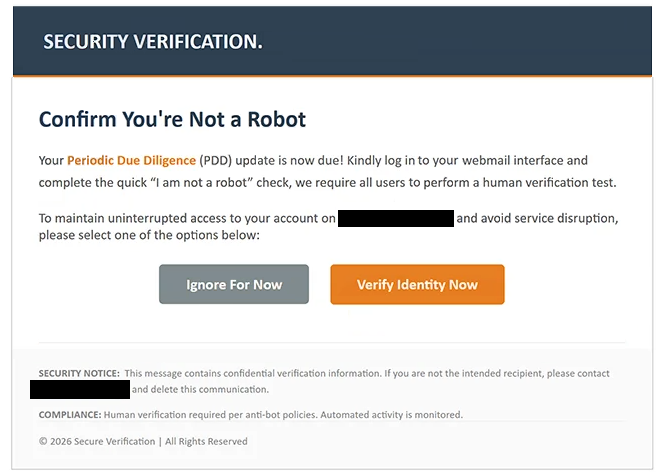
The email uses the subject line “Periodic Due Diligence” and includes prominent headings such as “SECURITY VERIFICATION” and “Confirm You’re Not a Robot.” It informs recipients that a Periodic Due Diligence (PDD) update is required and that they must log in to their webmail accounts to complete an identity check. However, the email does not identify a specific security incident or explain why the verification is necessary.
Recipients are warned that failing to complete the procedure may interrupt access to their email accounts. The notification includes two buttons, “Ignore For Now” and “Verify Identity Now,” encouraging users to select the verification option. This arrangement makes the request resemble a routine account maintenance procedure rather than an attempt to obtain sensitive information.
Clicking “Verify Identity Now” leads to a phishing website. The page imitates a cPanel Webmail login interface and requests the visitor’s email address and password. Despite the email’s claims about human verification, the website does not perform a legitimate CAPTCHA check.
The phishing form is designed to collect login credentials for the scammers. If recipients provide valid passwords, attackers may attempt to access their mailboxes, read private correspondence, and obtain sensitive attachments. They could also impersonate account owners to distribute additional phishing emails or attempt to compromise other services linked to the affected addresses.
The email includes references to anti-bot policies, automated activity monitoring, and confidential account verification procedures. These elements are intended to create an impression of official security administration, although they do not establish that any genuine review is taking place.
The “Security Verification – Periodic Due Diligence” phishing email misuses the appearance of legitimate webmail services, including cPanel. The supposed due diligence requirement is a pretext for credential theft, and no legitimate connection to cPanel has been identified.
The full “Security Verification – Periodic Due Diligence” phishing email is below:
Subject: Periodic Due Diligence
SECURITY VERIFICATION.
Confirm You’re Not a Robot
Your Periodic Due Diligence (PDD) update is now due! Kindly log in to your webmail interface and complete the quick “I am not a robot” check, we require all users to perform a human verification test.
To maintain uninterrupted access to your account on – and avoid service disruption, please select one of the options below:
[Ignore For Now] [Verify Identity Now]
SECURITY NOTICE: This message contains confidential verification information. If you are not the intended recipient, please contact – and delete this communication.
COMPLIANCE: Human verification required per anti-bot policies. Automated activity is monitored.
© 2026 Secure Verification | All Rights Reserved
How to recognize phishing emails
The “Security Verification – Periodic Due Diligence” phishing email contains several warning signs, beginning with its vague explanation of the supposed account review. It claims that verification is mandatory but does not identify the organization responsible for the requirement or provide account-specific details. Formal terminology alone does not establish that an administrative request is legitimate.
Another suspicious characteristic is the instruction to confirm that the recipient is human by logging in to a webmail account. Legitimate websites may use CAPTCHA challenges to distinguish people from automated software, but the identified phishing page requests an email password instead. This mismatch between the advertised security check and the actual authentication request is a strong indication of deception.
The warning about interrupted account access also creates pressure to act. Recipients are encouraged to believe that their mailboxes may become unavailable unless they complete the verification. However, the email does not explain what specific restriction will be applied or why the account requires additional authentication.
The two buttons, “Ignore For Now” and “Verify Identity Now,” are another distinctive feature. Their presentation makes the notification resemble a standard security reminder, with verification appearing to be the recommended action. Nevertheless, the verification button directs users to a website unrelated to their identifiable email provider.
The phishing website imitates a familiar cPanel Webmail login page, which may make it appear trustworthy. However, scammers can reproduce recognizable logos, authentication fields, and administrative interfaces. The website address and its relationship to the claimed service are more meaningful indicators than its visual design.
The email also contains references to anti-bot policies and confidentiality requirements. These statements give the notification a technical and official tone without providing verifiable evidence of an actual security procedure. The copyright reference to “Secure Verification” similarly does not establish the sender’s identity.
Site Disclaimer
2-remove-virus.com is not sponsored, owned, affiliated, or linked to malware developers or distributors that are referenced in this article. The article does not promote or endorse any type of malware. We aim at providing useful information that will help computer users to detect and eliminate the unwanted malicious programs from their computers. This can be done manually by following the instructions presented in the article or automatically by implementing the suggested anti-malware tools.
The article is only meant to be used for educational purposes. If you follow the instructions given in the article, you agree to be contracted by the disclaimer. We do not guarantee that the artcile will present you with a solution that removes the malign threats completely. Malware changes constantly, which is why, in some cases, it may be difficult to clean the computer fully by using only the manual removal instructions.