The “Wells Fargo – Attached is your payment remittance copy” email scam is a phishing email that pretends to deliver a payment remittance document from Wells Fargo. The email claims that a copy of a payment remittance is attached or available for review and implies that the recipient needs to open it to see transaction details. The message is not sent by Wells Fargo and is not connected to any real payment, transfer, or remittance activity.
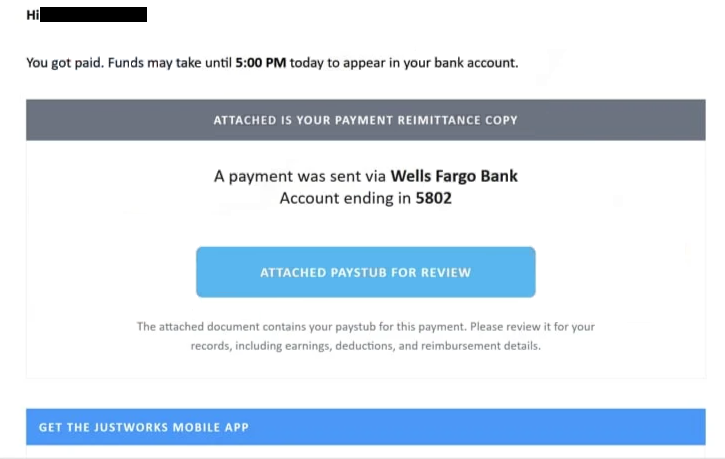
The email uses the exact wording “Wells Fargo – Attached is your payment remittance copy” to appear formal and business-related. The phrase is meant to suggest that the message contains an official financial document. This approach is intended to catch the attention of recipients who deal with invoices, supplier payments, reimbursements, or business transactions, but the email is also sent to individuals with no relationship to Wells Fargo at all.
The message states that the remittance copy is attached or accessible through a link. It may suggest that the document is provided for records, confirmation, or review. The wording is brief and avoids unnecessary detail, which helps it look like an automated financial notification rather than a conversation. The email does not include verifiable account information, transaction history, or specific payment details because no actual payment has occurred.
When the recipient clicks the link or opens the attachment, they are not shown a legitimate remittance document. Instead, the action leads to a phishing page or a file that redirects to a phishing page. That page is designed to imitate a Wells Fargo login screen or a secure document portal. The page asks the recipient to sign in to view the remittance copy.
Entering login details on this page does not provide access to any document. Scammers capture the credentials. In some cases, the page may request additional information, such as account numbers or security details, claiming this is required to confirm identity before viewing the remittance. These requests are part of the same attempt to collect sensitive information.
If valid banking credentials are entered, scammers may attempt to access the real Wells Fargo account. That access can allow them to view balances, transaction history, and personal details. It can also be used to attempt unauthorized transfers or gather information for further fraud. Even if account access fails, the stolen information can still be reused in follow-up scams or sold to other criminals.
A real Wells Fargo remittance copy would never be delivered through an unsolicited email attachment or link that leads to a sign-in page outside the official banking environment. Legitimate remittance records are accessed by signing in directly through the official website or mobile app.
How to recognize phishing emails
The “Wells Fargo – Attached is your payment remittance copy” email scam is distributed through bulk phishing campaigns. The same email is sent to large numbers of recipients without confirming whether they use Wells Fargo or have any payment activity. The email is written broadly so it can appear relevant to both individuals and businesses.
One of the clearest indicators of the scam is the sender address. While the display name may reference Wells Fargo or a finance department, the actual sending domain does not belong to Wells Fargo. The domain often has no connection to banking or financial institutions. Reviewing the full sender address reveals this mismatch.
The email content itself is minimal and lacks context. It does not explain why the payment was made, who sent it, or which account it relates to. Legitimate remittance emails include clear references to invoices, payers, or transaction identifiers that match known activity. The absence of such details is a key sign that the email is not authentic.
Links included in the email lead to domains that are not owned by Wells Fargo. Even if the page looks convincing, the web address does not match the bank’s official login domains. Any request to sign in to view a remittance copy through a page reached from an email link should be treated as unsafe.
Attachments used in this scam are also misleading. Files may appear to be PDFs or documents, but opening them can redirect the browser to a phishing page or display a message instructing the recipient to sign in online. Wells Fargo does not send remittance documents as unsecured attachments that require separate authentication through unfamiliar pages.
Another warning sign is the request for sensitive information. The phishing page associated with the “Wells Fargo – Attached is your payment remittance copy” email scam may ask for online banking credentials or additional personal details. Banks do not ask customers to enter full login information to view a document delivered through email.
The email also does not provide alternative ways to verify the payment. There is no suggestion to sign in directly through the official website, no reference to contacting support using known phone numbers, and no mention of viewing the remittance within an existing account dashboard. All actions are routed through the phishing link.
The “Wells Fargo – Attached is your payment remittance copy” email scam relies on the expectation that financial documents are important and time sensitive. Carefully checking the sender address, avoiding links and attachments in unexpected banking emails, and accessing accounts only through the official Wells Fargo website or app are effective ways to identify and avoid this specific phishing email.
Site Disclaimer
2-remove-virus.com is not sponsored, owned, affiliated, or linked to malware developers or distributors that are referenced in this article. The article does not promote or endorse any type of malware. We aim at providing useful information that will help computer users to detect and eliminate the unwanted malicious programs from their computers. This can be done manually by following the instructions presented in the article or automatically by implementing the suggested anti-malware tools.
The article is only meant to be used for educational purposes. If you follow the instructions given in the article, you agree to be contracted by the disclaimer. We do not guarantee that the artcile will present you with a solution that removes the malign threats completely. Malware changes constantly, which is why, in some cases, it may be difficult to clean the computer fully by using only the manual removal instructions.