The “Wells Fargo – merchant charges refund” email is a phishing scam that pretends to be a legitimate notification from Wells Fargo regarding a supposed refund tied to recent transactions. It is structured to resemble an official banking alert, often referencing a completed or pending refund for merchant charges. While this may seem like routine financial communication, the email is entirely fraudulent and has no connection to the actual bank.
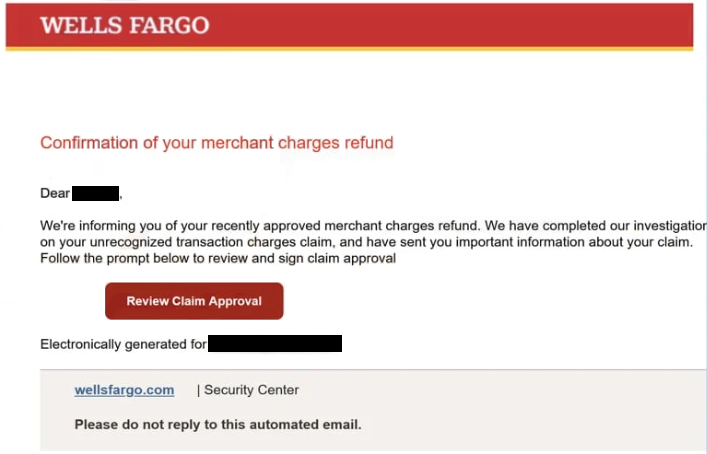
This phishing attempt is designed to take advantage of a situation that feels both familiar and harmless. Receiving a refund notification does not immediately raise suspicion for many users, which is why attackers use this theme. The “Wells Fargo – merchant charges refund” email typically informs the recipient that funds have been credited or are awaiting confirmation, then instructs them to review the details through a provided link.
That link is the central element of the scam. Instead of directing users to an official Wells Fargo page, it leads to a deceptive website created to imitate a legitimate banking interface. These pages are often visually convincing, using similar layouts, logos, and formatting to reduce suspicion. Once on the page, users may be asked to log in or provide additional information to “confirm” the refund. The attackers immediately capture any data entered.
In some variations, the email may include additional pressure by suggesting that the refund must be verified within a limited timeframe. This urgency is intentional and is meant to push recipients into acting quickly rather than carefully evaluating the message. The “Wells Fargo – merchant charges refund” scam may also appear in slightly different formats, but the overall strategy remains consistent: present a believable financial update and guide the user toward a malicious page.
The consequences of interacting with such emails can be serious. Stolen login credentials can be used to access banking accounts, authorize transactions, or gather further personal information. In some cases, attackers may attempt to reuse the same credentials across other services, increasing the overall impact. Because of this, even a single interaction with the “Wells Fargo – merchant charges refund” email can lead to broader security issues.
The full “Wells Fargo – merchant charges refund” phishing email is below:
Subject: Confirmation of your merchant charges refund
Wells Fargo
Confirmation of your merchant charges refund
Dear -,
We’re informing you of your recently approved merchant charges refund. We have completed our investigation on your unrecognized transaction charges claim, and have sent you important information about your claim. Follow the prompt below to review and sign claim approval
Review Claim Approval
Electronically generated for –
wellsfargo.com | Security Center
Please do not reply to this automated email.
How to recognize phishing emails
Identifying phishing emails like the “Wells Fargo – merchant charges refund” scam requires attention to several key details. Although these emails are designed to appear convincing, they often contain subtle indicators that reveal their true nature.
One of the most common signs is urgency. Phishing emails frequently create a sense that immediate action is required. In this case, the message may imply that the refund must be reviewed or confirmed quickly. This pressure is deliberate, as it encourages users to act without verifying the authenticity of the email. Legitimate financial institutions do not require urgent action through unsolicited emails in this manner.
Another important factor is the link included in the email. While it may appear to reference Wells Fargo, the actual destination often leads to an unrelated or suspicious domain. Hovering over the link before clicking can reveal discrepancies between the displayed text and the real URL. This mismatch is a strong indication that the email is not legitimate.
The sender’s email address should also be examined carefully. Phishing emails often imitate official addresses but include slight variations, such as additional characters or unusual domain extensions. Even small differences can signal that the message did not originate from Wells Fargo. Genuine communications typically come from consistent and recognizable domains associated with the bank.
Language quality can provide additional clues. Many phishing emails contain awkward phrasing, grammatical errors, or formatting inconsistencies. While some may appear polished, small irregularities often remain. These details can indicate that the email was not created by an official source.
Another warning sign is the type of request being made. Emails that ask users to provide sensitive information, such as login credentials or personal data, through embedded links should be treated with caution. Legitimate institutions do not request such information in this way. Additionally, any unexpected attachments should be avoided, as they may contain harmful files.
A reliable way to verify a message is to access the account directly through the official website instead of interacting with the email. If the refund mentioned in the “Wells Fargo – merchant charges refund” email is genuine, it will be visible in the account dashboard. If no such transaction exists, the email can be safely ignored or reported.
Developing awareness of these patterns is essential for avoiding phishing scams. The “Wells Fargo – merchant charges refund” email relies on trust and quick reactions. Taking a moment to review the message, question unexpected requests, and verify information independently can prevent unauthorized access and protect sensitive financial data.
Incoming search terms:
Site Disclaimer
2-remove-virus.com is not sponsored, owned, affiliated, or linked to malware developers or distributors that are referenced in this article. The article does not promote or endorse any type of malware. We aim at providing useful information that will help computer users to detect and eliminate the unwanted malicious programs from their computers. This can be done manually by following the instructions presented in the article or automatically by implementing the suggested anti-malware tools.
The article is only meant to be used for educational purposes. If you follow the instructions given in the article, you agree to be contracted by the disclaimer. We do not guarantee that the artcile will present you with a solution that removes the malign threats completely. Malware changes constantly, which is why, in some cases, it may be difficult to clean the computer fully by using only the manual removal instructions.