The “Wells Fargo – Merchant Credit” email is a phishing scam that pretends to be a financial notification from Wells Fargo. It typically informs the recipient that a credit or refund has been issued by a merchant and is ready for review. At first glance, the email may look legitimate, using formal language and banking-related terminology to appear credible. However, it is not connected to Wells Fargo and should not be trusted.
This scam is designed to trick recipients into interacting with a malicious link. The email usually includes instructions to view transaction details, confirm the credit, or access a document related to the supposed refund. These actions are presented as routine banking steps, making the request seem harmless. In reality, clicking the provided link redirects the user to a fraudulent or compromised website controlled by attackers.
Once redirected, users may encounter a fake login page that imitates Wells Fargo’s online banking interface. The goal is to collect sensitive information such as usernames, passwords, and possibly additional personal data. In some cases, interacting with the link can also lead to malware being downloaded onto the device, depending on how the scam is structured.
The “Wells Fargo – Merchant Credit” email relies heavily on social engineering. It creates a believable financial scenario, such as a refund or credit that requires attention, and encourages quick action. This sense of urgency increases the likelihood that recipients will click the link without verifying the message. Similar scams often claim there is a payment, transfer, or account update waiting, all with the same underlying goal of stealing information or compromising systems.
Another important detail is that emails like this are often sent in large volumes as part of spam campaigns. Attackers distribute them widely, hoping that a small percentage of recipients will engage. Even if the message seems generic or unexpected, it can still be effective due to the trust people place in recognizable institutions like Wells Fargo. Because of this, the safest approach is to avoid interacting with any unexpected financial notification received via email.
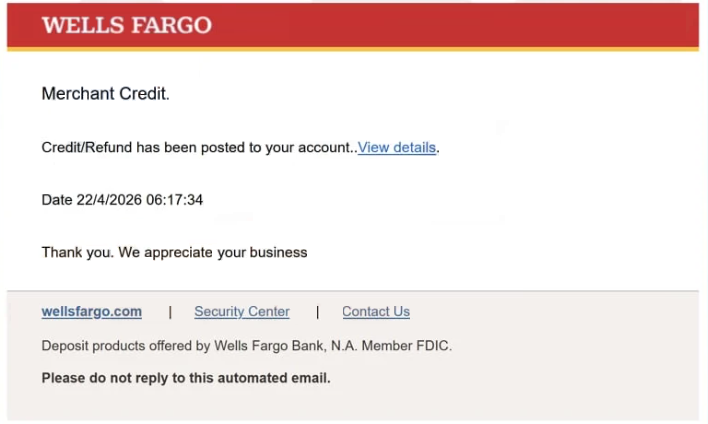
The full “Wells Fargo – Merchant Credit” phishing email is below:
Subject: Woo! Your Credit has posted.
Wells Fargo
Merchant Credit.Credit/Refund has been posted to your account..View details.
Date 22/4/2026 06:17:34
Thank you. We appreciate your business
wellsfargo.com | Security Center | Contact Us
Deposit products offered by Wells Fargo Bank, N.A. Member FDIC.Please do not reply to this automated email.
How to recognize phishing emails
Recognizing phishing emails is essential for avoiding scams like the “Wells Fargo – Merchant Credit” campaign. These emails often share consistent characteristics that can help distinguish them from legitimate communication.
One of the most common warning signs is urgency. Phishing emails frequently claim that immediate action is required, such as reviewing a transaction or confirming account activity. This pressure is intentional, as it encourages quick decisions without proper verification. According to official guidance, suspicious messages often push recipients to act immediately when there is supposedly a problem with their account.
Another key indicator is the sender’s email address. Fraudulent emails may appear to come from Wells Fargo but use domains that do not match the official “wellsfargo.com” format. Even small differences in spelling or structure can indicate that the message is not genuine. Attackers often rely on these subtle changes, knowing that many recipients will not examine the address closely.
Links included in phishing emails are also a major red flag. While the visible text may suggest a legitimate destination, the actual link often leads to an unrelated or suspicious website. Hovering over the link before clicking can reveal discrepancies. In many cases, these links redirect users to fake login pages designed to collect credentials. Because of this, it is safer to avoid clicking any links in unexpected emails and instead access accounts directly through official websites.
The overall tone and structure of the email can provide additional clues. Phishing emails may use generic greetings, such as addressing the recipient as “customer” rather than by name. They can also contain unusual phrasing, formatting inconsistencies, or language that feels slightly unnatural. Even when the message appears polished, small irregularities often remain.
Another important factor is the type of request being made. Legitimate banks do not ask users to provide sensitive information, such as passwords or one-time codes, through email links. Any message requesting such details should be treated with caution. In addition, unexpected attachments should not be opened, as they may contain malicious files capable of infecting a system.
A reliable way to verify whether a notification is legitimate is to check the account directly. Instead of following instructions in the email, users can open a browser and manually enter the official Wells Fargo website address. If the alert is real, it will be visible within the account interface. If not, the email can be safely ignored or reported.
Developing awareness of these patterns is key to avoiding phishing attempts. Scams like the “Wells Fargo – Merchant Credit” email depend on quick reactions and misplaced trust. Taking a moment to review the details, question unexpected requests, and verify information independently can prevent unauthorized access, financial loss, and potential identity theft.
Site Disclaimer
2-remove-virus.com is not sponsored, owned, affiliated, or linked to malware developers or distributors that are referenced in this article. The article does not promote or endorse any type of malware. We aim at providing useful information that will help computer users to detect and eliminate the unwanted malicious programs from their computers. This can be done manually by following the instructions presented in the article or automatically by implementing the suggested anti-malware tools.
The article is only meant to be used for educational purposes. If you follow the instructions given in the article, you agree to be contracted by the disclaimer. We do not guarantee that the artcile will present you with a solution that removes the malign threats completely. Malware changes constantly, which is why, in some cases, it may be difficult to clean the computer fully by using only the manual removal instructions.