The “You’ll soon lose access to Spotify Premium” phishing email is part of a scam that impersonates Spotify to trick recipients into updating their payment information through a deceptive website. The phishing email claims that there is a problem with the recipient’s payment details and warns that their Premium subscription may be interrupted unless they take action.
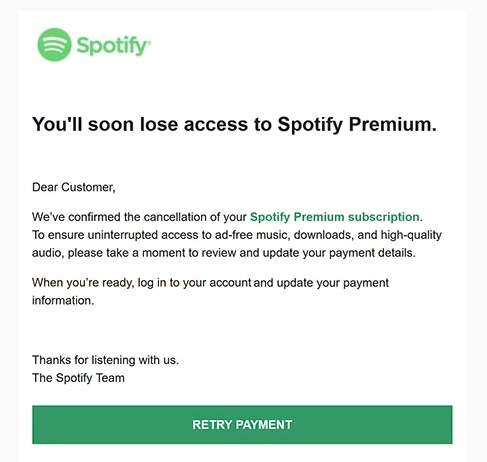
The scam uses the possibility of losing access to a paid subscription to encourage recipients to respond quickly. By presenting the situation as a routine billing issue, the phishing email attempts to make the requested payment update appear necessary. The recipient is led to believe that following the instructions will help maintain their existing Spotify Premium membership.
The phishing email refers to the recipient as “Customer” rather than addressing them by name. This impersonal greeting is one of the warning signs of the scam, particularly because the email supposedly concerns an individual subscription and its billing status. However, a generic greeting alone does not prove that an email is phishing.
The phishing attempt relies on Spotify’s recognizable name and the expectation that subscription services occasionally require payment updates. The objective is to direct recipients away from the legitimate service and persuade them to disclose sensitive information under the pretext of resolving a billing problem.
The phishing email uses the subject line “Update Billing Details” and states that the recipient’s Premium subscription has already been cancelled because of a payment problem. It includes a “RETRY PAYMENT” button that leads to a counterfeit Spotify login page hosted at 4f70b74c7c.nxcli.io. The page imitates Spotify’s sign-in interface and offers several authentication options, including Google, Facebook, Apple, phone number, and a conventional email-and-password form.
Despite its appearance, the website is not an authorized Spotify login page. Its purpose is to capture credentials entered by visitors, which could allow scammers to take control of their Spotify accounts, change passwords, and prevent legitimate owners from signing in. Reused passwords could also put unrelated accounts at risk. The identified phishing attempt focuses on credential theft, rather than a confirmed malware installation process.
The full “You’ll soon lose access to Spotify Premium” phishing email is below:
Subject: Update Billing Details
You’ll soon lose access to Spotify Premium.
Dear Customer,
We’ve confirmed the cancellation of your Spotify Premium subscription.
To ensure uninterrupted access to ad-free music, downloads, and high-quality audio, please take a moment to review and update your payment details.When you’re ready, log in to your account and update your payment information.
Thanks for listening with us.
The Spotify Team
[RETRY PAYMENT]
© 2026 Spotify ABSpotify (Pty) Ltd, 2st Floor, Block B, The Boulevard Office Park, Searle Street, Woodstock, Cape Town, 392
How to recognize phishing emails
The “You’ll soon lose access to Spotify Premium” phishing email contains several details that can help distinguish it from a genuine subscription notification. One is its generic greeting, “Dear Customer,” instead of the recipient’s name. While legitimate automated emails can sometimes use impersonal greetings, this is a potential sign of phishing, especially when the email claims to concern a specific customer’s billing status.
Another warning sign is the combination of a cancelled subscription claim and an immediate request to update payment information. The phishing email refers to familiar Premium benefits, including ad-free listening, downloads, and high-quality audio, to make the threatened loss of service more persuasive. These details do not establish that Spotify actually attempted to collect a payment or cancelled the recipient’s subscription.
The sender’s address provides another way to identify the deception. Although the phishing email uses Spotify’s name and includes company information, its sending address is unrelated to Spotify’s official domains. Recipients should examine the complete sender address rather than relying on the displayed name or the branding within the email.
The “RETRY PAYMENT” button is particularly revealing because it directs users to a website outside Spotify’s legitimate domain. The counterfeit page closely resembles a genuine sign-in screen, including familiar authentication options, but its appearance does not establish authenticity. A login form reached through an unexpected billing email should be assessed by its actual website address, not its visual design.
The phishing email also includes a Spotify copyright notice and a physical company address, giving it the appearance of a routine corporate communication. Such details can be copied into phishing emails and should not be considered reliable evidence of the sender’s identity.
Site Disclaimer
2-remove-virus.com is not sponsored, owned, affiliated, or linked to malware developers or distributors that are referenced in this article. The article does not promote or endorse any type of malware. We aim at providing useful information that will help computer users to detect and eliminate the unwanted malicious programs from their computers. This can be done manually by following the instructions presented in the article or automatically by implementing the suggested anti-malware tools.
The article is only meant to be used for educational purposes. If you follow the instructions given in the article, you agree to be contracted by the disclaimer. We do not guarantee that the artcile will present you with a solution that removes the malign threats completely. Malware changes constantly, which is why, in some cases, it may be difficult to clean the computer fully by using only the manual removal instructions.