The “Your Prime benefits are on hold due to a billing issue” phishing email impersonates Amazon and falsely claims that a payment for the recipient’s Prime membership has failed. Scammers use the supposed billing problem to direct recipients to a fake Amazon website and steal sensitive account information.
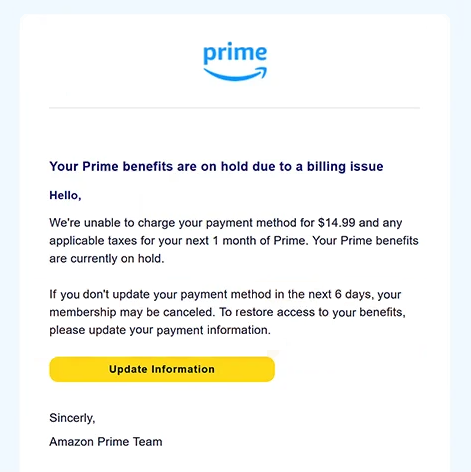
According to the email, Amazon attempted to charge $14.99, plus applicable taxes, for another month of Prime membership but could not process the payment. It claims that the recipient’s Prime benefits have consequently been placed on hold.
The email gives the recipient six days to update their payment method. It warns that failing to do so could result in the Prime membership being canceled. The combination of suspended benefits and a deadline is intended to pressure recipients into dealing with the supposed payment failure quickly.
Recipients are told to select “Update Information” to correct their billing details. This does not take them through a legitimate Amazon payment update. Instead, it directs them to a phishing website made to resemble an Amazon account page.
The website associated with this phishing email was no longer active when examined. Therefore, the exact forms and information it requested could not be fully determined. Its purpose was to obtain Amazon login credentials, and the fake billing scenario could also be used to request payment information.
Amazon has no connection to this email. The scammers use the company’s name, Prime membership, monthly subscription price, and familiar billing scenario to make their claims more convincing.
If valid Amazon credentials are stolen, scammers may attempt to access the victim’s real account. This could expose personal details stored there and potentially allow unauthorized changes or purchases. A reused password could also put unrelated accounts at risk.
If payment card details are requested and submitted, the consequences can extend to financial fraud and unauthorized transactions.
The full “Your Prime benefits are on hold due to a billing issue” phishing email is below:
Subject: Your Prime benefits are on hold due to a billing issue on –
Information regarding your payment from Amazon Prime
Your Prime benefits are on hold due to a billing issue
Hello,
We’re unable to charge your payment method for $14.99 and any applicable taxes for your next 1 month of Prime. Your Prime benefits are currently on hold.If you don’t update your payment method in the next 6 days, your membership may be canceled. To restore access to your benefits, please update your payment information.
[Update Information]Sincerly,
Amazon Prime Team
© Amazon.com, Inc. or its affiliates. All rights reserved. Amazon, Amazon.com, Prime, the Amazon.com logo and 1-Click are registered trademarks of Amazon.com, Inc. or its affiliates.
Amazon.com, 410 Terry Avenue N., Seattle, WA 98109-5210.
How to recognize the “Your Prime benefits are on hold due to a billing issue” phishing email
The “Your Prime benefits are on hold due to a billing issue” phishing email uses a realistic subscription problem to encourage an immediate response. Failed recurring payments do happen, making the claim potentially convincing to someone who already pays for Amazon Prime.
The email becomes more urgent by claiming that Prime benefits are already unavailable. It then gives recipients only six days before the membership may be canceled. These warnings are intended to make updating the supposed payment information seem more important than verifying the email first.
There are also problems with the writing. For example, the closing contains the misspelling “Sincerly.” Errors like this are unusual for an official Amazon billing email and provide another reason to question its legitimacy.
Recipients should not assume an email is genuine simply because it contains Amazon branding, subscription details, copyright information, or a company address. Scammers can copy publicly available information and reproduce the appearance of legitimate company emails.
The simplest way to check the claim is to access Amazon independently. A Prime member can sign in normally and review the status of the subscription and payment method from within the real account. If the $14.99 payment genuinely failed or Prime benefits were suspended, the issue should be visible there.
The appearance of the website reached through the email should not be trusted either. A phishing page can copy Amazon logos and account layouts while having no connection to the company.
Receiving or opening the “Your Prime benefits are on hold due to a billing issue” phishing email does not by itself compromise an Amazon account. Problems arise when recipients provide credentials or other sensitive information through the fake website.
Anyone who has already entered an Amazon password should change it through the legitimate service and review the account for unfamiliar activity or changes. The password should also be replaced anywhere else it was reused. Enabling two-step verification can provide additional protection.
If card information was provided, the bank or card issuer should be contacted promptly. Recent transactions should be reviewed, and the financial institution can advise whether the affected card should be blocked or replaced.
Site Disclaimer
2-remove-virus.com is not sponsored, owned, affiliated, or linked to malware developers or distributors that are referenced in this article. The article does not promote or endorse any type of malware. We aim at providing useful information that will help computer users to detect and eliminate the unwanted malicious programs from their computers. This can be done manually by following the instructions presented in the article or automatically by implementing the suggested anti-malware tools.
The article is only meant to be used for educational purposes. If you follow the instructions given in the article, you agree to be contracted by the disclaimer. We do not guarantee that the artcile will present you with a solution that removes the malign threats completely. Malware changes constantly, which is why, in some cases, it may be difficult to clean the computer fully by using only the manual removal instructions.