Sweden’s Government Offices have introduced new restrictions on artificial intelligence tools, blocking employees from directly accessing ChatGPT and Claude through their work computers. The measure, effective October 26, 2026, is intended to reduce the risk of confidential government information being shared through services that have not received official approval.
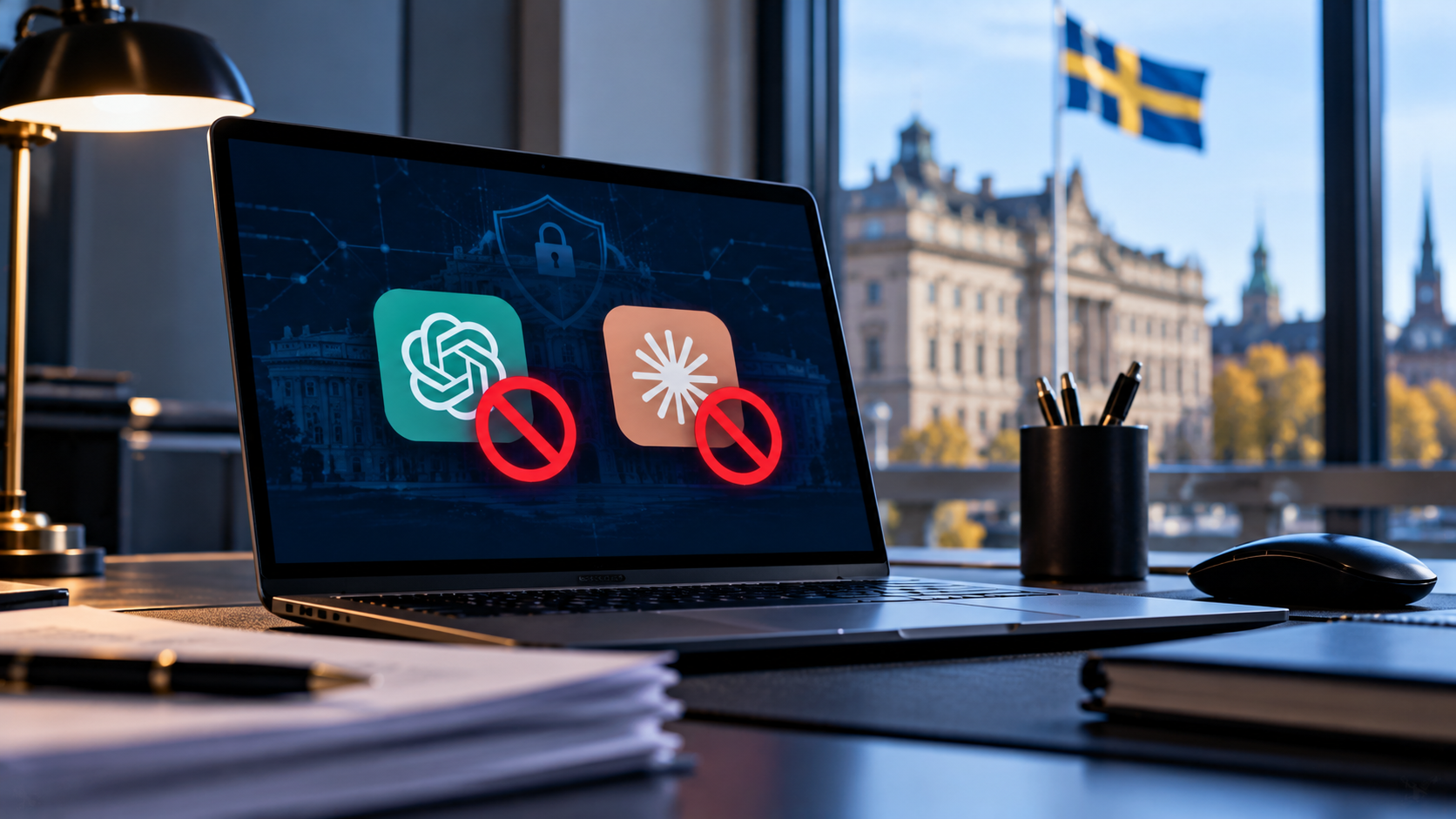
The decision affects the administrative organization supporting Sweden’s government and ministries, rather than imposing a nationwide ban on the two AI platforms. Civil servants are instead being directed toward Microsoft Copilot, which has undergone an internal security review and remains authorized for workplace use.
Mikael Wettercrantz, the Government Offices’ director of digitalization, warned employees that using AI services without appropriate agreements could create information security problems. Officials have also strengthened security settings for Copilot, although the government has declined to disclose the technical changes.
Concerns about AI use within Swedish public institutions had already emerged earlier this year. An internal audit at the Swedish Transport Administration found widespread use of approximately ten different AI services, including instances where employees entered potentially sensitive information and handled AI-generated responses in questionable ways.
Such practices can create risks when staff submit internal documents, personal information, or other confidential material to external AI platforms without understanding how the information is processed. The Swedish restrictions focus on controlling which services employees can use and ensuring that approved systems meet organizational security requirements.
However, ChatGPT and Claude have not been eliminated entirely from government workflows. Some employees will retain access to the underlying AI models through a specially developed assistant platform operated under government-approved arrangements, allowing their capabilities to be used within a more controlled environment.
Other Swedish authorities have introduced similar measures. The Swedish Tax Agency and the National Board of Institutional Care have restricted access to the two services, while the Swedish Enforcement Authority is considering whether to adopt comparable controls.
Sweden’s Government Offices had previously limited access to DeepSeek, another AI service that has attracted scrutiny over data protection concerns. The latest decision extends that approach to widely used American AI products, emphasizing the importance of institutional approval rather than the country where a technology was developed.