

Over the past few years, many Netflix users have opened their inboxes to find alarming messages claiming their account has been suspended or that their payment information needs to be updated. These emails look official. They use Netflix’s familiar branding, red logo, and even professional formatting. But beneath the polished design lies a scam designed to steal personal information and financial details.
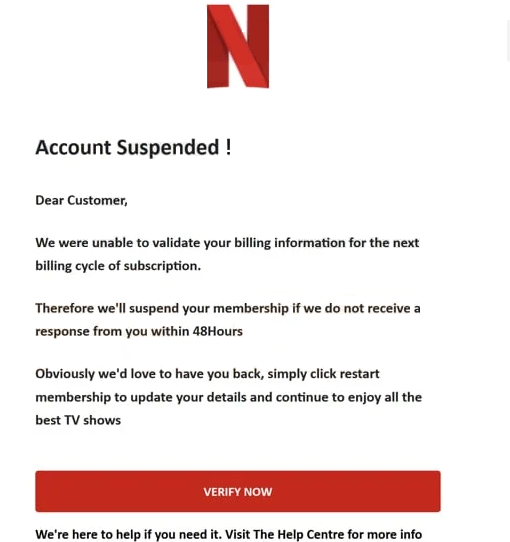
This type of email is part of a phishing campaign. Scammers send fraudulent messages that mimic legitimate companies to convince people to reveal their login credentials or credit card numbers. In this case, Netflix’s global popularity makes it an ideal target. Millions of people have accounts, so the odds of someone believing the scam are high.
How the scam works
The fraudulent email usually carries an urgent subject line. It might say that your account has been locked due to payment failure or that your subscription will be canceled unless you verify your details immediately. Inside, there’s a message written to create panic. It warns you that your access to Netflix will end soon unless you take quick action.
To “fix” the problem, the email includes a button or link that says something like “Restart Membership” or “Update Payment Details.” When you click it, you’re taken to a fake website that looks almost identical to the real Netflix homepage. The design, colors, and layout all match perfectly. The only subtle difference is the web address, which may have an extra letter or a domain that’s slightly off.
Once you reach that page, you’re prompted to sign in with your Netflix email and password. After entering your details, the site might ask you to verify your payment method by submitting your card number and security code. This information doesn’t go to Netflix. It goes straight to the scammers. From there, your credentials can be sold, reused, or used for direct financial theft.
Why are you targeted by Netflix phishing emails
Most people who receive these emails have not done anything wrong. Scammers rely on large-scale campaigns. They use databases of leaked or publicly available email addresses, sending millions of messages at once. The more messages they send, the greater the chance of tricking someone.
Some email addresses are chosen because they appeared in previous data breaches. Others may have been harvested from websites, forums, or social media platforms. Once your address is on one of these lists, you may receive similar scams again in the future.
The reason these scams work is simple: emotion. The scammers aim to make you panic. They know that if they can trigger fear—especially the fear of losing a favorite entertainment service—you’re more likely to click before thinking carefully. That sense of urgency is their most powerful weapon.
What to do if you receive a suspicious Netflix email
The first and most important step is to stay calm. If you get an email that looks suspicious, do not click on any links or attachments. Open your web browser manually, go to the official Netflix website, and sign in from there. If your account is working normally, the email you received was fake.
If you have already clicked the link but did not enter any information, you are likely safe. Simply close the tab, delete the message, and clear your browsing history. If you entered your password or payment details, act quickly. Change your Netflix password immediately. If you used the same password for other accounts, change those too.
If you provided financial information, contact your bank or credit card company right away. They can freeze your card, issue a new one, and monitor for fraudulent activity. It’s also a good idea to run a full device scan using trusted antivirus or antimalware software to make sure no malicious files were downloaded.
You should report the fake email to Netflix’s security team and mark it as spam within your email provider. This helps improve spam filters and reduces the chances of similar messages landing in your inbox again.
How to protect yourself from future scams
You can significantly reduce your risk of falling victim to phishing by building a few protective habits. Always check the sender’s address before taking an email seriously. Even if it looks like it came from Netflix, look closely for small spelling errors or unfamiliar domains.
Never provide personal or payment information directly from an email. Instead, type the company’s official web address into your browser or use the app. This simple habit prevents scammers from tricking you with fake websites.
Keep your devices updated. Regular updates patch security flaws that scammers and hackers exploit. Make sure your web browser, operating system, and security software are always current.
Consider using a password manager. It helps you create strong, unique passwords for every account. Password managers also recognize legitimate websites, which can prevent you from entering your details on a fraudulent page.
You should also enable two-factor authentication whenever possible. This adds another layer of protection. Even if someone steals your password, they won’t be able to access your account without the second verification code.
Finally, be skeptical of urgent or emotional language in emails. Scammers thrive on panic. They use words like “immediately,” “urgent,” or “final notice” to push you into acting without thinking. When in doubt, slow down and verify the message independently.
Why this scam is so dangerous
Phishing emails like these can have lasting consequences. Once scammers have your login information, they can access not only your Netflix account but potentially your email and other linked services. If you reuse passwords, the problem multiplies.
The financial impact can also be severe. Fraudsters may use your payment information for unauthorized purchases, or they might sell your data to other criminals. In some cases, victims of phishing experience identity theft that takes months to resolve.
Even if you don’t fall for the scam, these emails can still be harmful. They clutter inboxes, waste time, and erode trust in legitimate communications. The more realistic they appear, the harder it becomes for users to know what’s safe to click.
The bigger picture
The Netflix email scam is just one example of a growing trend. Scammers are constantly improving their tactics, using sophisticated designs and convincing language to impersonate major brands. Today it might be Netflix, tomorrow it could be your bank, a delivery service, or a government agency.
Understanding how phishing works is the best way to protect yourself. The techniques behind these scams rarely change — urgency, fear, and familiarity are always at their core. Once you recognize those patterns, you can spot them across any service or company.
If you ever receive a message claiming that your Netflix account has been suspended or that you must update your billing details immediately, take a moment before responding. Check the email address, verify through the official website, and never share sensitive information through a link you did not initiate.
These scams succeed only when they catch people off guard. By staying calm, thinking critically, and following a few safety habits, you can keep your personal and financial information secure. The next time a “Netflix account alert” lands in your inbox, you’ll know exactly what to do — nothing at all. Delete it, move on, and keep streaming safely.
Incoming search terms:
Site Disclaimer
2-remove-virus.com is not sponsored, owned, affiliated, or linked to malware developers or distributors that are referenced in this article. The article does not promote or endorse any type of malware. We aim at providing useful information that will help computer users to detect and eliminate the unwanted malicious programs from their computers. This can be done manually by following the instructions presented in the article or automatically by implementing the suggested anti-malware tools.
The article is only meant to be used for educational purposes. If you follow the instructions given in the article, you agree to be contracted by the disclaimer. We do not guarantee that the artcile will present you with a solution that removes the malign threats completely. Malware changes constantly, which is why, in some cases, it may be difficult to clean the computer fully by using only the manual removal instructions.