

The “Account Accessed From An Unfamiliar IP Address” email pretends to notify you that your account was accessed from a location you do not recognise. It claims the login came from a foreign IP address and urges you to follow a link or click a button to secure your wallet or email account. The message is designed to look urgent, making you feel like you must act immediately. But the email has nothing to do with any legitimate service, and its true aim is to steal your login credentials.
When you click the link, you are taken to a site that looks like a sign-in page or security check. You will be asked to enter your email address, password, or even cryptocurrency wallet details. Once you submit the info, it goes straight to the scammers. Many of these scams also collect additional data, such as your IP address, browser details, and device info, to make future attacks more likely or convincing.
Giving away your email or crypto wallet credentials can have serious consequences. Once scammers gain access, they may search the inbox for sensitive messages, reset passwords on other connected accounts, or attempt to drain any linked wallets. Because many people reuse passwords, one compromised account often opens the door to many others. In some cases, users have reported irreversible financial losses and long-term identity theft as a result of trust in messages like this one.
Attackers also use hijacked accounts to send further phishing emails or malicious links to your contacts. The compromised account can become a tool for them to exploit even more people. Over time, the damage done by such access can spread far wider than the original email alone.
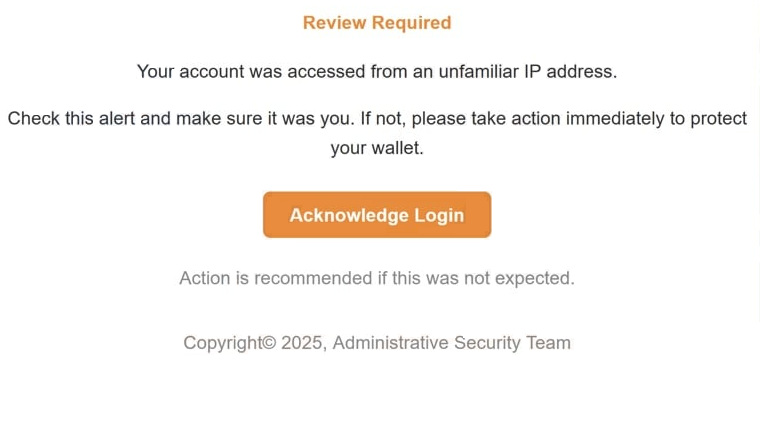
The full “Account Accessed From An Unfamiliar IP Address” is below:
Subject: Review Your Account- Unfamiliar Login Activity
Review Required
Your account was accessed from an unfamiliar IP address.
Check this alert and make sure it was you. If not, please take action immediately to protect your wallet.
Acknowledge Login
Action is recommended if this was not expected.
Copyright© 2025, Administrative Security Team
How to recognise and avoid these scam emails
There are several clear warning signs that an email like this is a scam. The email may open with a vague greeting, like “Dear user” or simply your email address, rather than your actual name. The sender’s address may look odd or mimic a real company, but it comes from a mismatched domain. Often, the email will claim something alarming, like unauthorised access, but make you click a link to “verify” or “secure” your account immediately.
Hovering over any link (without clicking) will often show a different address than what appears in the text. Legitimate companies do not ask you to enter your full login credentials from an email link to confirm a login. If you were not expecting a security alert or cannot remember the account connected to the notification, treat the email with suspicion. Instead of clicking, go directly to the website of the service in question and log in from there to check your account status.
Lastly, be cautious of emails that pressure you to act quickly with phrases like “within 24 hours” or “if you do not act now, your account will be locked.” Scammers use urgency to stop you from thinking twice. Taking a moment to check the sender, the link destination, and the overall tone of the email can help you avoid falling into these traps.
Remove “Account Accessed From An Unfamiliar IP Address” email
If you get this email, you can just remove “Account Accessed From An Unfamiliar IP Address” email from your inbox. If you have fallen for the phishing scam, you need to change the password for the affected account immediately.
Site Disclaimer
2-remove-virus.com is not sponsored, owned, affiliated, or linked to malware developers or distributors that are referenced in this article. The article does not promote or endorse any type of malware. We aim at providing useful information that will help computer users to detect and eliminate the unwanted malicious programs from their computers. This can be done manually by following the instructions presented in the article or automatically by implementing the suggested anti-malware tools.
The article is only meant to be used for educational purposes. If you follow the instructions given in the article, you agree to be contracted by the disclaimer. We do not guarantee that the artcile will present you with a solution that removes the malign threats completely. Malware changes constantly, which is why, in some cases, it may be difficult to clean the computer fully by using only the manual removal instructions.