

The “American Express Account on Hold” phishing scam is an email-based attack that impersonates American Express and falsely claims that the recipient’s bank account has been restricted or suspended. The purpose of the email is to frighten recipients into revealing sensitive information, primarily login credentials and payment-related data. The message is crafted to appear as an official account notice, even though it has no connection to American Express or any of its services.
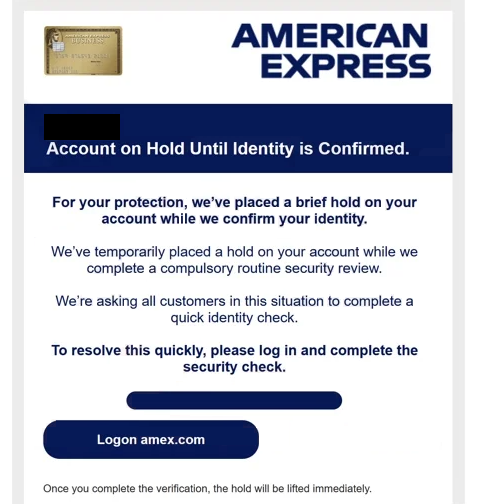
The email informs the recipient that their American Express account has been placed on hold due to a supposed issue. The stated reason may involve suspicious activity, billing problems, or verification requirements, but the message does not provide verifiable details. Instead, it instructs the recipient to resolve the issue immediately by clicking a link or button embedded in the email. The wording implies that failure to act will result in continued account restriction or loss of access.
When the recipient clicks the provided link, they are redirected to a phishing website that imitates an American Express login or verification page. The page uses branding elements such as logos, colour schemes, and layout choices designed to resemble the genuine American Express website. The goal is to create a sense of familiarity and legitimacy so that the recipient does not question the request.
The phishing page asks the recipient to enter sensitive information. This may include an American Express user ID, account password, credit card number, expiration date, security code, or personal identification details. Once this information is submitted, it is collected by the scammers. The page may then display a confirmation message, redirect to another page, or show an error, none of which reflect any real account status.
The stolen information allows attackers to attempt unauthorised transactions, commit identity fraud, or sell the data to other criminals. Because credit card accounts are directly linked to financial assets, this scam poses an immediate risk of monetary loss. The attackers may also use the collected information to craft further targeted attacks, including follow-up phishing emails that appear even more convincing.
The “American Express Account on Hold” scam does not involve real account monitoring, real security checks, or legitimate communication channels. The attackers do not have visibility into the recipient’s account status. Every claim made in the email is fabricated to provoke a reaction. The scam relies on the strong brand recognition of American Express and the fear associated with financial account restrictions.
This phishing attack targets both existing American Express customers and recipients who do not hold an American Express account. The attackers rely on volume rather than accuracy, knowing that a portion of recipients will either have an account or assume the email relates to one. The message does not verify account ownership before requesting information.
The effectiveness of the scam lies in its timing and tone. The email presents the issue as urgent but solvable, encouraging immediate action while discouraging verification through official channels. By directing recipients to a fake site instead of advising them to log in through the official website or app, the attackers control the entire interaction.
Subject: Action Required: Verify Your Identity.
American Express
-,
Account on Hold Until Identity is Confirmed.For your protection, we’ve placed a brief hold on your account while we confirm your identity.
We’ve temporarily placed a hold on your account while we complete a compulsory routine security review.
We’re asking all customers in this situation to complete a quick identity check.
To resolve this quickly, please log in and complete the security check.
Logon amex.com
Once you complete the verification, the hold will be lifted immediately.
Your account security is our top priority. We apologize for any inconvenience this may have caused.
Thank you for your Card Membership.
Sincerely,
The American Express Protection Team.
How to recognise phishing emails like “American Express Account on Hold”
Identifying phishing emails such as the “American Express Account on Hold” scam requires close attention to how the message communicates and what it asks the recipient to do. One of the most important warning signs is the claim that an account has been placed on hold without prior context. Legitimate financial institutions do not impose restrictions without providing detailed explanations through secure channels.
Another clear indicator is the request for sensitive information via an email link. American Express does not ask customers to confirm account credentials, card details, or personal information through unsolicited emails. Any message that directs recipients to enter such information after clicking a link should be treated as untrustworthy.
The sender address is another critical detail. While the display name may reference American Express, the actual email address often belongs to an unrelated or misspelled domain. Reviewing the full sender information rather than relying on the visible name can reveal inconsistencies that indicate phishing.
Phishing emails also avoid specific account references. The “American Express Account on Hold” message does not include the recipient’s name, partial card number, or recent transaction details. Instead, it relies on vague language that could apply to anyone. Authentic account notifications usually reference identifiable information that confirms the message is intended for a specific customer.
The link destination provides further evidence. Hovering over the link may show a web address that does not match the official American Express domain. Phishing sites often use long URLs, unrelated domain names, or subtle spelling variations to appear credible at first glance.
Formatting and language issues can also expose phishing attempts. The email may include awkward phrasing, inconsistent branding, or unusual spacing that differs from official American Express communications. Even when the design appears polished, small discrepancies can indicate that the message is not legitimate.
Another sign is the absence of alternative verification options. Genuine financial institutions encourage customers to check account status by logging in through official websites or mobile apps. A message that insists on using a specific email link and discourages independent verification is not acting in the customer’s interest.
Recipients should also question unexpected timing. If there has been no recent login attempt, payment issue, or contact with American Express, an unexpected account hold notice should raise suspicion. Phishing emails often arrive without any preceding event that would justify such action.
To avoid falling victim to scams like “American Express Account on Hold,” recipients should refrain from clicking links in unsolicited emails. Accessing accounts through official apps or manually typing website addresses is safer. Suspicious emails should be deleted or reported rather than acted upon.
Recognising these signs reduces the likelihood of financial loss and identity theft. The scam succeeds when urgency overrides caution. Slowing down and verifying information through trusted channels is the most effective defence against phishing attacks of this kind.
Site Disclaimer
2-remove-virus.com is not sponsored, owned, affiliated, or linked to malware developers or distributors that are referenced in this article. The article does not promote or endorse any type of malware. We aim at providing useful information that will help computer users to detect and eliminate the unwanted malicious programs from their computers. This can be done manually by following the instructions presented in the article or automatically by implementing the suggested anti-malware tools.
The article is only meant to be used for educational purposes. If you follow the instructions given in the article, you agree to be contracted by the disclaimer. We do not guarantee that the artcile will present you with a solution that removes the malign threats completely. Malware changes constantly, which is why, in some cases, it may be difficult to clean the computer fully by using only the manual removal instructions.