The “Benefits Review Notice” email scam is a phishing campaign that attempts to steal personal information and account credentials by impersonating an official benefits-related notification. The email claims that the recipient’s benefits information requires review, verification, or updating and urges immediate action to prevent interruptions to benefits eligibility or account access.
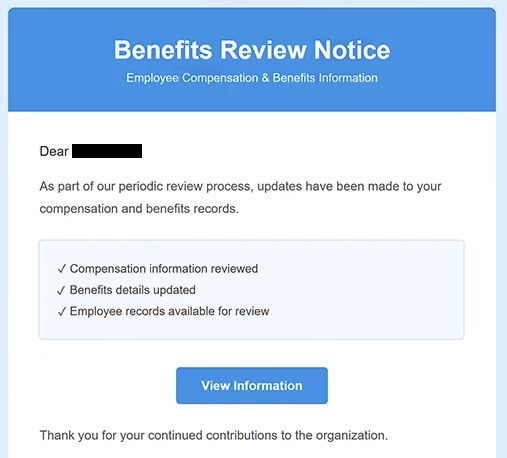
The phishing message is designed to appear as a legitimate communication from a government agency, benefits administrator, insurance provider, or employee benefits department. Recipients are informed that a recent review has identified missing information, outdated records, or verification requirements that must be addressed promptly.
To supposedly complete the review process, the “Benefits Review Notice” email instructs recipients to click a link or button included in the message. Rather than directing users to a legitimate benefits management portal, the link opens a phishing website designed to imitate an official login page or verification form. The fraudulent website may request usernames, passwords, Social Security numbers, personal identification details, financial information, or other sensitive data.
Once submitted, the information is transmitted directly to the cybercriminals operating the scam. Attackers can use the stolen data for identity theft, financial fraud, account takeovers, or additional phishing campaigns targeting the victim or their contacts.
The “Benefits Review Notice” scam exploits concerns about losing access to benefits and government-related services. Many people depend on healthcare coverage, retirement benefits, unemployment assistance, or workplace benefit programs, making warnings about account reviews particularly effective. The possibility of interrupted benefits can pressure recipients into acting quickly without carefully verifying the legitimacy of the message.
Another factor contributing to the effectiveness of the scam is its use of official-sounding language. The email may reference eligibility reviews, compliance requirements, benefits verification procedures, policy updates, or account maintenance activities. These references are intended to create the impression that the notification originated from a legitimate organization.
Unlike phishing emails that focus on technical problems or security threats, the “Benefits Review Notice” scam relies on administrative concerns. Rather than claiming that an account has been compromised, the message suggests that action is required to maintain benefits eligibility or prevent service disruptions. This approach can make the email appear less suspicious and more routine.
Anyone who entered information into a website linked to the “Benefits Review Notice” scam should immediately review affected accounts and take steps to secure them. If login credentials, financial information, or personal identification data were submitted, the appropriate institutions should be notified as soon as possible.
The full “Benefits Review Notice” phishing email is below:
Subject: Compensation and Benefits Review Completed – Updated Employee Information Available for Your Review
Benefits Review Notice
Employee Compensation & Benefits InformationDear –
As part of our periodic review process, updates have been made to your compensation and benefits records.
✓ Compensation information reviewed
✓ Benefits details updated
✓ Employee records available for review
[View Information]Thank you for your continued contributions to the organization.
Human Resources
© 2026 – Employee Communication
How to recognize phishing emails
Phishing campaigns such as the “Benefits Review Notice” scam frequently impersonate government agencies, benefits providers, and administrative departments to gain the trust of recipients. Recognizing common warning signs can help prevent identity theft and account compromise.
One major indicator is an unsolicited request to verify or update personal information. Legitimate organizations may occasionally request information updates, but unexpected emails demanding immediate action through embedded links should always be approached cautiously.
The sender’s address should be examined carefully. Fraudulent emails often imitate government agencies, insurance providers, or employee benefits departments while using unrelated domains or suspicious email addresses. Even when the sender name appears legitimate, the actual address may reveal that the message did not originate from the claimed organization.
Links contained within phishing emails are another important warning sign. In the “Benefits Review Notice” scam, the provided link typically leads to a counterfeit verification portal rather than an official website. Hovering over links before clicking can help identify suspicious destinations.
Another common tactic is the use of urgency. The email may claim that benefits could be delayed, suspended, restricted, or terminated unless immediate action is taken. Attackers use these warnings to pressure recipients into responding before verifying the authenticity of the notification.
Users should also be cautious whenever an email requests sensitive personal information. Legitimate organizations generally provide secure account portals and rarely ask users to submit passwords, Social Security numbers, or financial details through links contained in unsolicited messages.
Generic wording can provide another clue. Many phishing campaigns are distributed in bulk and therefore avoid highly personalized account information. Broad references to benefits reviews, eligibility verification, or account updates are often signs of a phishing attempt.
The safest response to suspicious benefits-related notifications is to avoid interacting with the email directly. Instead of clicking embedded links, users should manually visit the official website of the relevant organization and review their account information there. If no corresponding alert exists, the message is likely fraudulent.
Site Disclaimer
2-remove-virus.com is not sponsored, owned, affiliated, or linked to malware developers or distributors that are referenced in this article. The article does not promote or endorse any type of malware. We aim at providing useful information that will help computer users to detect and eliminate the unwanted malicious programs from their computers. This can be done manually by following the instructions presented in the article or automatically by implementing the suggested anti-malware tools.
The article is only meant to be used for educational purposes. If you follow the instructions given in the article, you agree to be contracted by the disclaimer. We do not guarantee that the artcile will present you with a solution that removes the malign threats completely. Malware changes constantly, which is why, in some cases, it may be difficult to clean the computer fully by using only the manual removal instructions.