

The “Child Pornography Found” pop-up scam is a fraudulent browser alert that accuses the visitor of having child pornography on their computer. This accusation is not based on any real scan, evidence, or detection. It is a scare tactic often used by scammers because it creates immediate panic and prompts people to react without thinking. The message is designed to shame and intimidate the visitor into following instructions as quickly as possible.
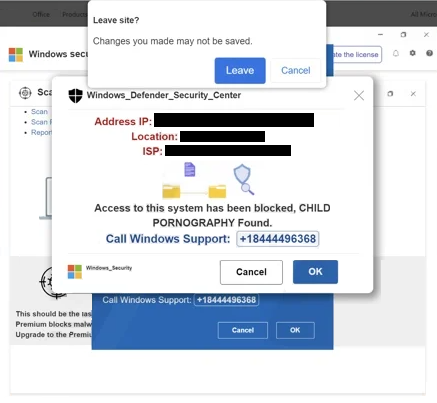
This pop-up appears inside a web browser and is not a legitimate warning from Microsoft or any other authority. It may use Microsoft branding, security language, and official-looking formatting to appear credible. The alert commonly claims that illegal content has been found, that the computer has been blocked, or that the user is facing serious legal consequences. It may also display a phone number or direct the visitor to contact “support” to resolve the situation.
The goal of the scam is to force contact with scammers. Once communication is established, scammers attempt to extract money, personal information, or remote access to the computer. The accusation is used to keep the victim compliant. The scam may claim that immediate payment is required to avoid arrest, that the device must be unlocked by “support,” or that sensitive data will be reported unless action is taken.
It is important to understand why this claim is false. If a computer actually contained child pornography, it would be handled through a criminal investigation. Real investigations are carried out by law enforcement agencies, not by random pop-ups claiming to be from Microsoft. A browser page cannot determine criminal activity, and Microsoft does not issue legal accusations through unsolicited pop-ups. A web page also cannot “detect” illegal files in the way the scam suggests, because a normal website does not have access to personal files stored on the device.
The “Child Pornography Found” pop-up scam is designed to look urgent and unavoidable, sometimes using full-screen behavior or repeated alerts to make closing the browser difficult. This is part of the manipulation. The pop-up is not proof of a crime, not proof of a device infection, and not proof that Microsoft has detected anything. It is a fabricated message created to frighten visitors into handing control to scammers.
Why users may be redirected to this scam page
Redirects to the “Child Pornography Found” pop-up scam usually happen through unsafe advertising and redirect chains. Many of these pages are delivered through ad networks that prioritize traffic volume and allow misleading content. Visitors can be sent to scam pages after clicking aggressive ads, fake download buttons, or misleading play controls on websites that rely heavily on pop-ups and redirects.
Some scam pages open after a single click on a deceptive advertisement. The click may occur on a page element that looks normal, such as a video player control, a download link, or a navigation button. Instead of performing the expected action, the browser is redirected to a page that displays the scam alert. In other cases, the redirect is triggered automatically by scripts running on the site, meaning the visitor can be forwarded without intentionally clicking anything meaningful.
Adware can also increase the chance of being redirected to scam pop-ups. When adware is present, it can inject extra advertising into websites, open sponsored tabs, and force redirects to scam pages during normal browsing. This can make the scam appear repeatedly across different websites, including legitimate ones, because the redirects are being triggered by unwanted software inside the browser environment.
Unwanted browser extensions can cause similar behavior. Extensions that have advertising functionality may change how pages load, insert extra ads, or route traffic through sponsored destinations. If an extension is responsible, redirects can continue even after leaving the original site where the scam first appeared.
Compromised websites are another possible source. A legitimate site can load third-party advertising or embedded content that has been altered, resulting in redirects to scam pages. In these cases, the website itself may not be intentionally hosting the scam, but the content it loads can trigger the redirect.
The “Child Pornography Found” pop-up scam is delivered through these browsing paths because it depends on shock value. The accusation is used to override normal caution and push immediate contact with scammers. The message is not connected to any real security system or law enforcement process. It is a browser-based intimidation tactic that relies on unsafe advertising routes and deceptive redirection.
Incoming search terms:
Site Disclaimer
2-remove-virus.com is not sponsored, owned, affiliated, or linked to malware developers or distributors that are referenced in this article. The article does not promote or endorse any type of malware. We aim at providing useful information that will help computer users to detect and eliminate the unwanted malicious programs from their computers. This can be done manually by following the instructions presented in the article or automatically by implementing the suggested anti-malware tools.
The article is only meant to be used for educational purposes. If you follow the instructions given in the article, you agree to be contracted by the disclaimer. We do not guarantee that the artcile will present you with a solution that removes the malign threats completely. Malware changes constantly, which is why, in some cases, it may be difficult to clean the computer fully by using only the manual removal instructions.