

The “Confirm New Privacy Security Update” scam is a phishing email that presents itself as an account security notice. It claims that the recipient’s email account is at risk of suspension due to inactivity or failure to comply with a new privacy or security update. The message creates urgency by warning that access will be lost if the required action is not completed.
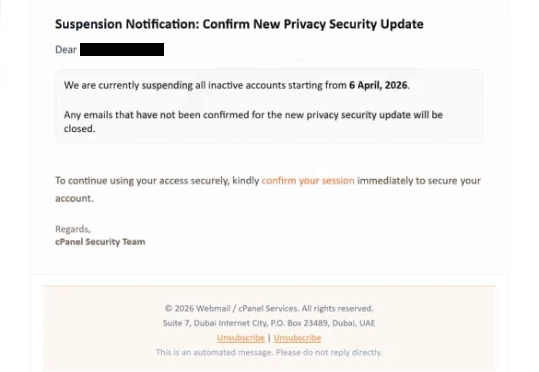
The email does not provide any verifiable details about the supposed issue. Instead, it directs the recipient to confirm their account through a link, often labeled as a session confirmation or update step. This link leads to a fraudulent login page designed to imitate a legitimate email provider such as Gmail or Yahoo.
The page does not offer any real account functionality. It does not display inbox content, account settings, or update details. The only purpose of the page is to collect login credentials. When users enter their email address and password, the information is sent directly to the scammers.
No update or verification is performed. The warning about account suspension is false and is used only to pressure the recipient into interacting with the link. After submitting credentials, the page may show a confirmation or redirect to a real website to make the process appear legitimate.
Once access to an email account is obtained, attackers can misuse it in several ways. They may read stored messages, collect personal data, or use the account to send further phishing emails. Compromised accounts can also be used to reset passwords for other services, increasing the scope of the attack.
Subject: [-]: Please confirm to continue.
Suspension Notification: Confirm New Privacy Security Update
Dear -,
We are currently suspending all inactive accounts starting from 6 April, 2026.
Any emails that have not been confirmed for the new privacy security update will be closed.To continue using your access securely, kindly confirm your session immediately to secure your account.
Regards,
cPanel Security Team© 2026 Webmail / cPanel Services. All rights reserved.
Suite 7, Dubai Internet City, P.O. Box 23489, Dubai, UAE
Unsubscribe | Unsubscribe
This is an automated message. Please do not reply directly.
How to recognize phishing emails like “Confirm New Privacy Security Update”
Emails like “Confirm New Privacy Security Update” follow a clear pattern that helps identify them as phishing attempts. One of the main indicators is the claim of an account issue without supporting details. The email refers to a security update or inactivity problem, but does not include information such as login history, timestamps, or account activity that can be verified.
Another key sign is the use of a direct link for account confirmation. Instead of guiding users to access their account through the official website, the email includes a button or link that leads to a login page hosted on an unrelated domain. This page is made to look legitimate, but is not connected to the actual service.
The sender address is also important to examine. While the display name may appear to represent a support or security team, the actual email address often belongs to a different domain. This mismatch indicates that the email is not genuine.
The message is usually written in a general format. It may not include the recipient’s name or any account-specific information. This allows the same email to be sent to a large number of users without modification.
The wording is designed to prompt quick action. By stating that the account will be suspended, the email creates pressure to respond immediately. This reduces the likelihood that the recipient will take time to verify the source.
Recognizing these patterns helps distinguish phishing emails from legitimate account notifications. Emails that combine vague security claims, external login links, and inconsistent sender details should be treated with caution.
Site Disclaimer
2-remove-virus.com is not sponsored, owned, affiliated, or linked to malware developers or distributors that are referenced in this article. The article does not promote or endorse any type of malware. We aim at providing useful information that will help computer users to detect and eliminate the unwanted malicious programs from their computers. This can be done manually by following the instructions presented in the article or automatically by implementing the suggested anti-malware tools.
The article is only meant to be used for educational purposes. If you follow the instructions given in the article, you agree to be contracted by the disclaimer. We do not guarantee that the artcile will present you with a solution that removes the malign threats completely. Malware changes constantly, which is why, in some cases, it may be difficult to clean the computer fully by using only the manual removal instructions.