

The “DHL Global Shipment Tracking Number” email scam presents itself as a notification related to a parcel delivery. The email claims to provide shipment updates or tracking confirmation for a DHL parcel. It often includes a tracking number that appears plausible and a link that supposedly leads to shipment details. The purpose of the email is to persuade the recipient to click the link. The link does not lead to DHL. It opens a website controlled by the attacker, where the user is prompted to enter personal details or login credentials.
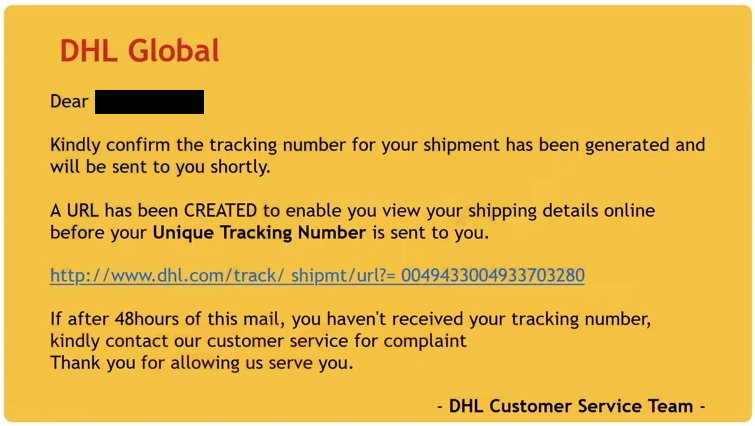
The email is designed to resemble a legitimate delivery update from DHL. It may reference a package that cannot be delivered, a shipment that requires confirmation or documentation that must be completed before dispatch. These details are chosen to exploit the common expectation of parcel deliveries. Many people receive online orders frequently, and scammers rely on this familiarity to increase the chance that the email will be opened.
The “DHL Global Shipment Tracking Number” email includes a tracking number that looks authentic even though it is not connected to any real shipment. The email may also display the DHL logo or a layout that mimics DHL’s visual style. These elements support the claim that the notification is genuine. However, the content does not reference the user’s name, order details or any verified shipment information. It avoids specifics because the scam is sent to a wide range of recipients who have no connection to the shipment described in the email.
The link or button within the email is the central part of the phishing attempt. The label often reads Track Shipment, View Details or Confirm Delivery. When clicked, the link opens a website designed to resemble a DHL page. Although the layout may look familiar, the website is not operated by DHL. The scammers use this imitation page to request information. Depending on the variant, the page may ask the user to log in, confirm personal data or provide delivery information. Once information is entered, it is sent directly to the attackers.
The aim of the “DHL Global Shipment Tracking Number” scam is to collect information that can be used for identity theft, account compromise or financial fraud. If the phishing page requests login details for an email account, those details can be used to access the account. Attackers may then attempt password resets on other services linked to that email address. If the phishing page requests personal details or payment information, this data may be used to commit unauthorised transactions or open fraudulent accounts. Some variants download attachments or files that install unwanted software.
Another element of this phishing attack is the sense of urgency created in the email. It may claim that the package will be returned, delayed or cancelled unless the user responds. This tactic reduces the likelihood that the recipient will examine the email closely. False urgency is common in phishing attacks because it discourages careful review.
The “DHL Global Shipment Tracking Number” email is not associated with DHL’s delivery systems. DHL does not request personal data or login credentials through unsolicited emails and does not require users to resolve delivery issues through external websites. All information presented in this phishing email is fake for the purpose of deceiving the recipient.
The full “DHL Global – Shipment Tracking Number” email is below:
Subject: DHL Shipment Notification – Order Details and Tracking Information.
DHL Global
Dear -,
Kindly confirm the tracking number for your shipment has been generated and will be sent to you shortly.
A URL has been CREATED to enable you view your shipping details online before your Unique Tracking Number is sent to you.
–
If after 48hours of this mail, you haven’t received your tracking number, kindly contact our customer service for complaint
Thank you for allowing us serve you.– DHL Customer Service Team –
How to recognise phishing emails
Being able to recognise phishing emails helps prevent information theft and account compromise. The “DHL Global Shipment Tracking Number” scam contains several signs that identify it as fraudulent.
One of the primary indicators is the sender address. Although the email claims to be from DHL, the sender address often uses unrelated or suspicious domains. It may include random strings, misspellings or domains that have no connection to DHL. A legitimate DHL delivery update uses an official DHL domain. If the sender address does not match a recognised domain, the email should be treated as unsafe.
Another sign is the absence of personal information. The phishing email does not address the recipient by name or reference a real order. DHL shipment updates include information related to an actual package. If an email does not contain details that are specific to the recipient, it is more likely to be a phishing attempt.
The content of the email also indicates phishing. The “DHL Global Shipment Tracking Number” scam often contains vague text and general references to issues with a shipment. It avoids describing the destination, order number or sender. Phishing emails use broad wording so they can target many recipients at once.
Suspicious links provide another clear warning. Hovering the cursor over the link allows the user to view the true web address. Phishing emails send users to websites that do not belong to DHL. The domain may appear similar at a glance, but it will not be DHL’s official domain. Users should avoid clicking any link that leads to an unfamiliar site.
Unexpected requests for information are a strong indication of phishing. The fraudulent site may ask for email credentials, personal data or payment information. DHL does not request such details through email links. Any request to log in or confirm sensitive details through an email should be seen as unsafe.
Language quality can also reveal the nature of the email. Phishing emails may include unusual phrasing or grammar issues. Although not all phishing emails contain obvious errors, inconsistent writing can signal a lack of authenticity.
If any of these signs appear in an email, it should be avoided. Users should not click links or download attachments. DHL shipments can be verified by entering a tracking number directly on DHL’s official website, rather than through links received in email.
Site Disclaimer
2-remove-virus.com is not sponsored, owned, affiliated, or linked to malware developers or distributors that are referenced in this article. The article does not promote or endorse any type of malware. We aim at providing useful information that will help computer users to detect and eliminate the unwanted malicious programs from their computers. This can be done manually by following the instructions presented in the article or automatically by implementing the suggested anti-malware tools.
The article is only meant to be used for educational purposes. If you follow the instructions given in the article, you agree to be contracted by the disclaimer. We do not guarantee that the artcile will present you with a solution that removes the malign threats completely. Malware changes constantly, which is why, in some cases, it may be difficult to clean the computer fully by using only the manual removal instructions.