

The “Email Account Disable Request” scam is a phishing attempt that presents itself as an administrative or system-generated notice. It usually claims that a request has been made to disable the recipient’s email account, and that action is required to cancel or review this request. The message is designed to create concern by suggesting that account access may soon be lost.
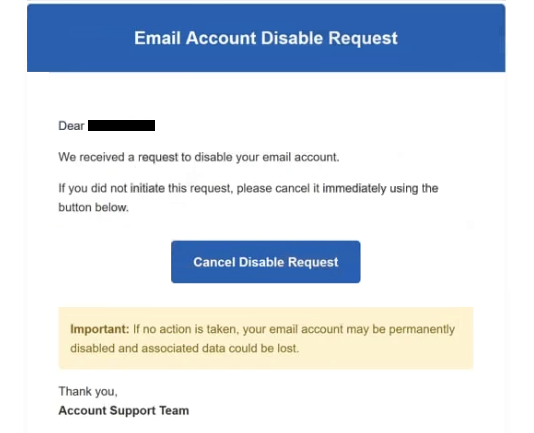
The email does not provide verifiable details about the supposed request. It may mention a pending action or scheduled deactivation, but it does not include timestamps, request origin, or any account-specific information that would confirm its legitimacy. Instead, it directs the recipient to follow a link to manage or cancel the request.
That link leads to a page that imitates a login or account verification screen. The layout may resemble a webmail interface, but it does not display any real account data. There are no settings, no request logs, and no confirmation options available. The only action presented is entering login credentials.
Submitting those details does not cancel any request. The page is designed to capture login information, which is then sent to the scammers. In some cases, the page may show a brief confirmation or redirect to a legitimate login page to make the process appear normal.
The disable request mentioned in the email is not real. It is a fabricated scenario used to push the recipient into reacting quickly. By presenting the situation as something that can be reversed with a single step, the scam encourages interaction without verification.
If attackers obtain valid credentials, they can attempt to access the email account. This may expose stored messages, attachments, and contact information. Because email accounts are often linked to other services, access can also be used to reset passwords and compromise additional accounts.
The full “Email Account Disable Request” phishing email is below:
Subject: Urgent Confirm Your Email Account Disable Request
Email Account Disable Request
Dear-,
We received a request to disable your email account.
If you did not initiate this request, please cancel it immediately using the button below.
Cancel Disable RequestImportant: If no action is taken, your email account may be permanently disabled and associated data could be lost.
Thank you,
Account Support TeamThis message was generated automatically. Replies to this email will not be monitored.
2026 Mail Service. All rights reserved.
How to recognize phishing emails like “Email Account Disable Request”
Phishing emails built around account requests or administrative actions share several common traits. One of the most noticeable is the lack of clear, verifiable information. The email refers to an action but does not provide details that allow the recipient to confirm it.
Another important sign is the use of external links for account management. Instead of directing users to access their accounts through official websites, the email includes a direct link to a login page. This page is hosted on a domain that does not belong to the legitimate service.
The sender address can also reveal inconsistencies. While the display name may appear to represent a support or system team, the actual email address often comes from a different domain. This mismatch is a strong indication that the email is not genuine.
The message is typically written in a general format. It may not include the recipient’s name or any account-specific identifiers. This allows it to be sent to many recipients without modification.
The wording is intended to create urgency. By suggesting that an account will be disabled, the email encourages quick action without careful review. This pressure reduces the likelihood that the recipient will verify the message.
Recognizing these patterns helps identify phishing emails before interacting with them. Emails that combine vague administrative claims, external login links, and inconsistent sender details should be treated with caution.
Site Disclaimer
2-remove-virus.com is not sponsored, owned, affiliated, or linked to malware developers or distributors that are referenced in this article. The article does not promote or endorse any type of malware. We aim at providing useful information that will help computer users to detect and eliminate the unwanted malicious programs from their computers. This can be done manually by following the instructions presented in the article or automatically by implementing the suggested anti-malware tools.
The article is only meant to be used for educational purposes. If you follow the instructions given in the article, you agree to be contracted by the disclaimer. We do not guarantee that the artcile will present you with a solution that removes the malign threats completely. Malware changes constantly, which is why, in some cases, it may be difficult to clean the computer fully by using only the manual removal instructions.