

The “Final Step Required: Email Account Closure” scam is a phishing email that tells the recipient their email account is scheduled to be closed. The email states that a closure process has been initiated and that the account will be disabled soon. It presents this as an official action connected to the mailbox. The message is fraudulent and is not sent by a real email provider.
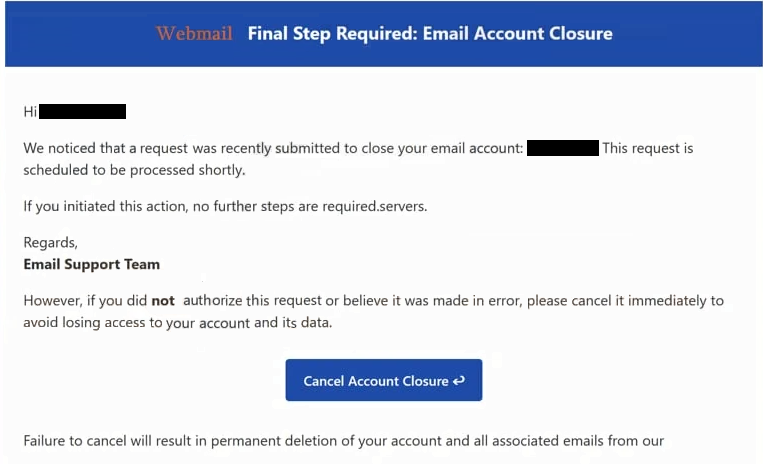
The text claims the recipient must confirm the account to stop the closure. It includes a button or link with wording about verifying or keeping the account active. This link does not open a legitimate provider site. It leads to a fake web page created to look like an email login screen. The page shows fields for an email address and password, and can display simple logos or layouts that resemble common webmail services.
When the recipient enters credentials on that page, the information is transmitted to the scammers. The page does not connect to the real email system and does not process any closure request. Its only function is to collect login data. After submission, the site can show an error or redirect to a real email login page so the activity appears normal. By that moment, the credentials are already captured.
The main target of the “Final Step Required: Email Account Closure” scam is the email login. Control over an email account provides access to private messages, contact lists, and stored files. Many online accounts rely on email for password resets and identity confirmation. With inbox access, scammers can request password changes for other services and approve them through the compromised mailbox. This can expose shopping accounts, social media profiles, subscriptions, and work-related platforms.
Access to a stolen mailbox also allows scammers to read past correspondence. They can search for invoices, personal details, or account confirmations. They can send emails from the victim’s address while pretending to be the owner. Those emails can repeat the same closure claim or present other false alerts. Since the emails come from a real address, recipients can trust them and follow the included links. This extends the impact beyond the first victim.
The closure claim itself is fabricated. The scammers do not control the recipient’s real account and cannot shut it down. The claim exists to create pressure and push for quick action. Real providers handle account status through official account pages and do not request credentials through links in unsolicited emails.
Subject: [-]: Please confirm to continue.
Webmail Final Step Required: Email Account Closure
Hi -,
We noticed that a request was recently submitted to close your email account: -. This request is scheduled to be processed shortly.
If you initiated this action, no further steps are required.servers.
Regards,
Email Support TeamHowever, if you did not authorize this request or believe it was made in error, please cancel it immediately to avoid losing access to your account and its data.
Cancel Account Closure
Delivery and identifying signs of phishing emails
The “Final Step Required: Email Account Closure” scam arrives as a standard email focused on account shutdown. The subject line refers to closure, deactivation, or urgent verification. The sender’s name is written to appear related to support or account administration. A full check of the sender address shows a domain that does not belong to a legitimate provider. This mismatch is a direct sign tied to this scam.
The body of the email is brief and centered on the closure story. It states that a request has been processed and gives a short deadline. It warns that access will be lost if no action is taken. The email does not include real account identifiers, billing references, or service history that a genuine provider would include. Its main element is the action link that leads to the phishing page.
The fraudulent page connected to the “Final Step Required: Email Account Closure” scam is minimal. It shows a login form and a title that mentions email or webmail. The domain in the address bar is unrelated to known providers and can contain random words or characters. The page lacks navigation menus, support sections, and detailed company information. It exists only to request credentials.
Another trait is the narrow focus on closure. The same theme appears in the subject line, body text, and link label. The email does not discuss storage limits, billing updates, or policy changes. It stays fixed on the claim that the account is about to be closed.
Legitimate providers do not send sudden closure warnings that require login through an external link. Authentic notifications direct users to sign in through official sites they already use. The combination of a closure claim, a mismatched sender domain, and a login page on an unrelated site defines the “Final Step Required: Email Account Closure” scam and separates it from real service emails.
Site Disclaimer
2-remove-virus.com is not sponsored, owned, affiliated, or linked to malware developers or distributors that are referenced in this article. The article does not promote or endorse any type of malware. We aim at providing useful information that will help computer users to detect and eliminate the unwanted malicious programs from their computers. This can be done manually by following the instructions presented in the article or automatically by implementing the suggested anti-malware tools.
The article is only meant to be used for educational purposes. If you follow the instructions given in the article, you agree to be contracted by the disclaimer. We do not guarantee that the artcile will present you with a solution that removes the malign threats completely. Malware changes constantly, which is why, in some cases, it may be difficult to clean the computer fully by using only the manual removal instructions.