

The “Funds Has Been Credited To Your Account” scam is a phishing email that claims a large sum of money has been transferred to the recipient. The email presents the transaction as completed and states that the funds are available but require confirmation or processing before they can be accessed. This claim is false and is not connected to any real financial institution.
The email is written to create interest rather than concern. It often states that the recipient has received a payment from an organization, government body, or financial authority. The message may include a specific amount and describe it as compensation, inheritance, or a business transaction. It suggests that the funds are ready but cannot be released without further steps.
Recipients are instructed to respond or follow a process to claim the money. This may involve replying to the email with personal details such as full name, address, phone number, or banking information. In some cases, the email includes a link that leads to a form requesting similar details. The process is presented as necessary to verify identity or complete the transfer.
The funds mentioned in the email do not exist. The purpose of the message is to collect personal or financial information. Once the recipient provides details, the scammers may continue communication and request additional information or payments. These payments are often described as processing fees, transfer charges, or administrative costs.
The scam may continue over multiple exchanges. After initial contact, the scammers can introduce new requirements or delays, asking for more information or money at each stage. The goal is to extract as much data or payment as possible before the victim realizes the situation is fraudulent.
If personal or banking details are shared, they can be used for financial fraud or identity-related misuse. Even basic information such as names and contact details can be used for further targeting.
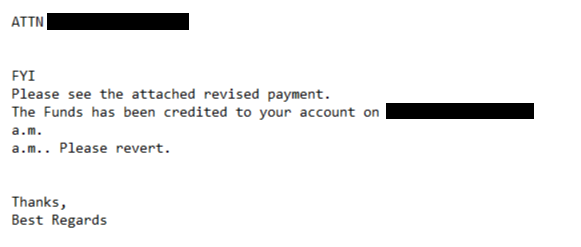
The contents of the “Funds Has Been Credited To Your Account” scam email are below:
Subject: ACH Payments Processed on 8/14/2023 11:26:08 a.m.
ATTN -,
FYI
Please see the attached revised payment.
The Funds has been credited to your account on 8/14/2023 11:26:08
a.m.
a.m.. Please revert.Thanks,
Best Regards
How to recognize phishing emails like “Funds Has Been Credited To Your Account”
Emails like “Funds Has Been Credited To Your Account” can be identified by their unrealistic claims and lack of verifiable details. One of the main signs is the unexpected nature of the message. The recipient is informed about a financial transaction that they did not initiate or expect.
The email usually does not provide clear information about the source of the funds. It may mention an organization or authority, but it does not include verifiable references such as official transaction records or account details. Legitimate financial notifications always include specific and traceable information.
Another indicator is the request for personal or financial data. The email asks the recipient to provide sensitive information in order to access the funds. Real financial institutions do not request such information through unsolicited emails.
The sender address is also important to examine. While the display name may appear official, the actual email address often belongs to an unrelated domain. This mismatch is a strong indication that the email is not legitimate.
The message may also introduce additional steps after the initial response. Requests for fees or further verification are common in this type of scam. These steps are used to extend the interaction and increase the amount of information or money collected.
The overall structure of the email relies on the appeal of unexpected funds. By presenting a financial gain, it encourages recipients to engage with the process without verifying its authenticity.
Site Disclaimer
2-remove-virus.com is not sponsored, owned, affiliated, or linked to malware developers or distributors that are referenced in this article. The article does not promote or endorse any type of malware. We aim at providing useful information that will help computer users to detect and eliminate the unwanted malicious programs from their computers. This can be done manually by following the instructions presented in the article or automatically by implementing the suggested anti-malware tools.
The article is only meant to be used for educational purposes. If you follow the instructions given in the article, you agree to be contracted by the disclaimer. We do not guarantee that the artcile will present you with a solution that removes the malign threats completely. Malware changes constantly, which is why, in some cases, it may be difficult to clean the computer fully by using only the manual removal instructions.