

The “iCloud Subscription Review Needed” phishing email leads victims to a fraudulent Apple login page that imitates the real iCloud account interface. The page appears legitimate at first glance. It may display Apple branding, familiar colors, and a short message stating that the account must be reviewed to continue using subscription services. The page asks visitors to sign in to confirm their subscription details.
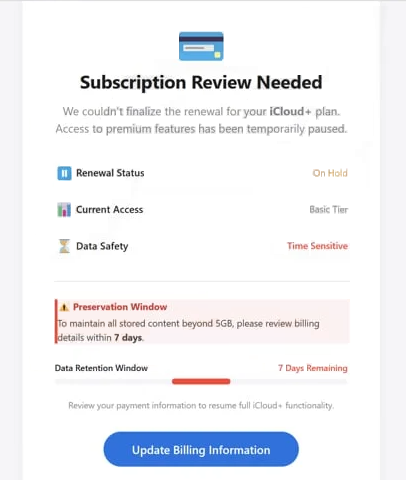
This page does not belong to Apple. It is created specifically to collect Apple ID credentials. The form typically asks for the Apple ID email address and password. Some versions continue the process by requesting additional details such as payment information, billing address, or authentication codes. None of the entered information is used to review a subscription. Instead, it is transmitted directly to the scammers controlling the phishing site.
If the credentials entered are valid, attackers can attempt to access the real Apple account. An Apple ID often provides access to services such as iCloud storage, App Store purchases, device backups, and personal account information. Attackers who gain control of the account may view stored files, access personal data, or attempt unauthorized purchases. In some situations, they may also change account settings or recovery information, making it difficult for the legitimate owner to regain access.
The fake login page is usually reached through a link included in a phishing email. The email claims that a subscription review is required and suggests that the user must verify their account to maintain access to Apple services. The message may mention subscription renewal, billing verification, or service continuation. These claims are fabricated and are not connected to any real Apple account activity.
The link inside the email directs the recipient to the phishing site rather than the official Apple website. Because the page resembles a genuine login portal, some users may enter their credentials without noticing that the domain in the browser address bar does not belong to Apple.
How to identify phishing emails
The email associated with the “iCloud Subscription Review Needed” scam is designed to resemble a standard account notification. It may appear to come from Apple support or an automated system message. The email claims that the recipient must review subscription information to avoid possible interruption of services.
The message often contains a short explanation about subscription verification. It may state that the user’s account requires confirmation due to a billing update or system review. A button or link is provided with wording such as “Review Subscription,” “Update Account,” or “Confirm Plan.” This link directs recipients to the phishing page that collects credentials.
A common sign of this scam is the sender’s address. Although the display name may suggest an official Apple department, the actual email domain frequently does not match Apple’s legitimate domains. Another indicator is the lack of specific account details. Genuine Apple notifications normally reference account-related information or direct users to manage subscriptions through official account settings.
The link embedded in the email also reveals the deception. Instead of directing users to apple.com or an official Apple service page, it leads to an unrelated domain hosting the fake login interface. This page exists only to collect credentials and other sensitive information.
The email may encourage recipients to act quickly by suggesting that the subscription must be reviewed immediately. This sense of urgency is intended to push users into clicking the link without verifying the authenticity of the message.
Recognizing these signs can help identify the “iCloud Subscription Review Needed” scam. Apple does not require users to confirm subscription information through external login pages reached via unsolicited email links.
Site Disclaimer
2-remove-virus.com is not sponsored, owned, affiliated, or linked to malware developers or distributors that are referenced in this article. The article does not promote or endorse any type of malware. We aim at providing useful information that will help computer users to detect and eliminate the unwanted malicious programs from their computers. This can be done manually by following the instructions presented in the article or automatically by implementing the suggested anti-malware tools.
The article is only meant to be used for educational purposes. If you follow the instructions given in the article, you agree to be contracted by the disclaimer. We do not guarantee that the artcile will present you with a solution that removes the malign threats completely. Malware changes constantly, which is why, in some cases, it may be difficult to clean the computer fully by using only the manual removal instructions.