

The “Immediate action required” email scam is a phishing email that attempts to provoke a rapid response by claiming that an email account or related service is at risk. The message asserts that urgent action is necessary to prevent negative consequences such as account suspension, restricted access, or security issues. The language is deliberately authoritative and time sensitive, presenting the situation as unresolved and critical.
This email is not sent by a legitimate service provider. It is distributed by scammers impersonating support teams, system administrators, or automated security services. The message avoids detailed technical explanations and instead focuses on urgency. Statements indicating that the issue is pending, unresolved, or flagged for immediate review are used to pressure the recipient into acting without verification.
The email contains a link directing recipients to a fraudulent web page. This page is designed to appear related to email access or account management. It commonly presents a sign-in form requesting email credentials, including the email address and password. In some cases, additional information such as security answers or secondary login details may also be requested. Any data entered into these fields is transmitted directly to the scammers.
No corrective action is performed after submission. The page does not resolve any issue or restore account status. Its sole function is credential collection. Once access to an email account is obtained, it can be used to read private communications, intercept verification messages, and initiate password resets for other online services linked to the email address. This enables broader account compromise beyond the email inbox itself.
The “Immediate action required” email scam does not involve attachments, software downloads, or warnings about device infection. Its effectiveness relies entirely on social engineering. By framing the situation as urgent and unresolved, the email encourages recipients to bypass standard caution and respond quickly. The lack of specific details makes the message broadly applicable, allowing it to be sent to users of many different email services.
Receipt of this email represents an attempt to obtain sensitive login information under false pretenses. Any interaction with the linked page places the recipient at risk of account takeover rather than resolving a legitimate service issue.
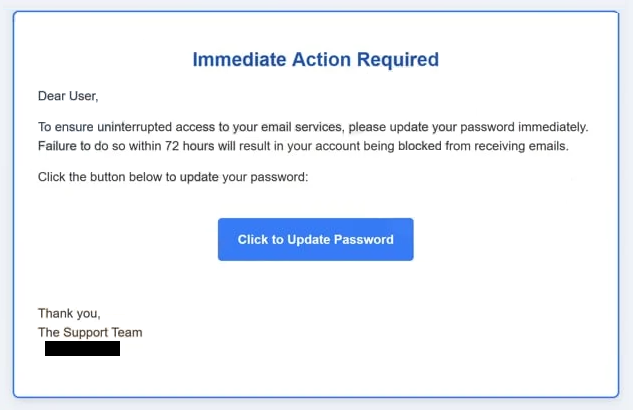
The full “Immediate Action Required” phishing email is below:
Immediate Action Required
Dear User,
To ensure uninterrupted access to your email services, please update your password immediately. Failure to do so within 72 hours will result in your account being blocked from receiving emails.
Click the button below to update your password:
Click to Update Password
Thank you,
The Support Team
How “Immediate action required” scam emails are distributed
The “Immediate action required” email scam is spread through bulk email campaigns. Scammers send large volumes of identical or lightly modified emails to extensive address lists. These lists are compiled from data leaks, public sources, previous scam campaigns, or automated address generation. The scam is not tailored to a specific provider, which allows the same message to be reused across different targets.
The structure of the email is intentionally minimal. Subject lines are short and urgent, often containing phrases such as immediate action required or account notice. The message body is brief and focused on prompting a single action. Excessive branding or formatting is avoided to make the email resemble internal alerts or automated system messages rather than promotional content.
Sender information is manipulated to appear legitimate. Display names may reference security teams, administrators, or notification services. While the sending address itself may not match any real organization, this detail is easy to overlook when attention is drawn to the urgency of the message rather than its origin.
Links included in the email are masked behind generic action-oriented text. The visible wording suggests account review, verification, or resolution of an issue. The actual destination is a phishing web page hosted on an unrelated or newly registered domain. These pages are often replaced frequently to evade detection and blocking by security systems.
The scam exploits familiarity with routine security alerts. Email users are accustomed to receiving warnings about account activity, policy changes, or verification requests. By presenting the message as an unresolved issue requiring immediate confirmation, the email blends into normal inbox traffic while creating pressure to respond quickly.
This scam is effective across all devices and operating systems. It does not rely on technical vulnerabilities or malware delivery. Any device capable of opening the email and loading the linked web page can be used to submit credentials.
The “Immediate action required” email scam demonstrates how urgency and authority are used to manipulate recipients into disclosing sensitive information. By presenting a vague but pressing problem and directing users to a credential harvesting page, scammers are able to compromise email accounts without deploying malicious software or exploiting system flaws.
Site Disclaimer
2-remove-virus.com is not sponsored, owned, affiliated, or linked to malware developers or distributors that are referenced in this article. The article does not promote or endorse any type of malware. We aim at providing useful information that will help computer users to detect and eliminate the unwanted malicious programs from their computers. This can be done manually by following the instructions presented in the article or automatically by implementing the suggested anti-malware tools.
The article is only meant to be used for educational purposes. If you follow the instructions given in the article, you agree to be contracted by the disclaimer. We do not guarantee that the artcile will present you with a solution that removes the malign threats completely. Malware changes constantly, which is why, in some cases, it may be difficult to clean the computer fully by using only the manual removal instructions.