

The “MFA Revalidation Required” scam is a phishing email that claims the recipient must revalidate their multi-factor authentication settings to maintain access to an account. The message presents this request as part of a routine security update. It states that the existing authentication method has expired, failed a compliance check, or requires confirmation. This claim is false and is not sent by a legitimate service provider.
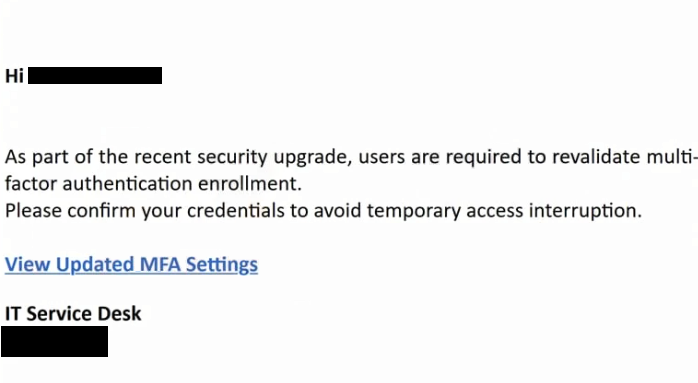
The email suggests that unless the user completes the revalidation process, access to the account will be limited or temporarily suspended. The wording focuses on protecting the account and ensuring uninterrupted service. A button or link is included, usually labeled with phrases such as “Revalidate Now,” “Confirm MFA,” or “Secure Account.” The email implies that this step is necessary to prevent login issues.
Clicking the link does not open the official website of the service mentioned in the email. Instead, it directs the recipient to a counterfeit web page built to resemble a standard login or authentication screen. The page may display a familiar logo and a short notice about authentication verification. It then requests login credentials, such as an email address and password.
In some cases, the fake page also asks for additional security information. This can include one-time authentication codes, verification codes from an authenticator app, or backup codes. The page claims this information is needed to complete the MFA revalidation. In reality, the site is designed only to capture sensitive account details.
When the recipient enters credentials or authentication codes, the information is transmitted to the scammers. The page does not verify or update any authentication settings. It does not connect to the legitimate account system. After submission, the site may show a generic confirmation message or redirect to the real login page to make the interaction appear legitimate. By that time, the attackers already have the collected data.
The targeted information in the “MFA Revalidation Required” scam includes login credentials and authentication codes. With both pieces of information, attackers can attempt to access the real account. Multi-factor authentication is intended to protect accounts by requiring more than just a password. However, if users provide both their password and active verification codes to scammers, that protection can be bypassed.
Once attackers gain access, they may change account passwords, update recovery information, and modify security settings to prevent the legitimate user from regaining control. Depending on the type of account targeted, this can lead to exposure of personal data, financial information, stored documents, or business communications.
The claim that MFA must be revalidated is fabricated. Legitimate service providers manage authentication settings within official account dashboards. They do not require users to submit login credentials and authentication codes through unsolicited email links.
How to recognize the “MFA Revalidation Required” phishing email
The “MFA Revalidation Required” scam can be identified by reviewing several details in the email. The sender address is a key indicator. While the display name may appear to belong to a trusted company, the full email address often uses a domain that is not associated with the legitimate service. Authentic security notifications are sent from verified company domains.
The email content usually lacks specific account references. It may not include the user’s name, partial account number, or other identifying information. Real authentication-related notifications typically reference the account in a way that confirms the service relationship without revealing sensitive data.
The link in the email is another strong warning sign. When inspected, the destination does not match the official website of the service being impersonated. The domain may contain extra words, unusual endings, or slight variations of the real brand name. Legitimate providers instruct users to sign in through their known website or application rather than through unfamiliar links.
The request for authentication codes is particularly suspicious. Multi-factor authentication codes are intended to be entered only on the official service platform during a secure login session. No legitimate company asks users to provide one-time codes through email links or external pages.
The tone of the email often creates urgency, stating that access will be disrupted if revalidation is not completed quickly. This pressure is meant to encourage immediate action without careful inspection. Real providers allow users to manage authentication settings directly within their account security section and do not rely on external verification pages.
By checking the sender address, examining the link destination, and recognizing that authentication codes should never be shared through email links, recipients can identify the “MFA Revalidation Required” scam and avoid exposing sensitive account information.
Site Disclaimer
2-remove-virus.com is not sponsored, owned, affiliated, or linked to malware developers or distributors that are referenced in this article. The article does not promote or endorse any type of malware. We aim at providing useful information that will help computer users to detect and eliminate the unwanted malicious programs from their computers. This can be done manually by following the instructions presented in the article or automatically by implementing the suggested anti-malware tools.
The article is only meant to be used for educational purposes. If you follow the instructions given in the article, you agree to be contracted by the disclaimer. We do not guarantee that the artcile will present you with a solution that removes the malign threats completely. Malware changes constantly, which is why, in some cases, it may be difficult to clean the computer fully by using only the manual removal instructions.