

The “One day left to verify my email account” email is a phishing attack that falsely claims the recipient must complete email account verification within a limited time frame. The message is not sent by a legitimate email provider. Its purpose is to pressure recipients into clicking a link and entering sensitive information on a phishing website.
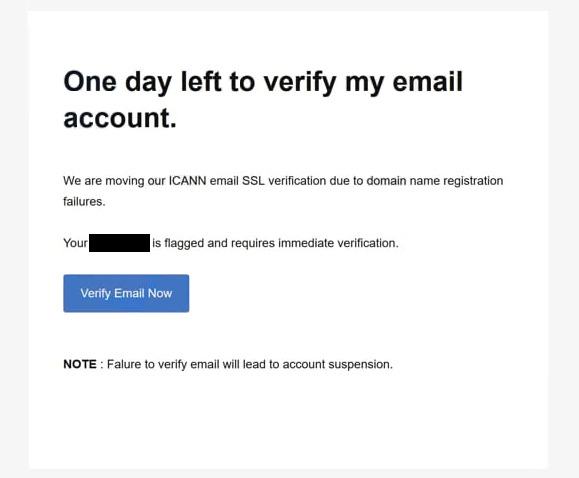
The email states that the recipient has one day remaining to verify their email account to avoid service disruption. It may warn that failure to complete verification will result in restricted access, suspended email delivery, or account deactivation. The language is designed to create urgency while presenting the request as a routine account requirement.
The message does not explain why verification is suddenly required. It avoids referencing any recent account activity, system change, or user action that would justify the deadline. No timestamps, mailbox identifiers, or provider-specific details are included. This lack of context allows the email to appear relevant to many recipients while preventing easy verification.
A link included in the email invites the recipient to complete the verification process. Clicking the link does not open the official website of an email service. Instead, it redirects the user to a phishing page designed to resemble an email login or account confirmation screen. The page uses a simple layout with standard login fields and neutral wording so it can plausibly represent different email providers.
The phishing page requests the recipient’s email address and password to verify the account. In some cases, additional confirmation details are requested, presented as necessary to complete the process. Any information entered into these fields is transmitted to the operators behind the phishing page.
After the information is submitted, the page may display a message stating that the account has been successfully verified. The session may then redirect elsewhere or close automatically. This behaviour is intended to make the interaction appear complete and discourage further investigation. The legitimate email account remains unchanged.
With valid login credentials, attackers can access the email account without the owner’s awareness. They can read messages, monitor communications, and initiate password resets for other services linked to the same email address. Because email accounts are often used for account recovery, access to one inbox can lead to access across multiple platforms.
The “One day left to verify my email account” scam does not involve attachments, downloads, or software installation. The attack relies entirely on impersonation and time pressure. Account verification requests are familiar to users, which makes the message appear plausible.
The email is distributed broadly and does not identify a specific email provider. This allows recipients to associate the message with whichever email account they use most often.
The full “One day left to verify my email account” phishing email is below:
Subject: Mail Verification Required
Domain: –
One day left to verify my email account.We are moving our ICANN email SSL verification due to domain name registration failures.
Your – is flagged and requires immediate verification.
Verify Email Now
NOTE : Falure to verify email will lead to account suspension.
Please do not reply to this email. Emails sent to this address will not be answered.
Copyright © 1999-2026 – Operating Company, LLC. 100 S Mill Ave, Suite 1600, Tempe, AZ 85281 USA. All rights reserved.
How to recognise the “One day left to verify my email account” phishing email
The “One day left to verify my email account” phishing email can be recognised by paying attention to what it claims and what it leaves out. One of the first red flags is the strict deadline combined with a lack of explanation. Real email providers do not impose sudden 24-hour verification limits without context.
Another warning sign is that the email does not clearly identify the account. It does not mention the recipient’s email address, mailbox name, or recent account activity. Legitimate verification notices usually include details that confirm the message applies to a specific user.
The way the email asks you to complete verification is also important. This message directs you to click a link and enter your email password. Email providers do not ask users to confirm accounts by submitting passwords through unexpected emails. Verification steps are completed only after signing in directly through official websites or apps.
Sender information can provide further clues. The name shown in the inbox may look official, but the actual sender address often comes from a domain that has no connection to your email service. Checking the full sender address can reveal this discrepancy.
The link itself is another indicator. Hovering over it often shows a web address that does not belong to a recognised email provider. The page may look convincing, but its domain name usually does not match any legitimate service. Security icons in the browser do not mean the page is trustworthy.
The email also relies heavily on pressure instead of clear communication. It warns about account problems without explaining what will happen or why. Real providers give clear instructions and multiple notices rather than forcing immediate action through a single email.
If you have not received earlier verification reminders or experienced account issues, an unexpected message claiming there is “one day left” should be treated with caution. The safest response is to ignore the link and go directly to your email provider’s official website by typing the address yourself.
After signing in normally, you can check account notifications or settings. If no verification request appears, the email was not legitimate.
Site Disclaimer
2-remove-virus.com is not sponsored, owned, affiliated, or linked to malware developers or distributors that are referenced in this article. The article does not promote or endorse any type of malware. We aim at providing useful information that will help computer users to detect and eliminate the unwanted malicious programs from their computers. This can be done manually by following the instructions presented in the article or automatically by implementing the suggested anti-malware tools.
The article is only meant to be used for educational purposes. If you follow the instructions given in the article, you agree to be contracted by the disclaimer. We do not guarantee that the artcile will present you with a solution that removes the malign threats completely. Malware changes constantly, which is why, in some cases, it may be difficult to clean the computer fully by using only the manual removal instructions.