

The “Storage usage alert” email scam is a phishing email that claims the recipient’s email or cloud account is almost out of storage space. The message states that the storage limit has been reached or is close to being reached and that action is required to avoid service disruption. The email is not sent by a real service provider and is not based on actual storage data.
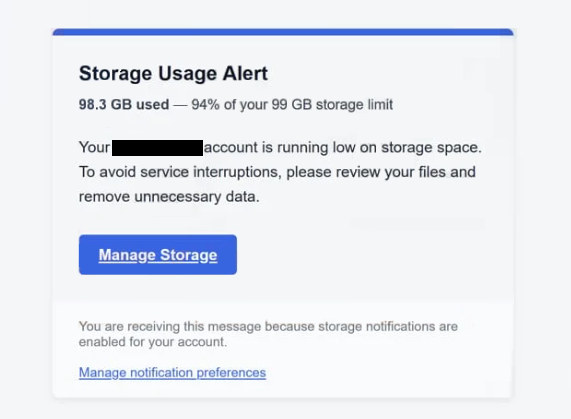
The subject line and message both use the phrase “Storage usage alert” to frame the email as an automated notice. The message tells the recipient that their mailbox or cloud storage is full or nearly full. It claims that new emails may stop arriving or that files may no longer sync if the issue is not resolved. These statements are presented as current account conditions even though no real check has taken place.
The email does not provide real usage statistics. It does not show total storage capacity, used space, or dates tied to the alleged limit. It does not display account identifiers or service plan information. This lack of detail exists because the sender has no access to the recipient’s real account.
The message instructs the recipient to click a link to review storage usage and free up space. The link is described as the page where the problem can be fixed. The email does not tell the recipient to sign in through the normal provider website or application. All action is directed through the embedded link.
Clicking the link opens a phishing page that imitates a login screen for an email or cloud service. The page asks for the recipient’s email address and password to continue. Entering this information does not show storage details or increase capacity. The credentials are sent to scammers who control the page.
After credentials are entered, the page may show a message stating that storage has been refreshed or that the account has been validated. This message is only visual and not connected to any system. No change is made to storage limits. The page does not connect to the real provider.
The “Storage usage alert” email scam does not involve real monitoring tools. An unsolicited email cannot measure storage on a remote account. A webpage reached from such an email cannot change quotas or restore capacity. The storage problem described in the message does not exist.
If valid credentials are captured, scammers can try to access the real account. Email or cloud access allows them to read messages, view files, and collect personal information. They can also intercept password reset emails for other services.
Because many accounts are tied to one email address, access to the mailbox can lead to further account compromise. Password resets for shopping accounts, social media, or financial services can be requested and completed using the compromised inbox. This can lead to unauthorized access beyond the original email account.
The scam depends on the idea that storage limits are common and that users may worry about losing access to messages or files. This makes the claim believable. Real providers do not resolve storage limits by asking for passwords on pages reached through unsolicited emails.
Subject: IMAP/POP3 Error – Refresh Email Server
Storage Usage Alert
98.3 GB used — 94% of your 99 GB storage limit
Your – account is running low on storage space. To avoid service interruptions, please review your files and remove unnecessary data.
Manage Storage
You are receiving this message because storage notifications are enabled for your account.Manage notification preferences
How to recognize phishing emails
The “Storage usage alert” email scam is distributed through bulk phishing campaigns. The same message is sent to many addresses without checking the actual storage use. The wording is broad, so it can apply to any user of email or cloud services.
The sender name may reference support or storage services, but the sending address does not belong to a legitimate provider. The domain used to send the email is unrelated to known services. Viewing the full sender address shows this mismatch.
The content of the email avoids precise details. It does not include exact usage numbers, timestamps, or plan names. Legitimate storage notices include clear figures and are visible after signing in through official channels. This scam includes none of that information.
The link in the email leads to a domain that is not an official login page. Even if the page looks similar to a real service, the address bar shows a different domain. Any page asking for credentials after a “Storage usage alert” email should be considered fraudulent.
The email also provides no alternative way to check storage. It does not suggest opening the provider website directly, checking account settings, or using the official app. The only path offered is clicking the link and entering credentials.
Another sign is the pressure to act quickly. The message claims that email delivery or file access will stop soon. It does not explain how long the limit has been in place or show evidence that delivery has already failed. This pressure is used to push for fast action.
Site Disclaimer
2-remove-virus.com is not sponsored, owned, affiliated, or linked to malware developers or distributors that are referenced in this article. The article does not promote or endorse any type of malware. We aim at providing useful information that will help computer users to detect and eliminate the unwanted malicious programs from their computers. This can be done manually by following the instructions presented in the article or automatically by implementing the suggested anti-malware tools.
The article is only meant to be used for educational purposes. If you follow the instructions given in the article, you agree to be contracted by the disclaimer. We do not guarantee that the artcile will present you with a solution that removes the malign threats completely. Malware changes constantly, which is why, in some cases, it may be difficult to clean the computer fully by using only the manual removal instructions.