

The “We Have Updated Your Citi Debit Card” email scam is a phishing email that impersonates the financial service company Citi and attempts to convince recipients that a debit card update has been processed. The “We Have Updated Your Citi Debit Card” email is presented as an official notification and frames the update as an account-related change that requires immediate attention. This type of wording is intended to trigger concern, especially if the recipient believes a card replacement or modification happened without authorization.
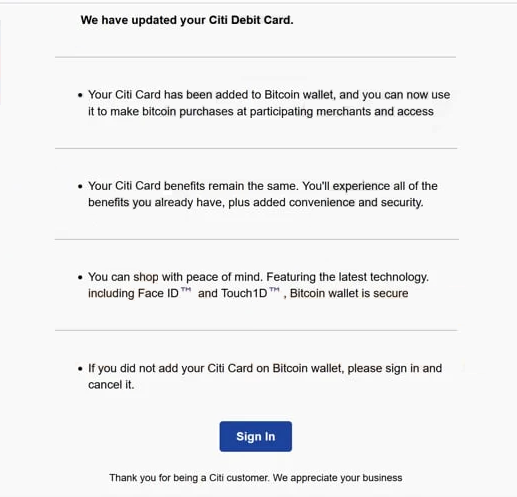
The “We Have Updated Your Citi Debit Card” email is not sent by Citi and is not connected to any legitimate banking system. It is distributed by scammers who use brand impersonation to increase credibility. The “We Have Updated Your Citi Debit Card” email typically suggests that a security update, card reissue, or account maintenance event has occurred and that the recipient must confirm details or review recent changes.
A link included in the “We Have Updated Your Citi Debit Card” email leads to a fraudulent website designed to imitate a Citi sign-in page or verification form. The goal is data theft. The page may request online banking credentials, debit card information, or personal details such as name, address, and phone number. Any information entered into the site is captured by scammers rather than being processed by a real bank.
The risks associated with the “We Have Updated Your Citi Debit Card” email scam include unauthorized account access and financial fraud. Stolen login details can be used to attempt account takeover, while collected personal data can support identity theft. If debit card information is submitted, it may be used for fraudulent purchases or resold to other criminals. The “We Have Updated Your Citi Debit Card” email is designed to appear credible enough to bypass suspicion long enough for the victim to interact with the phishing page.
The full “We Have Updated Your Citi Debit Card” email is below:
Subject: From CitiBank
We have updated your Citi Debit Card.
Your Citi Card has been added to Bitcoin wallet, and you can now use it to make bitcoin purchases at participating merchants and access
Your Citi Card benefits remain the same. You’ll experience all of the benefits you already have, plus added convenience and security.
You can shop with peace of mind. Featuring the latest technology. including Face ID™️ and Touch1D™️, Bitcoin wallet is secure
If you did not add your Citi Card on Bitcoin wallet, please sign in and cancel it.
Sign In
Thank you for being a Citi customer. We appreciate your business
Sincerely Card Services.
citibank
©️ 2026 Citi Online Banking
How the scam is delivered and how to recognize phishing emails
The “We Have Updated Your Citi Debit Card” email scam is distributed through spam campaigns sent to large numbers of recipients. Scammers use email address lists obtained from data leaks, public sources, and marketing databases. The “We Have Updated Your Citi Debit Card” email is not only sent to confirmed Citi customers. It is sent broadly because only a small portion of recipients need to engage for the campaign to succeed.
A common way to recognize phishing emails like the “We Have Updated Your Citi Debit Card” email is to review the sender details carefully. The display name may look legitimate, but the sending address often does not match the official domain used by the bank. Phishing campaigns also rely on lookalike addresses or unrelated domains that do not belong to Citi.
Link behavior is another key indicator. The “We Have Updated Your Citi Debit Card” email typically contains a button or hyperlink urging immediate action. Hovering over the link in a browser or viewing the destination preview can reveal that it leads to a non-official domain. A legitimate bank notification would not require logging in through an unfamiliar website address delivered through an unsolicited email.
Phishing emails, such as the “We Have Updated Your Citi Debit Card” email, frequently use urgency to force quick decisions. Claims that an update has already been processed, or that immediate verification is required, are used to reduce hesitation. This pressure tactic is a common characteristic of credential theft emails.
Language quality can also help identify scams. The “We Have Updated Your Citi Debit Card” email may include unusual phrasing, inconsistent formatting, or generic greetings that do not match how banks typically communicate. Legitimate banking notifications often include consistent branding and do not rely on vague statements that lack account-specific context.
Another warning sign is the type of information requested. The phishing page linked from the “We Have Updated Your Citi Debit Card” email may request debit card numbers, login credentials, or personal data in a single flow. Legitimate banks do not request full credential submission through an email link for routine card updates, and they do not ask for sensitive details in a manner that bypasses normal account security controls.
The “We Have Updated Your Citi Debit Card” email scam demonstrates how phishing campaigns combine brand impersonation, urgency, and fake login pages to steal sensitive information. Recognizing sender inconsistencies, suspicious links, pressure-based language, and improper data requests can help identify phishing emails before credentials or financial information are exposed.
Site Disclaimer
2-remove-virus.com is not sponsored, owned, affiliated, or linked to malware developers or distributors that are referenced in this article. The article does not promote or endorse any type of malware. We aim at providing useful information that will help computer users to detect and eliminate the unwanted malicious programs from their computers. This can be done manually by following the instructions presented in the article or automatically by implementing the suggested anti-malware tools.
The article is only meant to be used for educational purposes. If you follow the instructions given in the article, you agree to be contracted by the disclaimer. We do not guarantee that the artcile will present you with a solution that removes the malign threats completely. Malware changes constantly, which is why, in some cases, it may be difficult to clean the computer fully by using only the manual removal instructions.