

The “Wells Fargo – Transaction Notification” scam is a phishing email that claims a transfer request or payment activity has been detected on the recipient’s Wells Fargo account. The email presents itself as a standard banking alert and suggests that the transaction is either pending or requires confirmation. It implies that immediate review is necessary to prevent unauthorized movement of funds. This notification is fraudulent and is not issued by Wells Fargo.
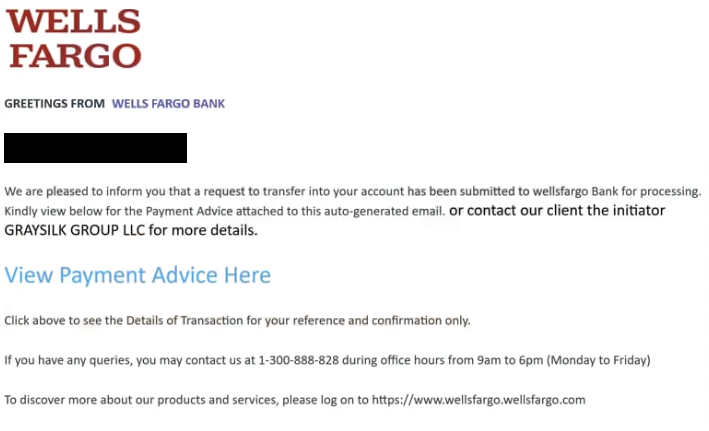
The email is structured to resemble a legitimate financial alert. It may reference a transaction amount, a date, or a generic description such as “wire transfer” or “ACH payment.” The message directs the recipient to click a button to review or cancel the activity. That button does not lead to the official wellsfargo.com domain. Instead, it opens a counterfeit web page created to look like the Wells Fargo login portal.
The fraudulent page displays fields for a user ID and password and may also request additional details such as security answers or one-time codes. The layout can include the Wells Fargo logo and a basic account access interface. Despite these visual elements, the domain shown in the browser address bar does not belong to Wells Fargo. The page does not provide real account access and does not display actual transaction data.
When the recipient enters credentials, the information is transmitted to the scammers. The site does not verify any transactions and does not cancel any payments. After submission, the page may display a generic message or redirect to the legitimate Wells Fargo website to make the process appear authentic. By then, the login data has already been captured.
The targeted information in the “Wells Fargo – Transaction Notification” scam includes online banking login credentials and potentially other authentication details. With this data, attackers can attempt to access the real account. If successful, they may review balances, initiate unauthorized transfers, change contact information, or add new payees. Financial account compromise can result in direct monetary loss and exposure of personal information.
The full “Wells Fargo – Transaction Notification” phishing email is below:
Subject: Transaction Notification.
GREETINGS FROM WELLS FARGO BANK
–
We are pleased to inform you that a request to transfer into your account has been submitted to wellsfargo Bank for processing. Kindly view below for the Payment Advice attached to this auto-generated email. or contact our client the initiator GRAYSILK GROUP LLC for more details.
View Payment Advice Here
Click above to see the Details of Transaction for your reference and confirmation only.
If you have any queries, you may contact us at 1-300-888-828 during office hours from 9am to 6pm (Monday to Friday)
To discover more about our products and services, please log on to –
How to identify the “Wells Fargo – Transaction Notification” phishing email
The “Wells Fargo – Transaction Notification” scam can be identified by closely examining the email’s technical and structural details. One of the clearest indicators is the sender address. Although the display name may reference Wells Fargo, the actual sending domain does not match wellsfargo.com. Phishing emails frequently use unrelated domains or slight variations of legitimate brand names.
The greeting in the email is often generic rather than personalized. Legitimate banking alerts typically address customers by their full name and may reference partial account numbers. The scam email usually avoids including accurate account-specific details. It relies on general language about a transaction rather than verifiable information.
Another sign is the embedded link. Hovering over the button reveals a destination URL that does not lead to the official Wells Fargo website. The domain may contain additional words, random characters, or a misspelled version of the brand name. Official banking alerts direct customers to sign in through the bank’s established website, not through unfamiliar external domains.
The email’s urgency is also a defining trait. It emphasizes immediate action to review or cancel the transaction. This pressure is used to prompt quick clicks without careful inspection. Authentic banking communications provide secure ways to review account activity through official channels and do not require customers to submit credentials through unsolicited links.
The combination of a mismatched sender domain, lack of personalized account details, urgent transaction claims, and links leading to non-Wells Fargo domains defines the “Wells Fargo – Transaction Notification” scam. Recognizing these specific elements helps distinguish the phishing email from legitimate banking notifications.
Site Disclaimer
2-remove-virus.com is not sponsored, owned, affiliated, or linked to malware developers or distributors that are referenced in this article. The article does not promote or endorse any type of malware. We aim at providing useful information that will help computer users to detect and eliminate the unwanted malicious programs from their computers. This can be done manually by following the instructions presented in the article or automatically by implementing the suggested anti-malware tools.
The article is only meant to be used for educational purposes. If you follow the instructions given in the article, you agree to be contracted by the disclaimer. We do not guarantee that the artcile will present you with a solution that removes the malign threats completely. Malware changes constantly, which is why, in some cases, it may be difficult to clean the computer fully by using only the manual removal instructions.