

Meta has offered competing AI chatbot developers temporary free access to WhatsApp in Europe as the company attempts to address growing antitrust concerns from European Union regulators.
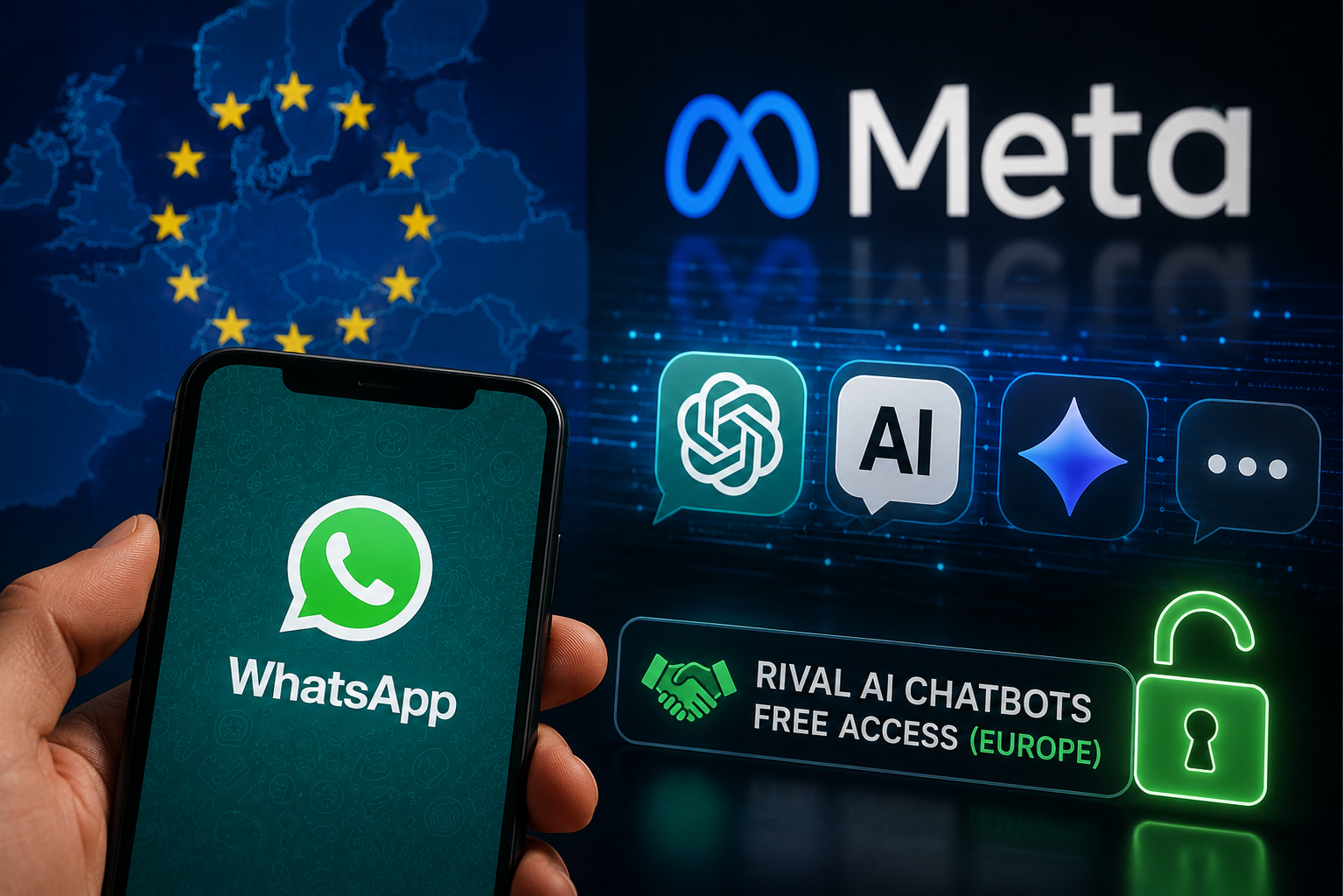
According to multiple reports, Meta’s proposal would allow rival AI assistants, including platforms such as OpenAI’s ChatGPT, to use WhatsApp’s Business API free of charge for a limited period. Once usage exceeds a certain message threshold, Meta would begin charging developers for access.
The move follows mounting pressure from the European Commission, which has been investigating whether Meta unfairly restricted competition by limiting access to WhatsApp for third-party AI services. Regulators reportedly considered forcing Meta to fully open the platform while the antitrust probe remains active.
Meta originally introduced a policy in January 2026 that effectively blocked rival general-purpose AI chatbots from operating on WhatsApp. Under the updated rules, only Meta AI could function natively within the messaging platform, prompting criticism from competitors and regulators.
In March, Meta partially revised the policy and began allowing external AI chatbot providers to access WhatsApp through paid API access. However, critics argued the pricing structure created financial barriers that favored Meta’s own AI ecosystem.
The latest proposal appears designed to avoid potential regulatory penalties and ease concerns that Meta could dominate the growing AI assistant market by leveraging WhatsApp’s massive user base. WhatsApp currently serves more than three billion users globally, making it one of the largest distribution platforms for consumer AI services.
Despite the concession, some smaller AI companies remain dissatisfied with Meta’s offer. Developers involved in the EU complaint reportedly argued that the temporary access arrangement does not fully resolve competition concerns because Meta AI itself is not subject to the same limitations or fees.
The European Commission has not yet announced a final decision on whether it will accept Meta’s proposal or continue pursuing formal enforcement measures. Regulators said their priority remains maintaining an open and competitive AI assistant ecosystem within Europe’s digital market.
The case highlights growing global scrutiny surrounding how major technology companies integrate artificial intelligence into dominant communication platforms. Regulators increasingly fear that large platforms could use control over messaging ecosystems, app stores, and APIs to suppress smaller AI competitors before the market fully matures.
Site Disclaimer
2-remove-virus.com is not sponsored, owned, affiliated, or linked to malware developers or distributors that are referenced in this article. The article does not promote or endorse any type of malware. We aim at providing useful information that will help computer users to detect and eliminate the unwanted malicious programs from their computers. This can be done manually by following the instructions presented in the article or automatically by implementing the suggested anti-malware tools.
The article is only meant to be used for educational purposes. If you follow the instructions given in the article, you agree to be contracted by the disclaimer. We do not guarantee that the artcile will present you with a solution that removes the malign threats completely. Malware changes constantly, which is why, in some cases, it may be difficult to clean the computer fully by using only the manual removal instructions.