

The “Email Access Expired” email is a phishing message designed to obtain recipients’ email account login credentials. It is presented as an urgent system notification concerning the status of the recipient’s mailbox, but the warning does not originate from a legitimate email service provider. Instead, scammers use the fabricated account problem to direct recipients to a fraudulent login page where submitted credentials can be stolen.
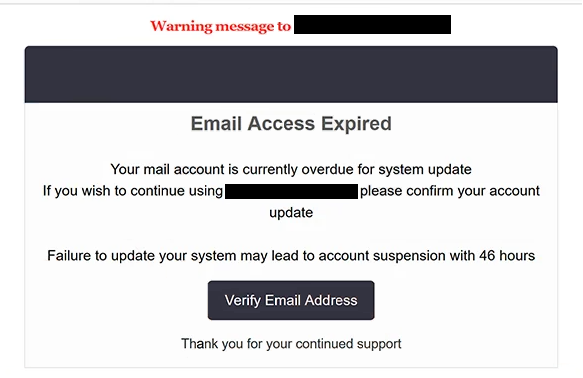
The phishing email has been observed with the subject line “Last Warning Email Access Has Expired.” This wording immediately introduces urgency by suggesting that access to the recipient’s mailbox has already expired and that action is required to restore or maintain normal use of the account.
Inside the message, the recipient is told that their mail account is overdue for a system update. The email claims that the account must be confirmed and warns that it could be suspended within 46 hours if the supposed update is not completed. This deadline is intended to encourage recipients to act on the message rather than independently verify whether their email account actually requires attention.
The “Email Access Expired” message provides a button labeled “Verify Email Address” as the supposed way to resolve the issue. Despite what the message claims, this button is not part of a genuine email account update procedure. Selecting it takes the recipient to a phishing website designed to resemble a cPanel Webmail login page.
Once recipients reach the fake Webmail page, they are asked to enter an email address and password. The page does not use those credentials to confirm an account, complete a system update, or restore expired email access. Information submitted through the phishing form is instead collected by the scammers behind the campaign.
The stolen credentials can allow unauthorized access to the affected mailbox if they are still valid. This can expose private emails and other information accessible through the account. An email account can also have an important role in securing other online services because password resets and account verification messages are commonly sent to the registered email address.
Access to a compromised mailbox may consequently help criminals target other accounts connected to the same email address. The affected email account can also be used to impersonate its owner when communicating with contacts. Messages originating from an account that recipients already recognize may appear more credible than messages arriving from an unfamiliar address.
The full “Email Access Expired” phishing email is below:
Subject: Last Warning Email Access Has Expired 12 August, 2026
Warning message to –
Email Access Expired
Your mail account is currently overdue for system update
If you wish to continue using -, please confirm your account updateFailure to update your system may lead to account suspension with 46 hours
[Verify Email Address]Thank you for your continued support
How to recognize and avoid the “Email Access Expired” phishing email
The claims made in the “Email Access Expired” email should be verified independently before taking any action. An unexpected message stating that mailbox access has expired and that an account could soon be suspended creates pressure to respond quickly. In this campaign, recipients are specifically given 46 hours to complete the supposed system update.
Instead of using the “Verify Email Address” button, recipients can check the status of their account by accessing their email provider through the website or application they normally use. This avoids relying on a destination supplied by an unsolicited message. If the account genuinely requires attention, users can handle the issue through the provider’s legitimate account-management interface.
The destination attached to an email button should also be examined where possible. Hovering over a button without selecting it can reveal its underlying address in many desktop browsers and email clients. The destination should correspond to the service that supposedly sent the notification. An unexpected external destination is a reason not to provide credentials.
Recipients should also examine the sender information rather than relying exclusively on the name displayed by their email application. A sender name or message formatting can be made to resemble an automated service notification. Checking the full sending address and comparing its domain with the legitimate provider can help identify inconsistencies.
The request for credentials is another critical warning sign in the “Email Access Expired” scam. The message creates an alleged account problem and then directs the recipient to a separate Webmail login page to enter an email address and password. There is no need to use that page to determine whether the warning is genuine. The account can be checked directly through the normal email service.
Users who receive the email but do not submit credentials through the phishing website should avoid further interaction with the message and delete it. Receiving or opening the email itself does not mean that the scammers have obtained the recipient’s email password.
If credentials have already been entered into the fake cPanel Webmail page, the password for the affected account should be changed through the legitimate email provider as soon as possible. Any other account using the same password should also receive a new, unique password. Continuing to use credentials that have already been submitted to a phishing site can leave other accounts exposed.
The affected mailbox should additionally be reviewed for unauthorized activity and unexpected account changes. Since access to an email account may be relevant to password recovery for other services, users who submitted credentials should also check important accounts associated with the email address.
Site Disclaimer
2-remove-virus.com is not sponsored, owned, affiliated, or linked to malware developers or distributors that are referenced in this article. The article does not promote or endorse any type of malware. We aim at providing useful information that will help computer users to detect and eliminate the unwanted malicious programs from their computers. This can be done manually by following the instructions presented in the article or automatically by implementing the suggested anti-malware tools.
The article is only meant to be used for educational purposes. If you follow the instructions given in the article, you agree to be contracted by the disclaimer. We do not guarantee that the artcile will present you with a solution that removes the malign threats completely. Malware changes constantly, which is why, in some cases, it may be difficult to clean the computer fully by using only the manual removal instructions.