

The “Unsuccessful Log-on Attempts on Your American Express Online” phishing email is a scam that impersonates American Express to steal online account credentials. It claims that multiple unsuccessful login attempts have been detected from an unfamiliar location and urges recipients to verify their identities. The warning is intended to create concern about unauthorized account access and direct users to a fake American Express login page.
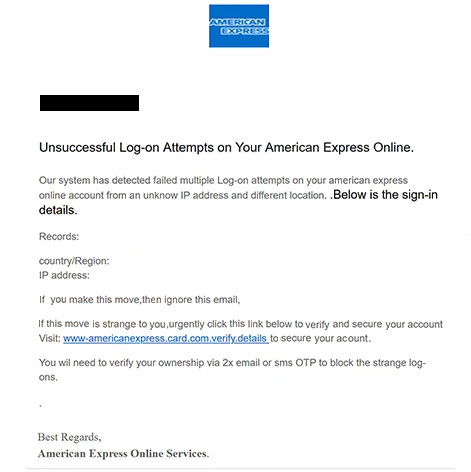
The phishing email uses the subject line “Unsuccessful Login Attempts From New Location” and presents itself as a security notification from American Express Online Services. It claims that someone attempted to access the recipient’s account from an unknown IP address in Romania. To support this allegation, the email includes a section labeled “Records” containing the supposed location and IP address.
However, the technical information contains an obvious inconsistency. The listed IP address, 6.685.842.0, is not a valid IPv4 address because two of its numerical sections exceed the permitted range. This undermines the credibility of the alleged login records and indicates that the information was fabricated.
Recipients are instructed to follow an embedded link if they do not recognize the login attempts. The email claims that account ownership must be confirmed using email or SMS one-time passwords (OTPs) to block the suspicious activity. This makes the request resemble a legitimate financial account verification procedure.
The link directs recipients to a website unrelated to American Express. The phishing page was designed to imitate the company’s login portal and collect account credentials, although the identified website was no longer active when examined. The exact information that could still be submitted to the inactive page cannot be confirmed.
If scammers obtain valid American Express credentials, they may attempt to access the affected account and view sensitive financial information. Depending on the account’s security protections, stolen credentials could also be used in attempts to make unauthorized transactions or obtain additional personal information.
The full “Unsuccessful Log-on Attempts on Your American Express Online” phishing email is below:
Subject: Unsuccessful Login Attempts From New Location
American Express
-,
Unsuccessful Log-on Attempts on Your American Express Online.
Our system has detected failed multiple Log-on attempts on your american express online account from an unknow IP address and different location. .Below is the sign-in details.
Records:
country/Region:
IP address:If you make this move,then ignore this email,
if this move is strange to you,urgently click this link below to verify and secure your account Visit: [link] to secure your acount.
You wil need to verify your ownership via 2x email or sms OTP to block the strange log-ons.
Best Regards,
American Express Online Services.
How to recognize phishing emails
The “Unsuccessful Log-on Attempts on Your American Express Online” phishing email contains several warning signs, particularly its unusual presentation of the alleged login activity. Although it claims that someone attempted to access the recipient’s account from Romania, the IP address provided is technically invalid. Genuine IPv4 addresses consist of four numerical sections, each ranging from 0 to 255.
The email also contains numerous spelling and grammatical mistakes. Phrases such as “unknow IP address,” “If you make this move,” and “You wil need to verify” are inconsistent with the professional language expected in official banking communications. These errors are especially noticeable because the email claims to concern a sensitive financial security issue.
Another suspicious element is the instruction to verify account ownership through an embedded link. The email encourages recipients to act urgently if they do not recognize the alleged login attempts, creating pressure to follow the provided instructions. However, the link leads to a domain unrelated to American Express.
The reference to email and SMS one-time passwords is also significant. Scammers may incorporate familiar authentication terminology into phishing emails to make their requests appear legitimate. In this case, the mention of OTP verification is used to support an account security warning that has not been substantiated.
The sender’s claimed identity deserves attention as well. The email closes with “American Express Online Services,” but a recognizable company name in a signature does not verify who sent it. Phishing emails can reproduce financial institutions’ names, logos, and security terminology without authorization.
The wording of the notification creates additional inconsistencies. It refers to multiple failed login attempts but provides only a vague location and an invalid IP address, without reliable information about when the attempts occurred. The email also instructs recipients to ignore the warning if they recognize the activity, despite presenting the attempts as unsuccessful.
Site Disclaimer
2-remove-virus.com is not sponsored, owned, affiliated, or linked to malware developers or distributors that are referenced in this article. The article does not promote or endorse any type of malware. We aim at providing useful information that will help computer users to detect and eliminate the unwanted malicious programs from their computers. This can be done manually by following the instructions presented in the article or automatically by implementing the suggested anti-malware tools.
The article is only meant to be used for educational purposes. If you follow the instructions given in the article, you agree to be contracted by the disclaimer. We do not guarantee that the artcile will present you with a solution that removes the malign threats completely. Malware changes constantly, which is why, in some cases, it may be difficult to clean the computer fully by using only the manual removal instructions.