

The “Update required – Netflix account on hold” phishing email is a fraudulent message that impersonates the popular streaming service in an attempt to steal account credentials and financial information. The email falsely claims that the recipient’s payment method has failed, expired, or can no longer be processed, warning that continued access to the streaming service will be interrupted unless the billing information is updated. The notification is not sent by Netflix but by cybercriminals conducting a phishing campaign.
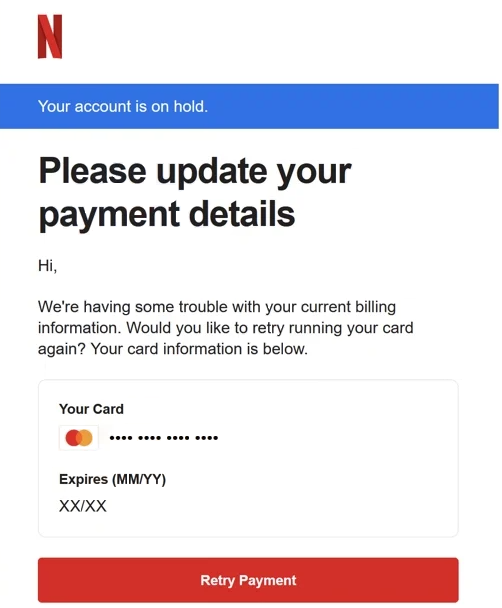
The message typically informs recipients that their most recent subscription payment could not be completed due to an issue with the registered payment card. It may claim that the billing information is outdated, that the payment was declined by the bank, or that the account requires immediate verification before the next billing cycle. To increase urgency, the email often warns that the Netflix subscription will be suspended or cancelled if no action is taken within a limited period.
To supposedly resolve the billing issue, the email includes a button labelled with phrases such as “Update Payment Details”, “Verify Account”, or “Restart Membership”. Rather than directing recipients to Netflix’s legitimate website, the embedded link leads to a counterfeit page that closely imitates the appearance of the official Netflix sign-in and payment portal.
Victims are first asked to sign in using their Netflix account credentials. After entering their username and password, they may be instructed to provide additional information, including their full name, billing address, credit or debit card number, expiration date, CVV code, and sometimes even telephone number. Instead of updating a subscription, the information entered into these forms is transmitted directly to the operators of the phishing campaign.
Stolen Netflix credentials may be used to access the victim’s streaming account, while payment card information can be exploited for unauthorized purchases or sold on criminal marketplaces. If the same password has been reused on other online services, attackers may also attempt to access those accounts using the stolen credentials.
The “Update required – Netflix account on hold” phishing email is designed to appear authentic by using Netflix branding, familiar colours, professionally formatted layouts, and customer service language. Some versions include fake invoice numbers, subscription references, or account identifiers to make the message appear more convincing. Despite these visual similarities, the email does not originate from Netflix.
Anyone who submitted login credentials after interacting with the “Update required – Netflix account on hold” phishing email should immediately change the password for their Netflix account. If the same password has been used elsewhere, it should also be replaced on those accounts. Recipients who disclosed payment card information should contact their bank or card issuer immediately to report the incident, monitor transactions for suspicious activity, and request a replacement card if necessary.
The full “Update required – Netflix account on hold” phishing email is below:
Subject: Update required – Netflix account on hold
Netflix
Your account is on hold.Please update your payment details
Hi,
We’re having some trouble with your current billing information. Would you like to retry running your card again? Your card information is below.
Your Card
MASTERCARD
•••• •••• •••• ••••
Expires (MM/YY)
XX/XXRetry Payment
Enter New Payment Method
We’re here to help if you need it. Visit the Help Center for more info or contact us.
The Netflix team
How to identify Netflix phishing emails
Unexpected emails claiming that a Netflix payment has failed should always be verified independently before any action is taken. Legitimate subscription services generally allow customers to review billing issues by signing in directly through their official website or mobile application instead of requiring authentication through links contained in unsolicited emails.
Recipients should carefully inspect the sender’s email address rather than relying solely on the displayed company name. Phishing campaigns frequently imitate well-known brands while using unrelated domains that reveal the message is fraudulent.
Another warning sign is an email that creates unnecessary urgency by threatening immediate account suspension or cancellation unless payment information is updated through the embedded link. Cybercriminals commonly use time pressure to persuade recipients to react before evaluating the message critically.
Before entering any login credentials or payment information, users should verify that the website displayed in the browser’s address bar belongs to Netflix’s official domain. A convincing design alone is not evidence that a webpage is legitimate.
The safest approach is to ignore links contained in unexpected billing notifications and manually visit the official Netflix website by typing its address into a browser. If no billing alert appears after signing in, the email should be regarded as a phishing attempt and deleted.
Site Disclaimer
2-remove-virus.com is not sponsored, owned, affiliated, or linked to malware developers or distributors that are referenced in this article. The article does not promote or endorse any type of malware. We aim at providing useful information that will help computer users to detect and eliminate the unwanted malicious programs from their computers. This can be done manually by following the instructions presented in the article or automatically by implementing the suggested anti-malware tools.
The article is only meant to be used for educational purposes. If you follow the instructions given in the article, you agree to be contracted by the disclaimer. We do not guarantee that the artcile will present you with a solution that removes the malign threats completely. Malware changes constantly, which is why, in some cases, it may be difficult to clean the computer fully by using only the manual removal instructions.