

The “24-Hour Password Expiration Notice” phishing email is a fraudulent message that attempts to steal email account credentials by claiming that the recipient’s password will expire within the next 24 hours. The email instructs users to keep their current password or update it immediately to avoid losing access to their mailbox. These claims are false and are used to lure recipients to a phishing website.
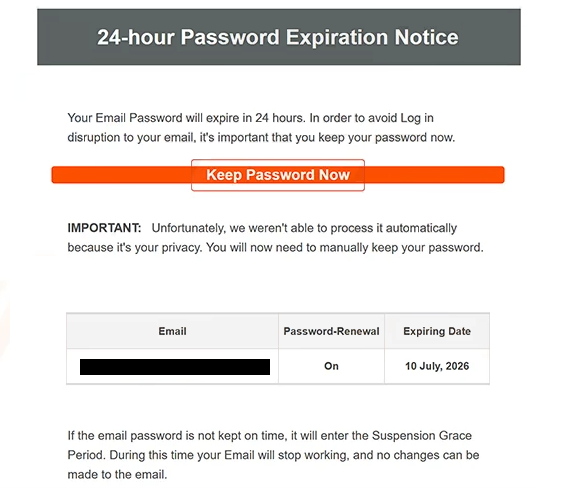
Unlike many phishing campaigns that focus on suspicious logins or mailbox storage limits, the “24-Hour Password Expiration Notice” phishing email revolves around password expiration. The message states that the account password is about to expire and warns that failing to respond before the deadline could result in account deactivation, login failures, or permanent loss of access. The notification is not associated with any legitimate email provider.
To supposedly prevent these consequences, recipients are instructed to click a button such as “Keep Current Password”, “Keep Same Password”, or another similarly worded option. Although the email presents this action as a routine account maintenance procedure, the embedded link redirects users to a counterfeit login page designed to capture credentials rather than manage passwords.
The phishing website typically imitates an email sign-in portal. Victims are asked to enter their email address and password to confirm their identity or retain their existing password. No password validation or account maintenance occurs. Instead, every credential entered into the form is collected by the attackers behind the campaign.
Email accounts are attractive targets because they often serve as the recovery method for many online services. Attackers who obtain access to a mailbox may search for password reset messages, financial notifications, contracts, invoices, authentication emails, or other sensitive information. They may also use the compromised account to impersonate its owner or attempt to gain access to additional services linked to the same email address.
A recurring characteristic of the “24-Hour Password Expiration Notice” phishing email is the use of urgency. By imposing a short deadline and suggesting that immediate action is necessary, the attackers attempt to discourage recipients from verifying the legitimacy of the notification. This social engineering technique is commonly used to increase the likelihood that users will follow the provided instructions without further scrutiny.
Anyone who entered login credentials through a website linked from the “24-Hour Password Expiration Notice” phishing email should immediately change the password for the affected email account. If the same password has been reused on other websites or services, it should be replaced there as well. Users should also review recent account activity and update recovery information if unauthorized access is suspected.
The full “24-Hour Password Expiration Notice” phishing email is below:
Subject: 24-hour Password Expiration Notice: –
24-hour Password Expiration Notice
Your Email Password will expire in 24 hours. In order to avoid Log in disruption to your email, it’s important that you keep your password now.
[Keep Password Now]IMPORTANT: Unfortunately, we weren’t able to process it automatically because it’s your privacy. You will now need to manually keep your password.
Email | Password-Renewal | Expiring Date
– | On | 10 July, 2026If the email password is not kept on time, it will enter the Suspension Grace Period. During this time your Email will stop working, and no changes can be made to the email.
Copyright © 2026
How to identify password expiration phishing emails
Emails claiming that a password will expire within a very short period should be approached with caution, particularly when they instruct recipients to follow an embedded link. Legitimate service providers generally allow users to manage account credentials after signing in through their official websites rather than through links contained in unsolicited emails.
Recipients should also examine the sender’s address carefully. Phishing emails frequently imitate support teams or system administrators while originating from unrelated domains that have no connection to the organization they claim to represent.
Another warning sign is any email encouraging users to keep their current password by clicking a button. Legitimate password management processes rarely require users to confirm an existing password through a link received in an unexpected email. Requests of this nature should always be verified independently.
Users should also inspect the destination of embedded links before opening them. A login page hosted on an unfamiliar or unrelated domain should not be trusted, even if it resembles a legitimate webmail portal.
The safest approach is to ignore links contained in password expiration notifications and instead access the email account by manually entering the provider’s official website address into a browser. If no corresponding notification is displayed after signing in, the email can safely be treated as a phishing attempt.
Incoming search terms:
Site Disclaimer
2-remove-virus.com is not sponsored, owned, affiliated, or linked to malware developers or distributors that are referenced in this article. The article does not promote or endorse any type of malware. We aim at providing useful information that will help computer users to detect and eliminate the unwanted malicious programs from their computers. This can be done manually by following the instructions presented in the article or automatically by implementing the suggested anti-malware tools.
The article is only meant to be used for educational purposes. If you follow the instructions given in the article, you agree to be contracted by the disclaimer. We do not guarantee that the artcile will present you with a solution that removes the malign threats completely. Malware changes constantly, which is why, in some cases, it may be difficult to clean the computer fully by using only the manual removal instructions.