

The Bittrex Remaining Claim email scam is a cryptocurrency phishing campaign that impersonates entities involved in the Bittrex bankruptcy and liquidation process. The email falsely claims that the recipient is entitled to receive a remaining claim payment and encourages them to access a portal in order to recover the funds. In reality, the message is designed to redirect victims to a fraudulent website where attackers attempt to steal cryptocurrency wallet information and digital assets.
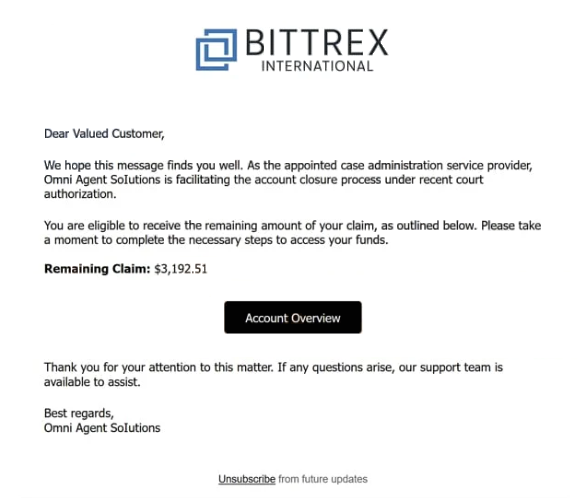
The phishing email presents itself as a notification from Omni Agent Solutions, a legitimate case administration company associated with bankruptcy proceedings. The message states that the recipient is eligible to receive a remaining claim amount of $3,192.51 and instructs them to click an “Account Overview” button to access the funds. By referencing a specific payment amount and a real organization, the scam attempts to appear authentic and trustworthy.
Recipients who click the button are redirected to a fake Bittrex-themed website hosted on domains such as client.793215-bittrex.com. The fraudulent page continues the deception by claiming that users can recover withheld assets and gains connected to the liquidation of Bittrex Global. Visitors are instructed to enter their email address and connect a cryptocurrency wallet supposedly associated with their Bittrex account.
The purpose of the fake website is to obtain sensitive wallet information. Victims may be asked to provide recovery phrases, secret keys, or wallet access details under the pretense of verifying ownership before funds can be released. Once attackers obtain this information, they can gain control of the wallet and transfer cryptocurrency to their own accounts. Since cryptocurrency transactions are generally irreversible, stolen assets are often impossible to recover.
The Bittrex Remaining Claim email scam exploits the real-world collapse and liquidation of the Bittrex cryptocurrency exchange. Attackers use public knowledge about the bankruptcy proceedings to create a believable scenario involving unclaimed balances and remaining distributions. Security researchers have observed multiple phishing campaigns using similar themes, including fake withdrawal notices, bankruptcy claims, and recovery opportunities connected to Bittrex users.
Another reason the scam appears convincing is its professional presentation. The email uses formal language, references legitimate organizations, and imitates official financial communications. Some versions even include authentic-looking contact details and formatting associated with real bankruptcy administration notices. These elements are intended to lower suspicion and encourage recipients to trust the fraudulent claim process.
Anyone who submitted wallet recovery phrases, private keys, or other sensitive information through a website connected to the Bittrex Remaining Claim email scam should assume that their cryptocurrency assets are at risk. Wallet credentials exposed to attackers can allow immediate unauthorized transfers and permanent financial loss.
The full Bittrex Remaining Claim email scam is below:
Subject: New Update Relating to Your Claim
Dear Valued Customer,
We hope this message finds you well. As the appointed case administration service provider, Omni Agent SoIutions is facilitating the account closure process under recent court authorization.
You are eligible to receive the remaining amount of your claim, as outlined below. Please take a moment to complete the necessary steps to access your funds.
Remaining Claim: $3,192.51
Account OverviewThank you for your attention to this matter. If any questions arise, our support team is available to assist.
Best regards,
Omni Agent SoIutions
Unsubscribe from future updates
Copyright 2025 Omni Agent SoIutions
This email was sent to info@rcservice.lt using govDelivery Communications Cloud on behalf of: Doña Ana County, New Mexico · 845 N Motel Blvd
How to recognize cryptocurrency phishing emails
Cryptocurrency phishing campaigns like the Bittrex Remaining Claim scam frequently rely on financial incentives to manipulate recipients into ignoring warning signs. Instead of threatening account suspension or security issues, these scams promise access to money, refunds, or previously unavailable cryptocurrency assets.
One major warning sign is an unexpected claim involving funds that the recipient was not actively attempting to recover. In this case, the email states that the recipient is entitled to receive a remaining claim payment connected to Bittrex. Unsolicited messages promising cryptocurrency payouts or unclaimed balances should always be verified independently before any action is taken.
Another common indicator is the use of suspicious domains. The Bittrex Remaining Claim scam redirects users to websites that imitate legitimate Bittrex-related services while using unofficial addresses such as client.793215-bittrex.com. Fraudulent cryptocurrency websites often rely on lookalike domains designed to resemble real organizations closely enough to deceive visitors.
Requests for wallet recovery phrases or private keys are among the strongest indicators of cryptocurrency fraud. Legitimate companies, exchanges, and bankruptcy administrators do not require users to reveal wallet seed phrases in order to verify ownership or distribute funds. Any website requesting this information should be considered malicious immediately.
Users should also be cautious when asked to connect cryptocurrency wallets to unfamiliar websites. Many phishing operations attempt to trick victims into approving malicious wallet interactions or exposing sensitive credentials through fake verification processes. Once access is granted, attackers may drain cryptocurrency assets directly from connected wallets.
The use of urgency is another common tactic. The Bittrex Remaining Claim email encourages recipients to act quickly in order to access funds. Cryptocurrency scams frequently use deadlines, limited-time opportunities, or warnings about forfeited assets to pressure users into making rushed decisions without carefully reviewing the legitimacy of the request.
A safer approach is to verify all cryptocurrency-related claims directly through official channels rather than through links embedded in emails. Users should navigate to legitimate websites manually and confirm whether any claim process actually exists before interacting with cryptocurrency wallets or providing sensitive information.
Site Disclaimer
2-remove-virus.com is not sponsored, owned, affiliated, or linked to malware developers or distributors that are referenced in this article. The article does not promote or endorse any type of malware. We aim at providing useful information that will help computer users to detect and eliminate the unwanted malicious programs from their computers. This can be done manually by following the instructions presented in the article or automatically by implementing the suggested anti-malware tools.
The article is only meant to be used for educational purposes. If you follow the instructions given in the article, you agree to be contracted by the disclaimer. We do not guarantee that the artcile will present you with a solution that removes the malign threats completely. Malware changes constantly, which is why, in some cases, it may be difficult to clean the computer fully by using only the manual removal instructions.