

The “DHL – Your Shipment Requires Attention” phishing email is a credential-stealing scam that impersonates DHL Express. It tells recipients that a shipment has been placed on hold and claims that additional information is required before delivery can continue.
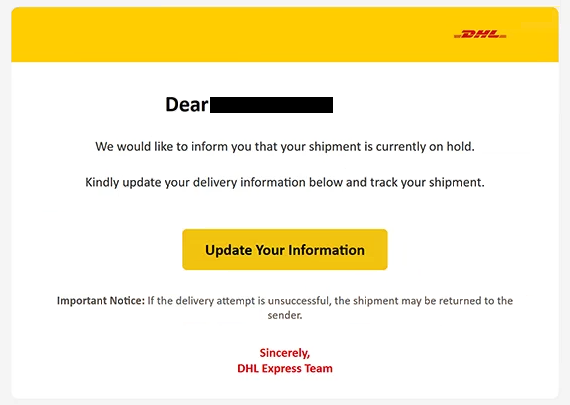
The email uses a shipment problem as a reason to encourage immediate action. Recipients are told that their package requires attention and are asked to update their delivery information. The email also suggests that they can track the shipment after completing the requested steps.
To supposedly resolve the issue, recipients are directed to select “Update Your Information”. The email warns that an unsuccessful delivery attempt could result in the shipment being returned to the sender. For someone expecting a package, this warning can make the request appear urgent.
The delivery problem is fabricated. Selecting “Update Your Information” does not take recipients to an official DHL service. Instead, the link opens a phishing website designed to imitate DHL Express Commerce.
The fraudulent website uses DHL branding and presents visitors with a login form. It asks for an email address and password. Credentials submitted through this form are exposed to the scammers rather than being used to update delivery information or manage a shipment.
Compromised credentials could allow unauthorized access to the affected account and information available through it. Reusing the same password elsewhere can create additional risks if scammers attempt to use the stolen credentials with other online accounts.
DHL Express has no involvement in this phishing campaign. Its identity and branding are being misused to make both the email and the fake login page appear more credible.
The full “DHL – Your Shipment Requires Attention” phishing email is below:
Subject: Important: Your Shipment Requires Attention
DHL
Dear -,
We would like to inform you that your shipment is currently on hold.
Kindly update your delivery information below and track your shipment.
[Update Your Information]Important Notice: If the delivery attempt is unsuccessful, the shipment may be returned to the sender.
Sincerely,
DHL Express Team
How to recognize phishing emails
The supposed shipment problem is one of the main details to examine in the “DHL – Your Shipment Requires Attention” phishing email. An unexpected warning that a delivery is on hold can encourage recipients to respond quickly, particularly when they are already expecting a package.
The threat that the shipment could be returned to the sender adds further pressure. Rather than treating this claim as proof that a delivery problem exists, recipients should verify the shipment independently.
The sender address can provide an important warning sign. In the analyzed campaign, the email was sent from an address unrelated to DHL. Company names, logos, and familiar display names can be copied, so the underlying sender address should be checked before trusting a delivery notification.
The “Update Your Information” link is another significant clue. Its visible wording suggests that it will open a DHL delivery page, but the actual destination is unrelated to DHL. Recipients should check where links lead before entering any account information.
The phishing website can also appear convincing because it imitates DHL Express Commerce and uses recognizable DHL branding. A professional-looking login page, however, does not prove that the website is operated by the company it represents. The actual domain displayed in the browser is more useful for determining where information is being submitted.
Recipients who are expecting a DHL shipment can avoid relying on an unsolicited email by accessing DHL’s legitimate website independently and checking the shipment there. This makes it possible to investigate a delivery issue without using a link supplied by an unknown sender.
Anyone who has already entered credentials on the fake page should change the affected password. If that password has been reused for other accounts, it should be changed on those services as well.
Site Disclaimer
2-remove-virus.com is not sponsored, owned, affiliated, or linked to malware developers or distributors that are referenced in this article. The article does not promote or endorse any type of malware. We aim at providing useful information that will help computer users to detect and eliminate the unwanted malicious programs from their computers. This can be done manually by following the instructions presented in the article or automatically by implementing the suggested anti-malware tools.
The article is only meant to be used for educational purposes. If you follow the instructions given in the article, you agree to be contracted by the disclaimer. We do not guarantee that the artcile will present you with a solution that removes the malign threats completely. Malware changes constantly, which is why, in some cases, it may be difficult to clean the computer fully by using only the manual removal instructions.