

The “Spotify – We still can’t process your payment” phishing email impersonates Spotify and claims there is a problem with the payment method connected to the recipient’s subscription. It directs users to a fake Spotify website where scammers attempt to collect login credentials and payment card information.
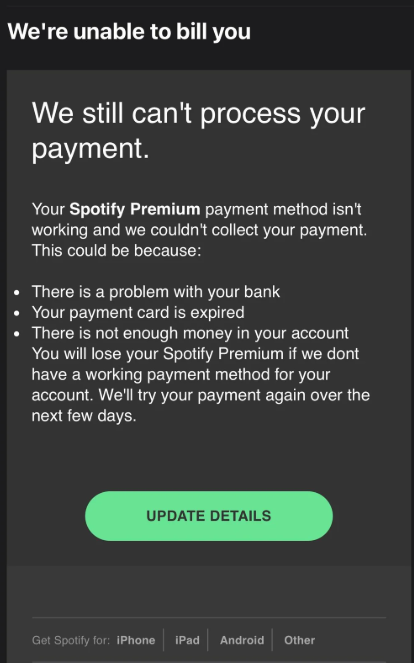
The email warns that Spotify is still unable to process the recipient’s payment. This creates a believable reason for asking the user to review their billing information, especially if the recipient actually uses Spotify Premium or recently had a card expire.
Following the instructions opens a website designed to resemble Spotify’s login page. Visitors are first asked to enter their Spotify credentials. The copied interface can look convincing enough to make the process appear to be part of a genuine subscription payment update.
Testing exposed how the phishing page worked. Completely invented login details could be entered, and the site would still continue to the next step. A legitimate Spotify authentication system would reject incorrect credentials rather than allow the user to proceed. The scammers do not need the fake page to provide access to a Spotify account. They only need it to record whatever credentials a victim submits.
After the supposed login, the “Spotify – We still can’t process your payment” phishing email leads victims toward another form requesting payment card information. This page was less convincing than the copied login screen. Some navigation options did not work, which provided another indication that the site was not a functional Spotify account website.
Valid Spotify credentials submitted through the site could be used to attempt unauthorized access to the real account. Payment card information is more serious, as providing it could expose victims to unauthorized charges or other financial fraud.
Spotify has no connection to this email or the phishing website. Its name and familiar subscription billing process are being copied to make the scam appear legitimate.
How to recognize the “Spotify – We still can’t process your payment” phishing email
The “Spotify – We still can’t process your payment” phishing email uses a payment problem that Spotify subscribers could realistically encounter. A failed recurring payment or expired card is not unusual, which means the warning may seem reasonable without relying on an extraordinary claim.
Recipients should verify such warnings directly through Spotify rather than following instructions in an unexpected email. Opening the Spotify app or accessing the official service independently allows users to check their subscription and payment status without relying on the supplied link.
The website address is another important detail. A page can reproduce Spotify’s logo, login form, fonts, and other visual elements while being hosted on a completely unrelated domain. Familiar branding should therefore never be used as the only indication that a login page is genuine.
The behavior of this particular phishing site provides an especially strong warning sign. It accepts incorrect and even completely fabricated credentials. Instead of checking whether the password belongs to the account, it simply moves visitors forward to the payment stage.
The payment page has further problems. Parts of the interface do not function properly, including navigation elements that would normally allow users to move to other areas of their Spotify account. The page appears to provide only the functionality needed to collect information.
The email itself also deserves scrutiny. In the reported example, it was sent to undisclosed recipients rather than clearly identifying the individual Spotify customer. The sender information also did not match Spotify.
A recipient who is genuinely experiencing a payment problem may be more vulnerable to this type of scam because the warning appears to confirm something they already know. A real expired card, however, does not prove that an email mentioning a payment failure came from Spotify.
Anyone who entered a valid Spotify password on the phishing site should change it through the legitimate Spotify service. The same password should also be changed anywhere else it was reused.
Site Disclaimer
2-remove-virus.com is not sponsored, owned, affiliated, or linked to malware developers or distributors that are referenced in this article. The article does not promote or endorse any type of malware. We aim at providing useful information that will help computer users to detect and eliminate the unwanted malicious programs from their computers. This can be done manually by following the instructions presented in the article or automatically by implementing the suggested anti-malware tools.
The article is only meant to be used for educational purposes. If you follow the instructions given in the article, you agree to be contracted by the disclaimer. We do not guarantee that the artcile will present you with a solution that removes the malign threats completely. Malware changes constantly, which is why, in some cases, it may be difficult to clean the computer fully by using only the manual removal instructions.