

The “Warning: Policy Violation Detected” phishing email is a fraudulent message that attempts to steal email account credentials by falsely claiming that the recipient has violated an organization’s email or security policies. The email warns that the alleged violation has placed the account at risk and instructs the recipient to complete a verification process to avoid restrictions. The notification is not sent by a legitimate email provider or administrator but is part of a phishing campaign.
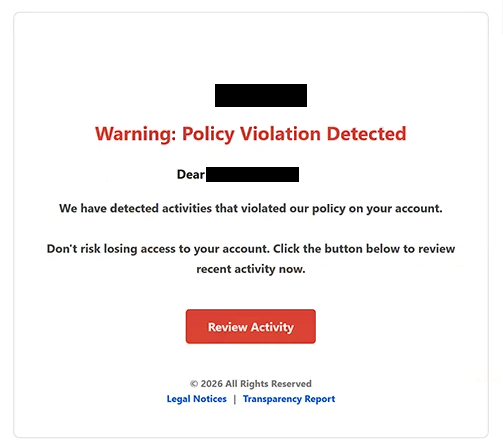
The message typically informs recipients that automated monitoring systems have detected activity that conflicts with company policies or acceptable use guidelines. Rather than identifying a specific incident, it refers to a generic policy breach and claims that the account must be reviewed immediately. This lack of detail is intentional and is meant to encourage recipients to click the provided link to determine what supposedly happened.
To resolve the alleged issue, the email includes a button inviting users to review the violation, verify their identity, or restore normal account status. Instead of opening an official account management portal, the link redirects users to a counterfeit website that imitates a webmail login page. In some cases, the phishing page is designed to resemble the recipient’s actual email provider, making the scam more convincing.
Recipients are instructed to enter their email address and password to confirm account ownership or complete the review process. No account investigation or verification occurs. The submitted credentials are transmitted directly to the operators of the phishing campaign, who can then attempt to access the compromised mailbox.
Email account credentials are valuable because they may provide access to sensitive information, including business correspondence, contracts, invoices, password reset emails, authentication codes, and financial notifications. Since many online services use email accounts for password recovery, attackers may also attempt to compromise additional accounts linked to the same email address.
Unlike phishing campaigns that rely on password expiration notices or mailbox storage warnings, the “Warning: Policy Violation Detected” phishing email exploits concerns about compliance and account misuse. By suggesting that the recipient has already broken organizational rules, the scammers attempt to trigger an immediate response before the legitimacy of the message is questioned.
To increase credibility, the email often includes administrative language, references to internal policies, security compliance, or automated monitoring systems. It may also impose an artificial deadline, warning that the account will be suspended or permanently restricted if the requested action is not completed promptly. These urgency tactics are intended to pressure recipients into interacting with the email without independently verifying its authenticity.
Anyone who entered login credentials after following a link contained in the “Warning: Policy Violation Detected” phishing email should immediately change the password for the affected mailbox. If the same password has been reused on other services, it should be changed there as well. Users should also review recent login history, verify recovery settings, and enable multi-factor authentication if it is available.
The full “Warning: Policy Violation Detected” phishing email is below:
Subject: Warning! Immediate action required!
Warning: Policy Violation Detected
Dear -,
We have detected activities that violated our policy on your account.Don’t risk losing access to your account. Click the button below to review recent activity now.
[Review Activity]
© 2026 All Rights Reserved
Legal Notices | Transparency Report
How to identify phishing emails
Unexpected messages claiming that an email account has violated organizational or security policies should be treated with caution. Legitimate service providers and IT departments generally allow users to review account status by signing in through their official websites or internal portals instead of requiring authentication through links embedded in unsolicited emails.
Recipients should carefully examine the sender’s email address, as phishing campaigns frequently imitate security teams or system administrators while using domains unrelated to the organization they claim to represent.
Another warning sign is a notification that accuses the recipient of violating a policy without identifying the specific rule or providing supporting information. Legitimate administrative notices typically explain the issue in greater detail and provide official methods for resolving it.
Before entering credentials, users should inspect the destination website. A login page hosted on an unfamiliar domain should not be trusted, even if it closely resembles the official webmail interface.
The safest response to an unexpected “Warning: Policy Violation Detected” email is to ignore the embedded links and access the email account directly through the provider’s official website. If no corresponding notification appears after signing in, the message should be treated as a phishing attempt.
Incoming search terms:
Site Disclaimer
2-remove-virus.com is not sponsored, owned, affiliated, or linked to malware developers or distributors that are referenced in this article. The article does not promote or endorse any type of malware. We aim at providing useful information that will help computer users to detect and eliminate the unwanted malicious programs from their computers. This can be done manually by following the instructions presented in the article or automatically by implementing the suggested anti-malware tools.
The article is only meant to be used for educational purposes. If you follow the instructions given in the article, you agree to be contracted by the disclaimer. We do not guarantee that the artcile will present you with a solution that removes the malign threats completely. Malware changes constantly, which is why, in some cases, it may be difficult to clean the computer fully by using only the manual removal instructions.