

The “Webmail Optimum Terms and Conditions Update” email is a phishing attempt that impersonates a webmail service and uses a supposed policy change to steal email account credentials. The message presents itself as an official notice from “Webmail Optimum” and the “CPanel Webmail Team,” but neither cPanel nor any legitimate webmail provider is associated with the campaign.
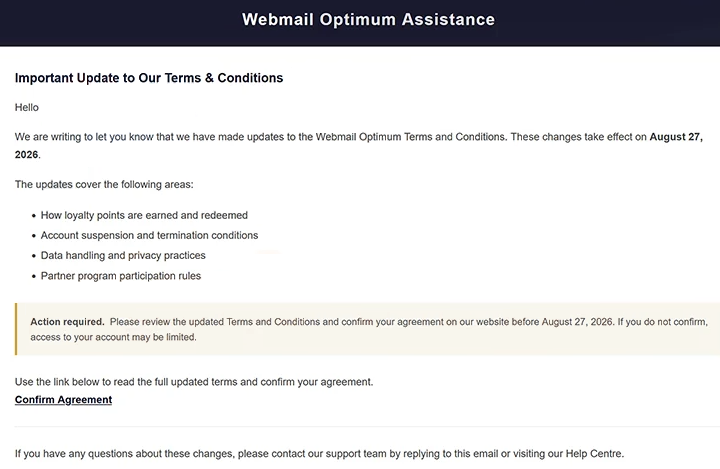
The phishing email has been observed with the subject “[-]: Please Confirm To Continue.” It tells recipients that the Webmail Optimum Terms and Conditions have recently been revised and that the changes take effect on August 27, 2026.
Recipients are instructed to review the updated conditions and confirm their agreement before August 27. The email warns that failure to provide confirmation could result in limited access to the account. A “Confirm Agreement” link is supplied as the method for completing the process.
Following this link does not display legitimate Webmail Optimum terms. Instead, it redirects to a fake cPanel Webmail login page hosted through an IPFS gateway. The page requests an email address and password. Credentials entered into the form are sent to the scammers rather than used to confirm any agreement.
If scammers obtain valid email credentials, they may be able to access private messages and other information stored in the mailbox. A compromised email account can also be used to impersonate its owner or request password resets for other services associated with the same address.
The full “Webmail Optimum Terms and Conditions Update” phishing email is below:
Subject: [-]: Please Confirm To Continue.
Webmail Optimum Assistance
Important Update to Our Terms & ConditionsHello -,
We are writing to let you know that we have made updates to the Webmail Optimum Terms and Conditions. These changes take effect on August 27, 2026.
The updates cover the following areas:
How loyalty points are earned and redeemed
Account suspension and termination conditions
Data handling and privacy practices
Partner program participation rulesAction required. Please review the updated Terms and Conditions and confirm your agreement on our website before August 27, 2026. If you do not confirm, access to your account may be limited.
Use the link below to read the full updated terms and confirm your agreement.
[Confirm Agreement]If you have any questions about these changes, please contact our support team by replying to this email or visiting our Help Centre.
Thank you for being a Webmail member.
Regards,
The CPanel Webmail Team© 2026 CPanel Webmail. All rights reserved.
You are receiving this notice because you hold a registered MakeMeLoyal account.
To unsubscribe from non-essential communications, click here. Note: transactional and legal notices cannot be unsubscribed.
How to recognize the “Webmail Optimum Terms and Conditions Update” phishing email
The inconsistent identities used throughout the email are among the strongest indications that it should not be trusted. The message refers to “Webmail Optimum,” claims to come from the “CPanel Webmail Team,” and then unexpectedly mentions a “MakeMeLoyal account” in its footer. These unrelated references do not belong in a legitimate webmail policy notification.
The artificial deadline is another important warning sign. Recipients are told that they must accept the revised conditions before August 27, 2026, or potentially have their account access restricted. This threat encourages quick action rather than giving recipients time to verify whether the notification is genuine.
Users should also be suspicious of the “Confirm Agreement” link. A familiar-looking cPanel Webmail page does not prove that the destination belongs to cPanel or the recipient’s email provider. In this campaign, the phishing page is hosted through an IPFS gateway rather than a legitimate cPanel service.
Unexpected requests for email passwords should always be treated cautiously. Accepting updated terms and conditions should not require users to enter their webmail credentials into an unfamiliar page reached through an unsolicited email.
Recipients who want to determine whether their email provider has actually changed its terms should access the service independently using its normal website. Account notices and policy updates can then be checked without relying on the link supplied in the email.
Simply receiving or reading the “Webmail Optimum Terms and Conditions Update” phishing email does not expose account credentials. Users who have not entered information on the linked page should avoid the “Confirm Agreement” link and delete the message.
Anyone who has already submitted an email address and password should change the affected password through the legitimate email provider. The same password should be replaced on any other accounts where it was reused, and the mailbox should be checked for unfamiliar sessions or unauthorized changes.
Incoming search terms:
Site Disclaimer
2-remove-virus.com is not sponsored, owned, affiliated, or linked to malware developers or distributors that are referenced in this article. The article does not promote or endorse any type of malware. We aim at providing useful information that will help computer users to detect and eliminate the unwanted malicious programs from their computers. This can be done manually by following the instructions presented in the article or automatically by implementing the suggested anti-malware tools.
The article is only meant to be used for educational purposes. If you follow the instructions given in the article, you agree to be contracted by the disclaimer. We do not guarantee that the artcile will present you with a solution that removes the malign threats completely. Malware changes constantly, which is why, in some cases, it may be difficult to clean the computer fully by using only the manual removal instructions.