

The “Webmail – We received a request to terminate your account” phishing email is a scam designed to steal email account credentials by impersonating a webmail service provider. It claims that someone has requested the termination of the recipient’s email account and warns that access will be permanently disabled unless the request is canceled. The email uses the threat of account closure to pressure recipients into visiting a phishing website.
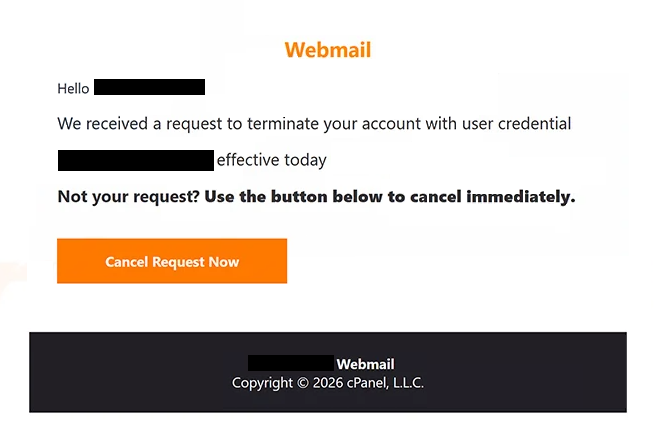
The phishing email uses the subject line “Reminder: Validate Your Credentials For -” and presents itself as an official account notification. It addresses the recipient using their email account identifier and claims that a termination request has been received. The notification also provides a specific date and timestamp for the supposed closure, making the warning appear more credible.
Recipients are informed that they can stop the termination process if they did not authorize it. A button labeled “Cancel Request Now” is presented as the way to preserve access to the account. However, the email provides no evidence that a legitimate termination request has been submitted.
Clicking the button directs recipients to a phishing page hosted on sharemyhtml.com, a platform that allows users to host HTML content. The page imitates a Google sign-in interface and displays the recipient’s email address automatically. Visitors are then asked to enter their passwords, supposedly to verify their identities and cancel the pending termination.
The login form is designed to capture credentials rather than process account management requests. If recipients enter valid passwords, scammers may attempt to access their email accounts, read private correspondence, and obtain sensitive attachments. They could also impersonate account owners or use the compromised mailboxes to target other individuals.
Access to an email account may also enable further attacks against connected online services. Scammers could attempt password resets for accounts associated with the affected address, potentially exposing additional personal or financial information. The consequences depend on the account’s security settings and whether the attackers successfully use the stolen credentials.
The email includes a copyright notice referencing cPanel, L.L.C., a legitimate web hosting software company. This reference is intended to make the notification appear official, but it does not establish any connection between the company and the phishing campaign. The alleged account termination is a deceptive claim used to obtain login credentials.
The full “Webmail – We received a request to terminate your account” phishing email is below:
Subject: Reminder: Validate Your Credentials For –
Webmail
Hello -,
We received a request to terminate your account with user credential -, effective today .
Not your request? Use the button below to cancel immediately.
[Cancel Request Now]
– Webmail
Copyright © 2026 cPanel, L.L.C.
How to recognize phishing emails
The “Webmail – We received a request to terminate your account” phishing email contains several warning signs, beginning with its unexpected account closure notification. It claims that a termination request has been submitted without explaining who initiated it or why the account is scheduled for deletion. The inclusion of a precise closure timestamp creates urgency but does not verify the warning.
Another suspicious characteristic is the instruction to cancel the request through an embedded button. The email presents “Cancel Request Now” as an immediate solution to a potentially serious account problem. This approach encourages recipients to follow the link before examining whether the notification is genuine.
The subject line also raises questions about the email’s purpose. While it refers to validating account credentials, the message itself focuses on stopping account termination. This inconsistency suggests that obtaining login information is central to the scam.
The destination of the cancellation button is particularly revealing. Instead of directing recipients to their usual webmail account management service, it opens a page hosted on an unrelated HTML hosting platform. The page displays a Google-style login form despite the email presenting itself as a cPanel-related notification.
The automatically populated email address may make the phishing page appear legitimate. However, scammers can include recipients’ addresses in phishing links or insert them into login forms without accessing the actual accounts. A personalized login page does not establish that the website belongs to a trusted service.
The email’s administrative formatting and copyright notice are additional elements intended to build credibility. References to cPanel and familiar account management terminology can make the notification resemble a genuine service announcement. Nevertheless, company names and standard email templates can be copied by scammers.
Site Disclaimer
2-remove-virus.com is not sponsored, owned, affiliated, or linked to malware developers or distributors that are referenced in this article. The article does not promote or endorse any type of malware. We aim at providing useful information that will help computer users to detect and eliminate the unwanted malicious programs from their computers. This can be done manually by following the instructions presented in the article or automatically by implementing the suggested anti-malware tools.
The article is only meant to be used for educational purposes. If you follow the instructions given in the article, you agree to be contracted by the disclaimer. We do not guarantee that the artcile will present you with a solution that removes the malign threats completely. Malware changes constantly, which is why, in some cases, it may be difficult to clean the computer fully by using only the manual removal instructions.